Get your free personalized podcast brief
We scan new podcasts and send you the top 5 insights daily.
AI models improve not just by getting bigger ("scaling laws"), but by adding distinct new capabilities. Recent breakthroughs include the ability to reason through problems (showing their work), use tools like the internet, and process multiple media types like text, images, and audio simultaneously.

Related Insights
Human understanding is the ability to connect new information to a global, unified model of the universe. Until recently, AI models were isolated (e.g., a chess model). The major advance with large multimodal models is their ability to create a single, cohesive reality model, enabling true, generalizable understanding.

Future AI expressivity won't come from adding more identical layers, but from 'nesting' levels with different update frequencies. This allows some parts of the system to adapt rapidly (like working memory) while others preserve core knowledge (long-term memory), mimicking human cognition.

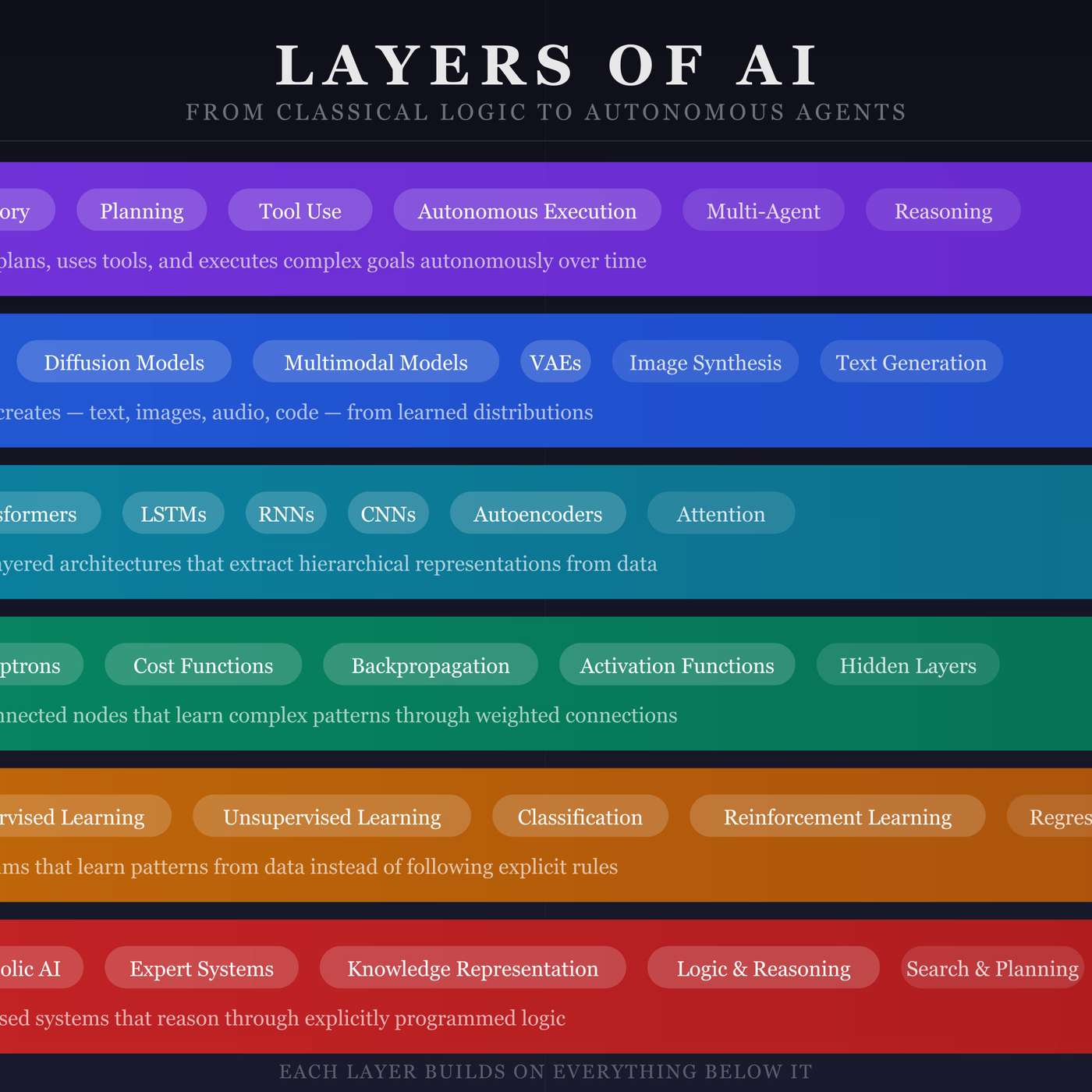
Contrary to the idea that new technologies make old ones obsolete, AI's evolution is a cumulative stack. Each new layer, like deep learning or generative AI, is built upon and extends the capabilities of the one beneath it, all the way down to the principles of classical AI.
While AI progress is marketed in revolutionary "step-changes" (e.g., GPT-3 to GPT-4), the underlying reality is more like compounding interest. A continuous stream of small, incremental improvements are accumulating, and their combined effect is what creates the feeling of an exponential leap in capability over time.

While language models are becoming incrementally better at conversation, the next significant leap in AI is defined by multimodal understanding and the ability to perform tasks, such as navigating websites. This shift from conversational prowess to agentic action marks the new frontier for a true "step change" in AI capabilities.

Contrary to the "bitter lesson" narrative that scale is all that matters, novel ideas remain a critical driver of AI progress. The field is not yet experiencing diminishing returns on new concepts; game-changing ideas are still being invented and are essential for making scaling effective in the first place.

AI progress was expected to stall in 2024-2025 due to hardware limitations on pre-training scaling laws. However, breakthroughs in post-training techniques like reasoning and test-time compute provided a new vector for improvement, bridging the gap until next-generation chips like NVIDIA's Blackwell arrived.
![Gavin Baker - Nvidia v. Google, Scaling Laws, and the Economics of AI - [Invest Like the Best, EP.451] thumbnail](https://megaphone.imgix.net/podcasts/d97fee14-d4d7-11f0-8951-8324b640c1c1/image/d3a8b5ecbf3957de5b91f278a191c9ff.jpg?ixlib=rails-4.3.1&max-w=3000&max-h=3000&fit=crop&auto=format,compress)
Third-party tracker METR observed that model complexity was doubling every seven months. However, a recent proprietary model shattered this trend, demonstrating nearly double the expected capability for independent operation (15 hours vs. an expected 8). This signals that AI advancement is accelerating unpredictably, outpacing prior scaling laws.

Bret Taylor explains the perception that AI progress has stalled. While improvements for casual tasks like trip planning are marginal, the reasoning capabilities of newer models have dramatically improved for complex work like software development or proving mathematical theorems.
Recent AI breakthroughs aren't just from better models, but from clever 'architecture' or 'scaffolding' around them. For example, Claude Code 'cheats' its context window limit by taking notes, clearing its memory, and then reading the notes to resume work. This architectural innovation drives performance.