Get your free personalized podcast brief
We scan new podcasts and send you the top 5 insights daily.
Gamma's CEO argues against the popular notion of a solo founder building a massive company. He believes it's not only unlikely to happen soon but also undesirable. The real reward of building an enduring business comes from the shared experience of doing it with a team.
Related Insights
The perception of a single individual producing a high volume of quality content is often a myth. Behind the scenes, a dedicated team handles research, idea generation, drafting, and editing. True scale and greatness in content creation are achieved through leveraging the "agency of others."

Most startups focus on product or technology innovation, but Gamma's CEO argues that innovating on organizational design is an equally powerful lever. This means rethinking hiring, management, and team composition to create a competitive advantage.
Gamma's CEO resists the pressure to scale headcount aggressively, arguing that doubling the team size does not guarantee double the speed. He believes a smaller, more agile team can change direction faster, which is more valuable than raw speed in a rapidly evolving market.
A business transitions from a founder-dependent "practice" to a scalable "enterprise" only when the founder shares wealth and recognition. Failing to provide equity and public credit prevents attracting and retaining the talent needed for growth, as top performers will leave to become owners themselves.
A sole creator, no matter how brilliant, will always have a limited impact. The key to exponential influence is to build an organization staffed with talented, well-compensated people. The true superpower is not just communication, but the ability to attract and retain talent that can scale the message far beyond what one person could ever achieve alone.
The idea of a solo founder running a billion-dollar company is more a marketing gimmick than a future reality. While technologically feasible with AI, individuals won't want to handle all the associated operational burdens like bookkeeping and taxes. The logical endpoint of AI automation isn't a one-person company, but a zero-person, fully automated business.
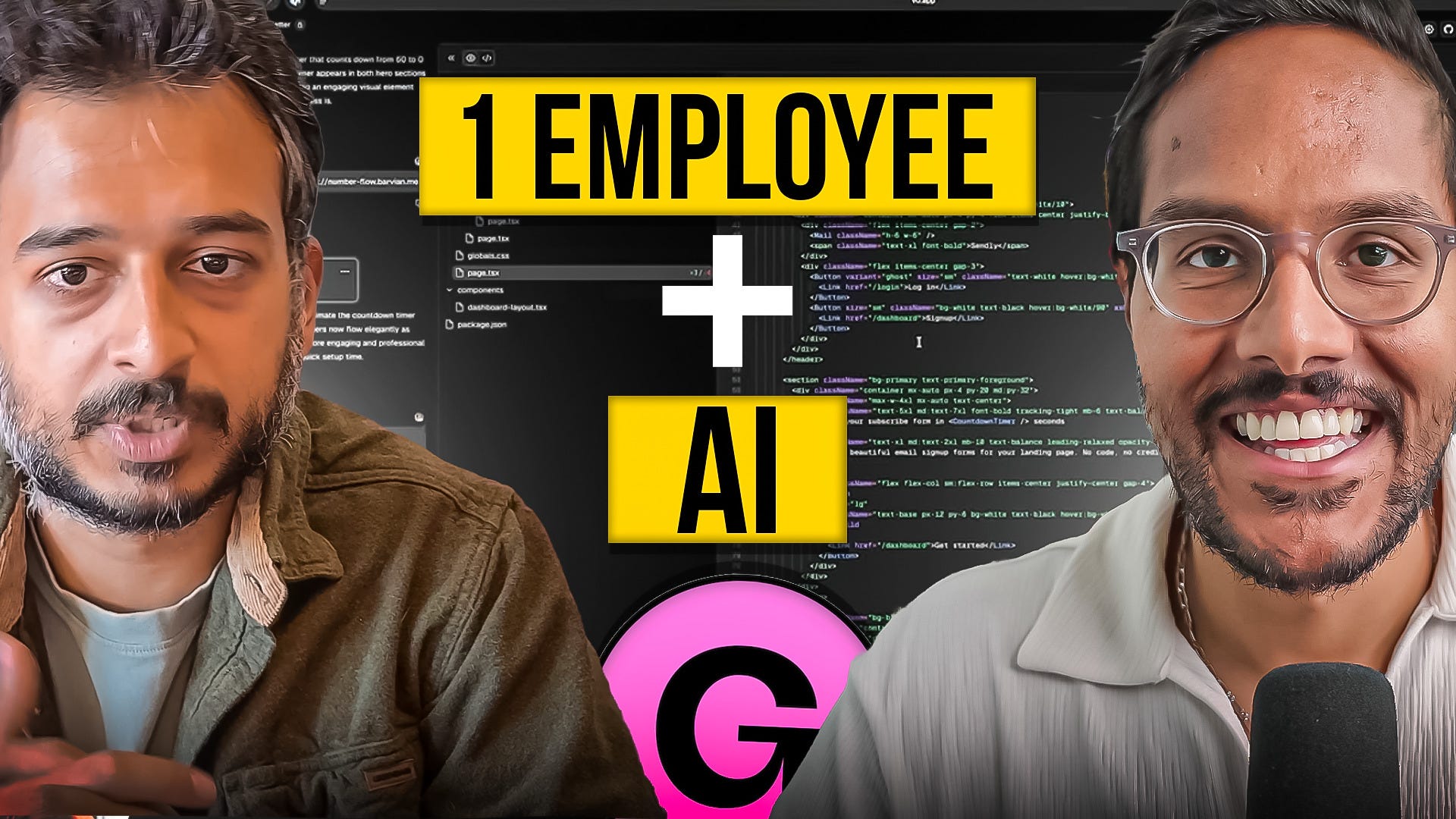
The indie hacking and solopreneur movements often become a dogmatic 'cult' that's simply a reaction against the 'pro-VC cult.' There is nothing inherently wrong with having a team, working in person, or getting acquired. Adhering strictly to a 'solo' or 'bootstrapped' ethos can be just as limiting as blindly following the venture-backed path.
Gamma scaled to a $2B valuation with only 50 people by innovating on org design, not just product. They prioritize hiring generalists over specialists and use a 'player-coach' model instead of a traditional management layer. This keeps the team lean, agile, and close to the actual work.
