Get your free personalized podcast brief
We scan new podcasts and send you the top 5 insights daily.
AI dramatically lowers the cost of experimentation. Tasks that would be too tedious for a human, like rewriting an entire test suite to gauge performance impact, can be done by an agent in the background. This allows engineers to answer long-standing 'what if' questions almost instantly.

Related Insights
The traditional product feedback loop is being compressed by AI. Instead of waiting for human developers to test a beta, companies like Stripe now see AI agents deployed instantly. These agents provide immediate, detailed feedback through logs, allowing for an unprecedented pace of iteration and development.

AMD has 'supercharged' its software development by using AI agents. These agents run in automated loops, constantly analyzing and optimizing customer models for AMD's hardware. This turns a slow, manual process into a scalable, nonstop operation, dramatically improving out-of-the-box performance for developers.
An experienced engineer built a new programming language, 'Roo', as a side project, which was only possible because AI agents handled tedious implementation. This allowed him to focus on high-level architecture and design, overcoming personal time constraints for a complex undertaking.

The primary value of AI coding assistants is not just writing code faster, but rapidly prototyping ideas to determine their viability. This allows teams to quickly decide whether a feature is worth pursuing, saving significant time and resources on dead-end explorations.

Ankur Goyal argues that AI agents can run far more exhaustive benchmarks and test more algorithms than even the best staff engineers manually could. This eliminates the common practice of prioritizing a few key benchmarks and "bullshitting" the rest, leading to more robust and performant software.

AI coding agents like Claude Code are not just productivity tools; they fundamentally alter workflows by enabling professionals to take on complex engineering or data tasks they previously would have avoided due to time or skill constraints, blurring traditional job role boundaries.

The AI agent's purpose is framed not as a replacement for engineers but as a tool to augment them. Its primary function is to handle the tedious, time-consuming tasks known as 'toil'—initial triage, data gathering, and running basic tests—freeing up senior engineers for high-judgment work that requires human expertise.
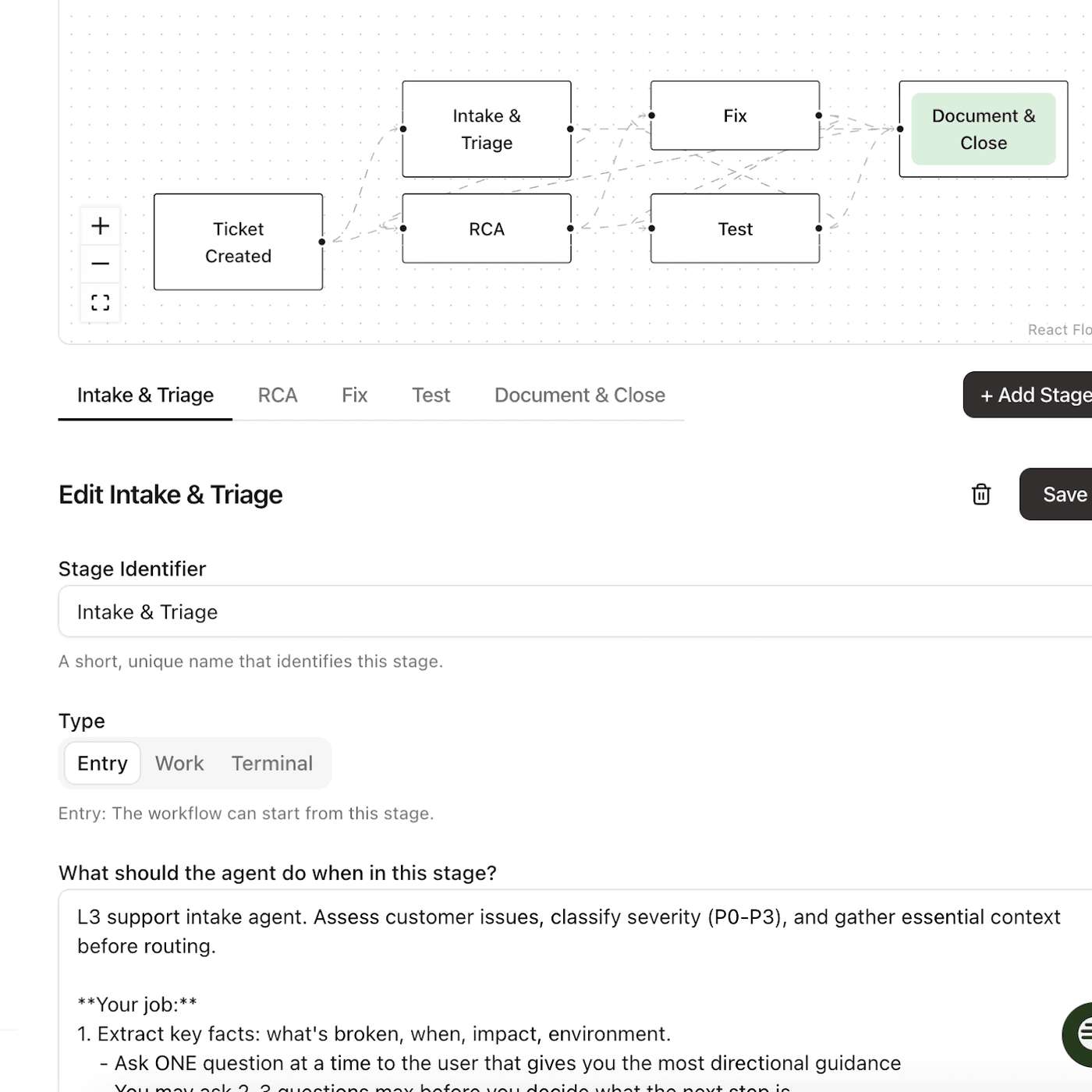
Traditionally, building software required deep knowledge of many complex layers and team handoffs. AI agents change this paradigm. A creator can now provide a vague idea and receive a 60-70% complete, working artifact, dramatically shortening the iteration cycle from months to minutes and bypassing initial complexities.

Since AI agents dramatically lower the cost of building solutions, the premium on getting it perfect the first time diminishes. The new competitive advantage lies in quickly launching and iterating on multiple solutions based on real-world outcomes, rather than engaging in exhaustive upfront planning.

The most underappreciated AI breakthrough is the ability for an agent to autonomously launch and manage subordinate agents. This allows for complex, parallel task execution and quality checking without human intervention, removing the human-in-the-loop as a primary bottleneck and enabling exponential productivity gains.
