Get your free personalized podcast brief
We scan new podcasts and send you the top 5 insights daily.
Humans rely on lossy proxies like journal prestige and citation counts to judge research. AI enables a shift to evaluating the work's content directly—methodology, sample size, and logical coherence—for a more accurate assessment of evidence quality tailored to a specific question.

Related Insights
The physics breakthrough provides a scalable template for AI-assisted research. The model involves AI identifying patterns and generating hypotheses from data, with human experts then responsible for rigorous validation and ensuring consistency. This is augmented, not autonomous, science.

AI is poised to revolutionize evidence synthesis by automating the grueling, multi-year process of systematic reviews. The ultimate goal is to enable anyone to get an accurate, near-instantaneous summary of the entire body of research on a specific question, effectively creating meta-analysis on demand.

The most effective way to use AI is not for initial research but for synthesis. After you've gathered and vetted high-quality sources, feed them to an AI to identify common themes, find gaps, and pinpoint outliers. This dramatically speeds up analysis without sacrificing quality.

Historically, generating a good hypothesis was the most prestigious part of science. Now, AI can produce theories at near-zero cost, overwhelming traditional validation systems like peer review. The new grand challenge is developing scalable methods to verify and filter this flood of AI-generated ideas.
If the AI community prioritizes truth-seeking over persuasive-sounding outputs, it could create a virtuous cycle. A more truth-seeking AI would better identify the most important interventions to improve its own reasoning, leading to a feedback loop that rapidly enhances epistemic quality.
For AI systems to be adopted in scientific labs, they must be interpretable. Researchers need to understand the 'why' behind an AI's experimental plan to validate and trust the process, making interpretability a more critical feature than raw predictive power.

Advanced AI tools like "deep research" models can produce vast amounts of information, like 30-page reports, in minutes. This creates a new productivity paradox: the AI's output capacity far exceeds a human's finite ability to verify sources, apply critical thought, and transform the raw output into authentic, usable insights.
AI's key advantage isn't superior intelligence but the ability to brute-force enumerate and then rapidly filter a vast number of hypotheses against existing literature and data. This systematic, high-volume approach uncovers novel insights that intuition-driven human processes might miss.

AI now generates complex scientific derivations faster than humans can validate them. For a recent quantum gravity paper, the AI produced the core results in days, but human collaborators spent three weeks just checking the work, shifting the research bottleneck from discovery to verification.
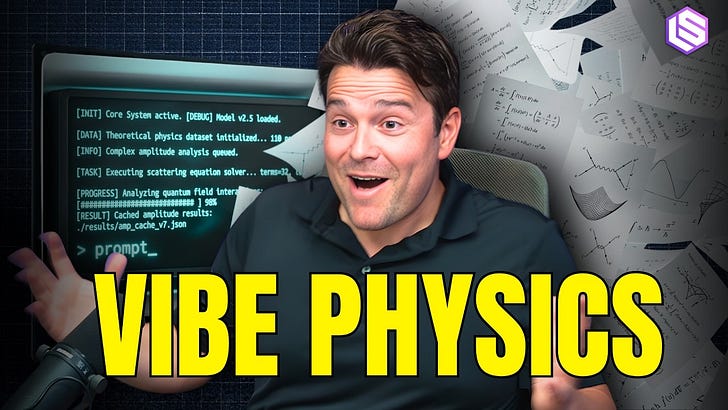
With AI generating complex formulas and proofs, the most challenging part of scientific research is no longer solving the core problem. Instead, the primary human task becomes verifying the AI-generated results and writing them up, fundamentally changing the research workflow.