Get your free personalized podcast brief
We scan new podcasts and send you the top 5 insights daily.
When designers build custom AI tools from scratch, generic LLMs frequently repeat common technical failures, such as rendering crashes in 3D libraries. Wrapping models in a routing engine with hardcoded domain skills and accumulated lessons prevents repeated pitfalls and automates baseline UI controls.

Related Insights
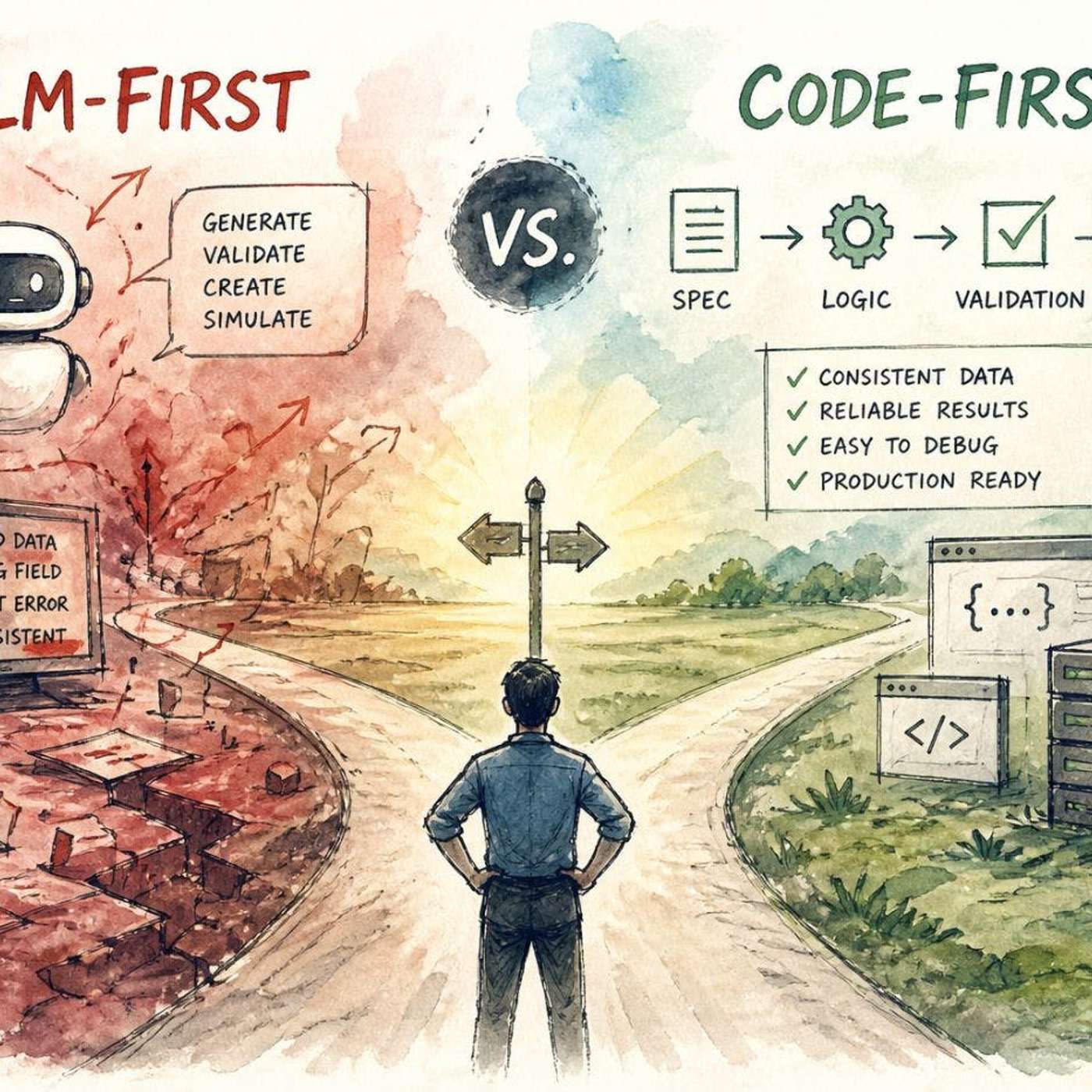
Don't give LLMs full control. Use deterministic code for core logic, validation, and enforcing rules. Delegate only tasks requiring flexibility or understanding of unstructured input to the LLM, treating it as a specialized component, not the entire system.
In complex domains like accounting, LLMs can act as a co-pilot for engineers, shortening their learning curve. By asking an LLM for context on rules and user problems, engineers can better understand the "why" behind their work, helping them identify edge cases and build more robust features.

Raw code generation prompts typically produce repetitive, generic layouts with purple gradients and predictable components because models lack high-quality UI references. Connecting tools via MCP to large libraries of shipped product designs forces agents to analyze real SaaS patterns like proof placement and pricing hierarchy. This grounds code generation in validated product design.

Connecting to a design system is insufficient. AI design tools gain true power by using the entire production codebase as context. This leverages years of embedded decisions, patterns, and "tribal knowledge" that design systems alone cannot capture.

Rather than celebrating generic wins, high-performing engineering teams actively map the precise edges where LLMs fail. Discerning which tasks are computational versus narrative keeps teams from shoehorning tabular or deterministic logic into textual forms that trigger severe signal loss and error propagation.

AI-driven code generation relies on design systems for instructions. A weak system leads to poor code output, making the design system a critical foundation for engineering quality and speed, not just a design team's responsibility.
Giving AI freedom to generate custom layouts dynamically risks disorienting users if interface patterns shift with every response. Rhiannon Bell explains that while AI can assemble components from design systems, designers must enforce human-defined rules. Predictability in where answers, interactive widgets, and links appear is critical so users do not have to learn a brand-new interface on each query.
To make AI tools like Warp more reliable, Marco Casalaina creates explicit rules (e.g., "remind me to activate owner access") and connects the agent to documentation servers. This pre-loading of context and constraints prevents common failures and improves the agent's performance on complex tasks, moving beyond simple prompting.

To use AI effectively in design, organizations need a mature, machine-readable design system. AI tools rely on this system's well-documented components and rules to assemble experiences consistently. Without it, AI-generated designs risk being off-brand and low-quality. Investing in the design system is a key prerequisite for mitigating AI risks at scale.

Treat AI skills not just as prompts, but as instruction manuals embodying deep domain expertise. An expert can 'download their brain' into a skill, providing the final 10-20% of nuance that generic AI outputs lack, leading to superior results.
