Standard AI models trained on public, observational biological data excel at descriptive tasks but underperform even linear models on causal predictions. To predict cellular responses to drug-like perturbations, models must be trained specifically on causal data generated from targeted experiments.
Unlike text, gene expression levels lack inherent order. Autoregressive models (like GPT) force an artificial sequence, limiting performance. Diffusion models, which operate on sets and iteratively refine predictions, are a more natural and effective architecture for modeling cellular responses to perturbations.
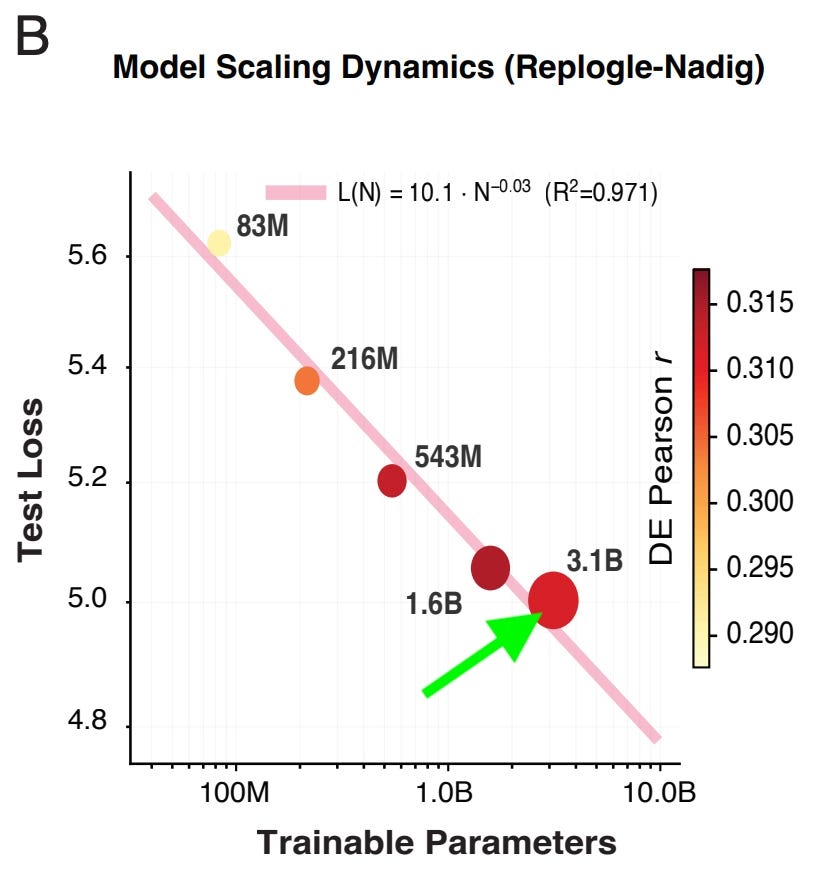
In developing the X-Cell model, Xaira found a clear hierarchy of impact. The quality, scale, and causal nature of the training data provided the most significant performance boost, followed by the choice of AI architecture (e.g., diffusion vs. autoregressive), and lastly, the integration of prior biological knowledge.
To build truly dynamic "virtual cells," two key technological hurdles must be overcome. First, developing high-throughput methods for measuring proteins, the cell's functional units. Second, inventing a sequencing technology that can measure the state of the *same cell* at multiple time points without destroying it.
High-throughput biology uses techniques like PerturbSeq to run thousands of genetic perturbation experiments simultaneously in a single "pool" of cells. This method is highly scalable and, crucially, avoids the batch effects that plague traditional experiments, creating clean, uniform data essential for training large-scale AI models.
The key utility of a "virtual cell" model isn't just predicting outcomes within its training data. Its power is the ability to generalize and make accurate causal predictions in entirely new contexts, such as different cell types or primary cells from donors, where large-scale experiments are difficult or impossible.
Simple linear models fail to generalize to new cell types because gene functions are highly context-dependent. Some "housekeeping" genes have universal effects, but many others behave differently in various cellular environments. A sophisticated, nonlinear AI model is required to capture these context-specific interactions.
For bench biologists, complex AI models gain trust not just from abstract metrics but from visually compelling results. A key "wow" moment for X-Cell was when heatmaps of its gene expression predictions were placed next to the ground truth data, showing the AI's output was undeniably closer to reality than a linear baseline.
Xaira's strategy combines three distinct AI platforms: one for protein design to create novel therapeutics, a "virtual cell" model to predict biological effects, and a patient representation model to predict clinical outcomes. This integrated approach aims to de-risk and accelerate the entire drug discovery pipeline.
Beyond its core architecture, X-Cell integrates five types of biological priors, including text embeddings from scientific literature, protein interaction networks, and morphology information. This diverse context allows the model to make more accurate predictions and provides interpretability by showing which priors are most important for specific cell types.
Generating millions of data points for AI requires industrializing lab workflows. To avoid data degradation from cell stress during long experiments, the Xaira team introduced chemical fixation to preserve cell states and re-engineered processes for time-shifted operations, ensuring consistent, high-quality training data.
The innovation pipeline in biotech often starts in academia with fundamental breakthroughs like CRISPR or single-cell sequencing. Industry then provides the resources and engineering mindset to scale these technologies, robustify them, and generate the massive, high-quality datasets required to power AI-driven discovery.