Get your free personalized podcast brief
We scan new podcasts and send you the top 5 insights daily.
The key utility of a "virtual cell" model isn't just predicting outcomes within its training data. Its power is the ability to generalize and make accurate causal predictions in entirely new contexts, such as different cell types or primary cells from donors, where large-scale experiments are difficult or impossible.
Related Insights
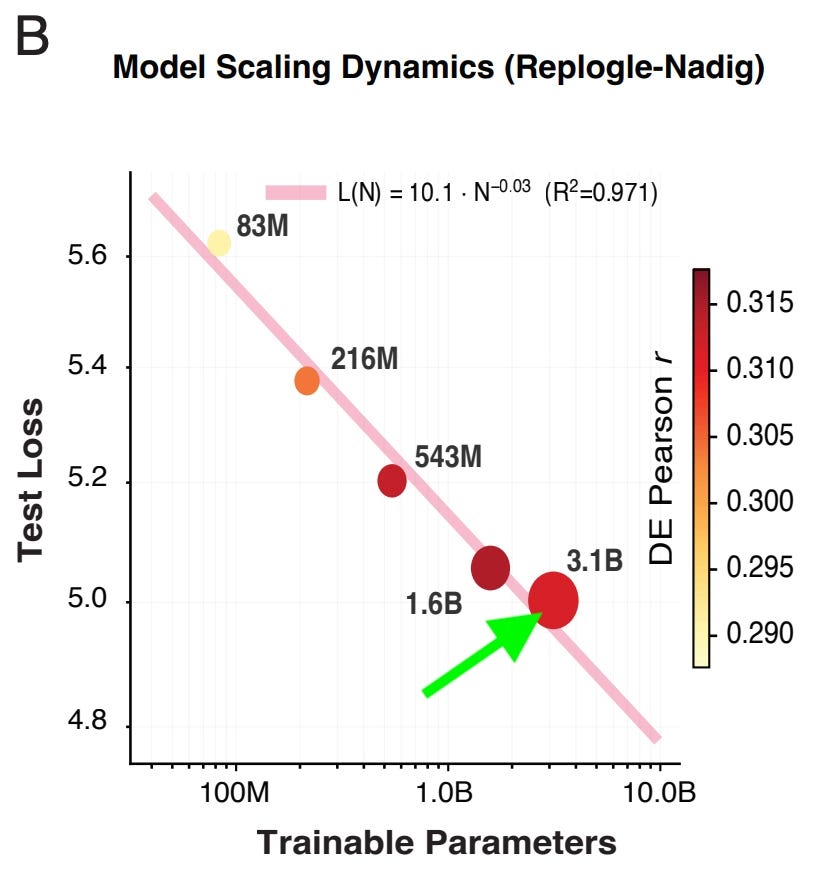
In developing the X-Cell model, Xaira found a clear hierarchy of impact. The quality, scale, and causal nature of the training data provided the most significant performance boost, followed by the choice of AI architecture (e.g., diffusion vs. autoregressive), and lastly, the integration of prior biological knowledge.
Traditional grant funding disincentivizes high-risk research because lab work is slow and expensive. Virtual cell models act as a "computational fruit fly," allowing scientists to test radical hypotheses in silico first. This lowers the barrier for exploring unconventional ideas by de-risking the time and resource investment before committing to the wet lab.

AI isn't just for designing RNA sequences. Its real value is in creating predictive models of complex cellular functions. This allows scientists to determine the precise set of instructions (RNAs) needed to make a cell perform a complex series of tasks, like targeting a brain tumor.
Standard AI models trained on public, observational biological data excel at descriptive tasks but underperform even linear models on causal predictions. To predict cellular responses to drug-like perturbations, models must be trained specifically on causal data generated from targeted experiments.
To create a predictive "virtual cell," data collection must shift from passive observation to active intervention. The strategy is to massively scale perturbation experiments (like Perturb-seq) across countless contexts and measure multi-modal responses, teaching the model cause and effect.

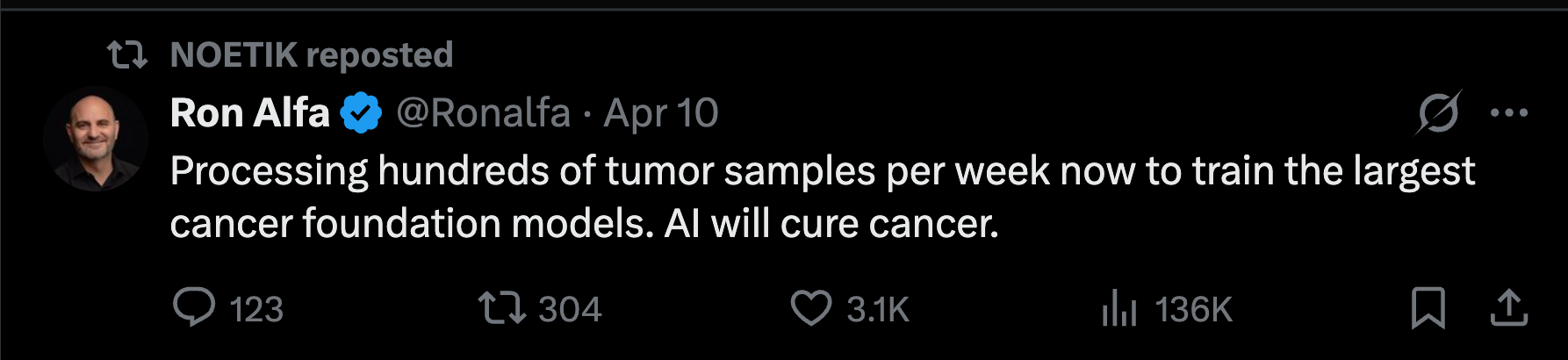
Instead of pursuing a purely academic goal of simulating every biochemical process, Noetik's "virtual cell" models are practical tools. They focus on understanding cell biology through heuristics that are useful for making drugs, like predicting a cell's transcriptome or protein expression in a specific context.
Today's "virtual cell" models represent training data well but cannot predict outcomes for novel interventions. The next frontier is building models that generalize to serve as true predictive oracles for experiments that haven't yet been performed, a key focus for BioHub.
AI models trained on descriptive data (e.g., RNA-seq) can classify cell states but fail to predict how to transition a diseased cell to a healthy one. True progress requires generating massive "causal" datasets that show the effects of specific genetic perturbations.

CZI's virtual cell models act as a computational "model organism," enabling scientists to run high-risk experiments in silico. This approach dramatically lowers the cost and time required to test novel ideas, encouraging more ambitious research that might otherwise be prohibitive.

Simple linear models fail to generalize to new cell types because gene functions are highly context-dependent. Some "housekeeping" genes have universal effects, but many others behave differently in various cellular environments. A sophisticated, nonlinear AI model is required to capture these context-specific interactions.