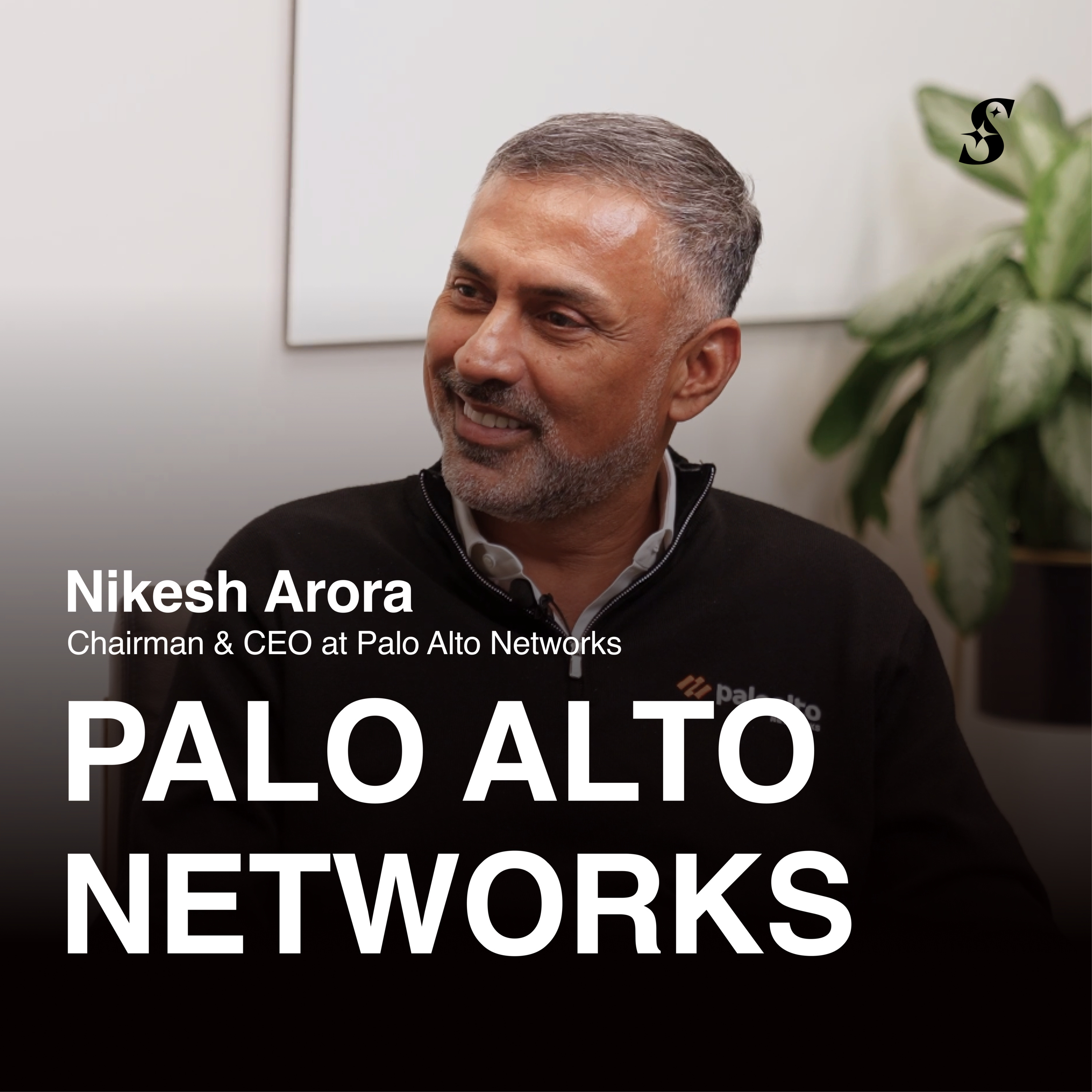
The rise of AI-powered attacks means vulnerabilities are exploited in minutes. Palo Alto Networks responded by developing a capability to deliver and deploy patches to all customers in just four hours, a massive reduction from the industry average of 55 days, fundamentally changing incident response time.
Unlike past software that performed deterministic tasks, future software will be infused with AI, giving it an 'opinion' and proactive intelligence. Nikesh Arora predicts this fundamental shift means the entire software industry will be rewritten over the next 10 years, creating massive disruption and opportunity.
Instead of an imperialistic 'I bought you' attitude, Palo Alto Networks' M&A approach is rooted in humility. The mindset is 'you kicked our ass, come tell us what we did wrong.' They empower the acquired team to lead their category, absorbing their unique insights rather than imposing their own culture.
To find genuinely AI-native talent, the company hires from hackathons. This strategy targets individuals so passionate they spend their free time experimenting with the latest models. These new hires are then infused into existing teams to accelerate the company's overall AI transformation from the ground up.
Nikesh Arora uses a framework that analogizes team roles to home construction. 'Architects' design the vision, 'Builders' execute it, and 'Maintainers' run it. Effective leaders recognize that individuals excel in different areas and build teams that combine these complementary skills, rather than expecting one person to be all three.
Upon joining Palo Alto Networks, Nikesh Arora wrote a document outlining his core beliefs and operational style. This preemptively explained the 'why' behind his actions, aligning his new team on a common language and set of principles, and turning potential friction into productive debate and faster execution.
SoftBank's Masayoshi Son advised Nikesh Arora against spending excessive energy trying to fix underperforming investments. As an investor, the same effort applied to a winning company could quadruple its value, yielding far greater returns than bringing a failing one back to baseline. It's a lesson in focusing on power-law outcomes.
Nikesh Arora uses LinkedIn as a primary recruiting tool, not just for outreach but for deep vetting. By analyzing a candidate's posts over several years, he gets an unfiltered view of their thinking and personality, which he finds more revealing than a polished 30-minute interview.
Nikesh Arora describes his leadership style as a yin-and-yang of contradictions. He maintains a paranoid 'go get shit done' attitude to win, but couples it with an inner calm. This 'do your best and let things take their course' mindset prevents burnout and allows for resilience in the face of failure.