Get your free personalized podcast brief
We scan new podcasts and send you the top 5 insights daily.
While generally not recommended, Dropbox successfully migrated off S3 by building a storage system tailored to its unique file access patterns. This hyper-specialization, combined with using cutting-edge hardware, allowed them to achieve cost efficiencies that a general-purpose service like S3 couldn't match.

Related Insights
Turbopuffer's design avoids a complex consensus layer (like Zookeeper) by relying on two recent cloud primitive upgrades: S3's strong consistency (post-2020) and a compare-and-swap feature for metadata updates. This creates a simpler, more robust, and stateless system.
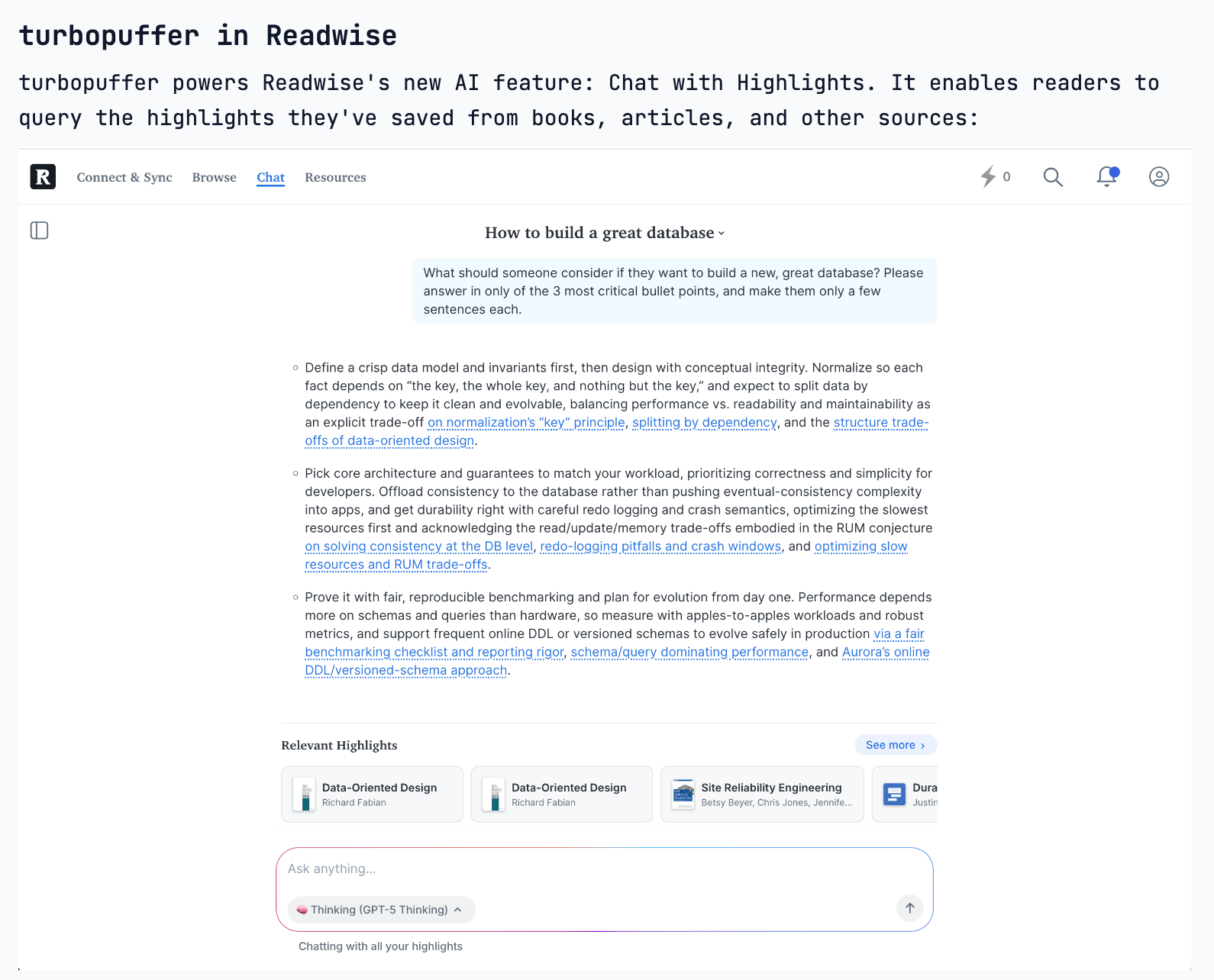
TurboPuffer achieved its massive cost savings by building on slow S3 storage. While this increased write latency by 1000x—unacceptable for transactional systems—it was a perfectly acceptable trade-off for search and AI workloads, which prioritize fast reads over fast writes.

Unlike compute-rich giants, AppLovin's bootstrapped culture enforces extreme efficiency in its AI infrastructure. Engineers don't have unlimited GPUs, forcing them to optimize code and models for cost and performance. This constraint-driven approach leads to significant cost savings and a lean operational model.

By building their own data centers, Railway achieves a payback period of just three months on hardware costs versus renting from hyperscalers. This dramatic cost advantage is a strategic enabler for offering resource-intensive services, like parallel AI agent execution, at a viable price.

Inspired by Google, Cloudflare made an early decision to build its global network using inexpensive, commodity hardware instead of specialized equipment. This software-centric approach allows them to scale their infrastructure rapidly and cost-effectively, a key structural advantage over competitors.
![Cloudflare: Leading Cybersecurity - [Business Breakdowns, EP.241] thumbnail](https://megaphone.imgix.net/podcasts/cd4e36dc-0515-11f1-83d0-db915309e405/image/63f96f239cd7d53c5b87978bfd6c7f0e.jpg?ixlib=rails-4.3.1&max-w=3000&max-h=3000&fit=crop&auto=format,compress)
The founder used a "Napkin Math" approach, analyzing fundamental computing metrics (disk speed, memory cost). This revealed a viable architecture using cheap S3 storage that incumbents overlooked, creating a 100x cost advantage for his database.
Go's garbage collector led to unpredictable memory usage. In Dropbox's storage system, a node OOMing would trigger a massive re-replication workload, which could cause other nodes to OOM, leading to a system-wide "congestion collapse". Rust's memory management provided the predictability needed to prevent these catastrophic failures.
Instead of overprovisioning their physical hardware for worst-case scenarios, Dropbox built a system to temporarily offload writes to S3 when capacity got tight. This "escape hatch" allowed them to operate their own infrastructure with much higher utilization, providing the benefits of on-prem cost savings with cloud-like elasticity.
Railway's hybrid strategy uses public clouds like AWS and GCP as a safety valve for demand spikes. This allows them to maintain service availability during hypergrowth while systematically migrating workloads to their own more cost-efficient bare metal infrastructure as they build it out.
Contrary to the belief that object storage (like S3) is the future, the traditional file system is poised for a comeback as the universal interface for data. Its ubiquity and familiarity make it the ideal layer for next-gen innovation, especially if it can be re-architected for the cloud era.
