Get your free personalized podcast brief
We scan new podcasts and send you the top 5 insights daily.
AI could significantly increase human well-being in ways traditional metrics like GDP fail to capture. Services like receiving instant, valuable medical advice from a chatbot create immense personal value disproportionate to their monetary cost, making GDP an increasingly inaccurate proxy for welfare.

Related Insights
The assumption that AI will create trillions in corporate profit overlooks a key economic reality: only 1% of global GDP is profit above the cost of capital. Intense competition in AI will likely drive prices down, meaning the vast majority of economic benefits will be passed to consumers, not captured by a few monopolistic companies.

Beyond simple productivity gains, AI will eliminate the need for entire service-based transactions, such as paying for basic legal documents or second medical opinions. This substitution of paid services with free AI output can act as a direct deflationary headwind, a counterintuitive effect to the typical AI-fueled growth narrative.

Conservative GDP growth forecasts for AI often fail because they analyze its capabilities at a single point in time. The most critical factor is AI's exponential improvement trajectory, which makes analyses based on year-old capabilities quickly obsolete and misleadingly pessimistic.
For a $200/month subscription, AI provided analysis and peace of mind potentially worth tens of thousands of dollars, representing less than 0.2% of the total estimated medical costs. In a high-stakes crisis, the speaker notes he would have willingly paid $10,000/month, highlighting AI's immense, under-captured value.

A paradox of powerful AI is that it can be 'GDP-destroying.' When AI substitutes for a service you would have paid for (e.g., hiring a contractor), it creates immense personal value but removes a transaction from the economy. This makes GDP a poor metric for AI's true economic contribution, which may be understated.

Traditional metrics like GDP fail to capture the value of intangibles from the digital economy. Profit margins, which reflect real-world productivity gains from technology, provide a more accurate and immediate measure of its true economic impact.

Altman argues that as AI capabilities grow, abstract technical benchmarks become less relevant. He suggests the ultimate measure of an AI's effectiveness will be its direct economic contribution, jokingly proposing "GDP impact" as the next major metric to watch.
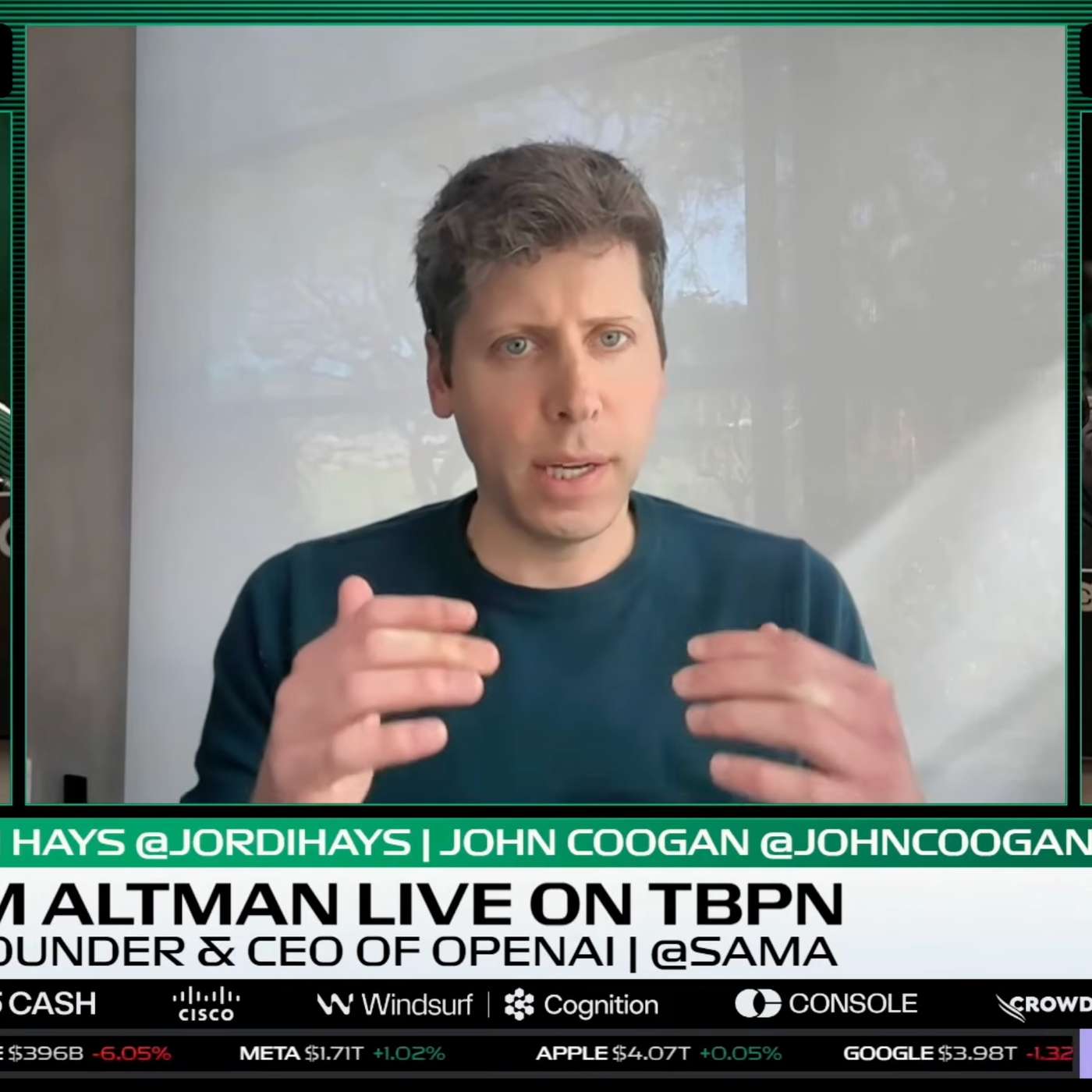
Sam Altman suggests that as AI models create enormous economic value, proxy metrics like task completion benchmarks will become obsolete. The most meaningful chart will be the model's direct impact on GDP. This signals a fundamental shift from the research phase of AI to an era of broad economic transformation.

The anticipated AI productivity boom may already be happening but is invisible in statistics. Current metrics excel at measuring substitution (replacing a worker) but fail to capture quality improvements when AI acts as a complement, making professionals like doctors or bankers better at their jobs. This unmeasured quality boost is a major blind spot.

Emad Mostaque argues that as AI makes intelligence abundant (e.g., free expert medical advice), our economic system, which is built on scarcity, interprets the resulting job displacement and disruption as poverty, even if overall well-being improves.