Get your free personalized podcast brief
We scan new podcasts and send you the top 5 insights daily.
Sam Altman suggests that as AI models create enormous economic value, proxy metrics like task completion benchmarks will become obsolete. The most meaningful chart will be the model's direct impact on GDP. This signals a fundamental shift from the research phase of AI to an era of broad economic transformation.

Related Insights
Unlike traditional software that optimizes for time-in-app, the most successful AI products will be measured by their ability to save users time. The new benchmark for value will be how much cognitive load or manual work is automated "behind the scenes," fundamentally changing the definition of a successful product.

Elon Musk theorizes that if 'applied intelligence' is a direct proxy for economic growth, the exponential advancement of AI could lead to unprecedented double-digit GDP growth within 18 months and potentially triple-digit growth in five years. This frames AI not just as a tool, but as the primary driver of a new economic golden era.

Traditional metrics like GDP fail to capture the value of intangibles from the digital economy. Profit margins, which reflect real-world productivity gains from technology, provide a more accurate and immediate measure of its true economic impact.

OpenAI's CEO believes the term "AGI" is ill-defined and its milestone may have passed without fanfare. He proposes focusing on "superintelligence" instead, defining it as an AI that can outperform the best human at complex roles like CEO or president, creating a clearer, more impactful threshold.

OpenAI's new GDPVal framework evaluates AI on real-world knowledge work. It found frontier models produce work rated equal to or better than human experts nearly 50% of the time, while being 100 times faster and cheaper. This provides a direct measure of impending economic transformation.
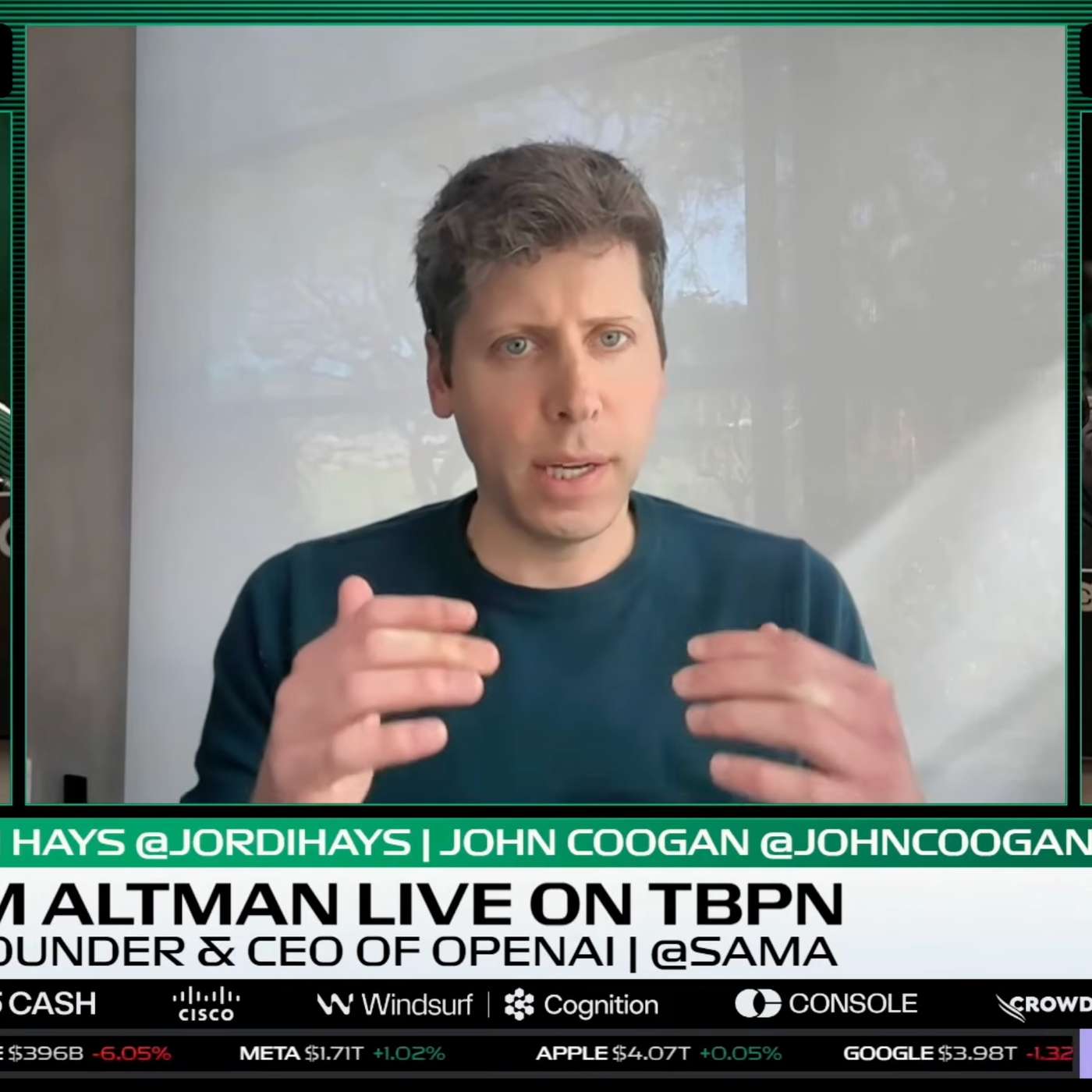
Altman argues that as AI capabilities grow, abstract technical benchmarks become less relevant. He suggests the ultimate measure of an AI's effectiveness will be its direct economic contribution, jokingly proposing "GDP impact" as the next major metric to watch.
Instead of relying on hyped benchmarks, the truest measure of the AI industry's progress is the physical build-out of data centers. Tracking permits, power consumption, and satellite imagery reveals the concrete, multi-billion dollar bets being placed, offering a grounded view that challenges both extreme skeptics and believers.

OpenAI's new GDP-val benchmark evaluates models on complex, real-world knowledge work tasks, not abstract IQ tests. This pivot signifies that the true measure of AI progress is now its ability to perform economically valuable human jobs, making performance metrics directly comparable to professional output.
The ultimate measure of success in the AI race isn't just technical superiority on a benchmark test, but market dominance and ecosystem control. The winning nation will be the one whose models and chips are most widely adopted and built upon by developers globally.

OpenAI's CEO believes a significant gap exists between what current AI models can do and how people actually use them. He calls this "overhang," suggesting most users still query powerful models with simple tasks, leaving immense economic value untapped because human workflows adapt slowly.