Get your free personalized podcast brief
We scan new podcasts and send you the top 5 insights daily.
Continuous on-body glucose monitors provide granular, real-time data that is far more valuable than periodic A1C or fasting glucose tests. This allows for precise management of toxicities like hyperglycemia and neuropathy caused by drugs like Enfortumab Vedotin or AKT inhibitors.

Related Insights
While known for weight loss, GLP-1 agonists are also highly effective for managing hyperglycemia from both steroids and PI3K inhibitors. Using low or "micro" doses can be very helpful in cancer patients, providing glucose control while minimizing GI side effects like nausea.
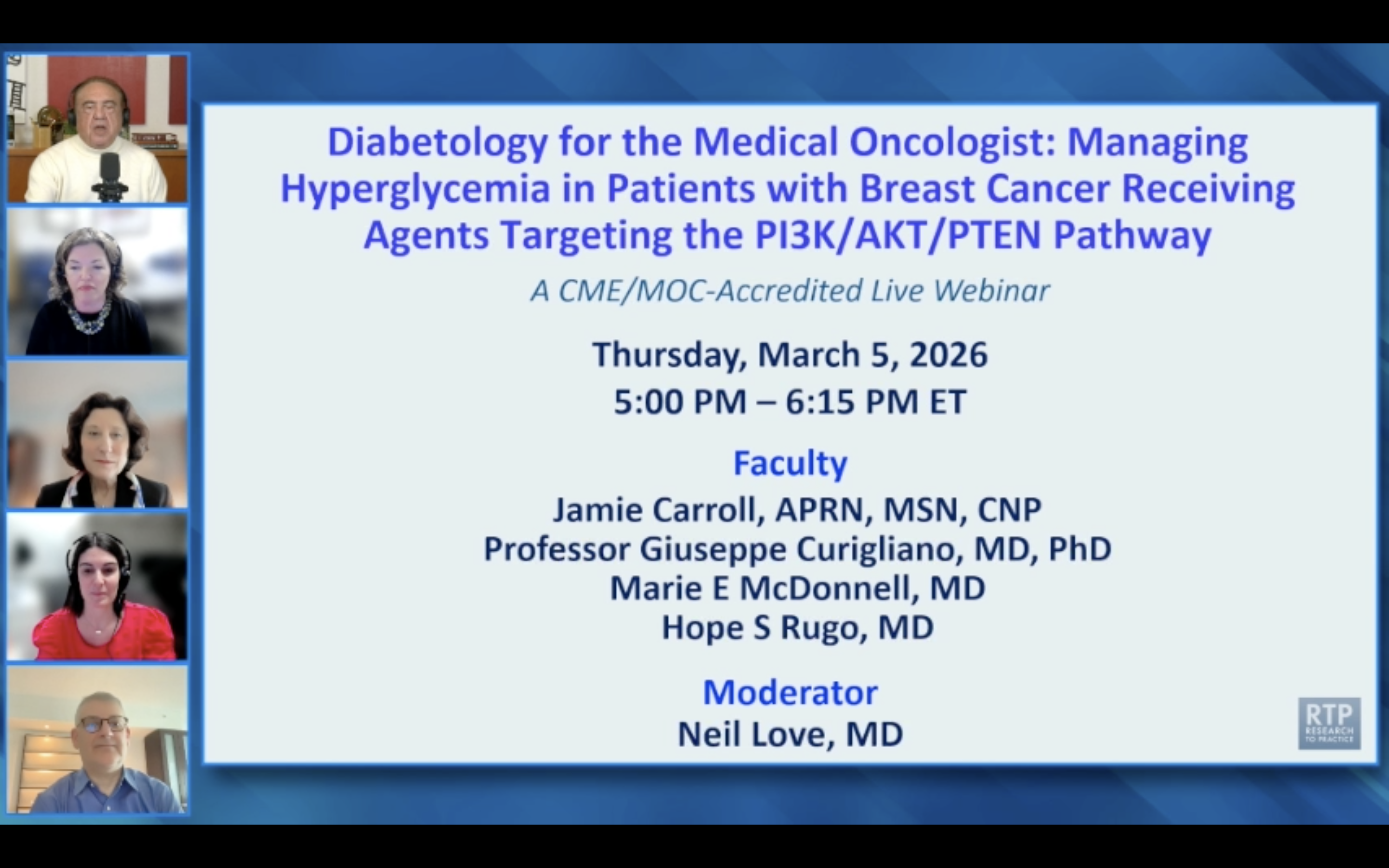
Advances in drug design mean newer PI3K inhibitors are more targeted, resulting in significantly less off-target toxicity. For example, some investigational agents have a hyperglycemia risk under 15%, a substantial improvement over earlier drugs, making them easier to manage clinically.
For patients with life-threatening metastatic urothelial cancer and poorly controlled diabetes, experts advise starting enfortumab vedotin (EV) without delay. The immediate cancer threat outweighs the risks of a high hemoglobin A1C. Aggressive glucose monitoring and early endocrinologist involvement are initiated simultaneously to manage the hyperglycemia.
Beyond managing hyperglycemia, GLP-1 inhibitors have been observed to improve neuropathy in diabetic patients receiving Enfortumab Vedotin (EV). This suggests a dual benefit, challenging the assumption that EV is the sole cause of worsening neuropathy in this population.
On-body glucose monitors give oncologists a richer understanding of a patient's glucose control, including 24-hour trends, time-in-range, and an A1c equivalent (GMI). This real-time data is critical for managing hyperglycemia from targeted therapies, offering more insight than periodic fasting tests.
By continuously measuring a drug's effect on the body (pharmacodynamics), the wearable device provides a real-time view of a patient's phenotype. This granular data can revolutionize clinical trial design, safety monitoring, and drug dosing, moving beyond static genomic data to understand real-world drug response.

A critical but easily missed safety issue with the ADC enfortumab vedotin (EV) is its risk of severe hyperglycemia. The drug is formally contraindicated in patients with a hemoglobin A1c above 8%. Clinicians must screen for this to prevent potentially fatal ketoacidosis.
A key eligibility criterion for the landmark EV-302 trial was glycemic control. Patients with an A1C above 8 were excluded due to hyperglycemia and diabetic ketoacidosis (DKA) risk from the enfortumab vedotin component. This has critical implications for patient selection and monitoring.

For select patients who find frequent lab checks for hyperglycemia monitoring to be a significant barrier, a continuous glucose monitor (CGM) can be a practical alternative. While off-label, it provides valuable data for management in patients who might otherwise be non-adherent with monitoring.
A patient's diabetes must be well-managed before starting the inavolisib triplet, with an HbA1c below 8. The pivotal trial used an even stricter cutoff of 6.0. Proactive management, including consideration of continuous glucose monitoring, is critical to prevent severe hyperglycemia, a major toxicity of this effective regimen.