Get your free personalized podcast brief
We scan new podcasts and send you the top 5 insights daily.
AI models are most effective with languages they have seen the most in training data, like JavaScript and Python. This creates a feedback loop where AI makes developers more productive in these languages, further cementing their dominance and raising the barrier for new niche languages to gain traction.

Related Insights
As AI writes more code, language simplicity becomes more critical, not less. Humans must be able to verify the AI's output, and languages with complex, hidden mechanisms make this harder, as an AI might use an obscure feature without considering human readability.

According to Boris Churney, the specific programming language a developer uses is becoming less important because the AI model doesn't care. While features like type-checking currently help guide the model, future AIs will be sophisticated enough to write perfect code directly in low-level languages like assembly, abstracting away language choice entirely.

Increased developer productivity from AI won't lead to fewer jobs. Instead, it mirrors the Jevons paradox seen with electricity: as building software becomes cheaper and faster, the demand for it will dramatically increase. This boosts investment in new projects and ultimately grows the entire software engineering industry.
![⚡ [AIE CODE Preview] Inside Google Labs: Building The Gemini Coding Agent — Jed Borovik, Jules thumbnail](https://assets.flightcast.com/V2Uploads/nvaja2542wefzb8rjg5f519m/01K4D8FB4MNA071BM5ZDSMH34N/square.jpg)
A flywheel effect is occurring: AI models excel with modern web stacks (Tailwind, Next.js), encouraging their adoption, which in turn improves the models. This will create a massive divide in workflows and capabilities between designers on modern stacks and those on legacy systems, making them almost different professions.

AI labs deliberately targeted coding first not just to aid developers, but because AI that can write code can help build the next, smarter version of itself. This creates a rapid, self-reinforcing cycle of improvement that accelerates the entire field's progress.

The initial success of AI in coding is a natural outcome. Like early PC users who built tools for computers, software developers, as the primary early adopters of LLMs, logically focused on applying the new technology to their own workflows first.

AI tools don't make junior developers senior; they accelerate existing workflows. Juniors produce junior-level code at a senior's pace, while seniors produce high-quality code at a supernatural speed. The tool magnifies the user's existing skill and discipline, for better or worse.

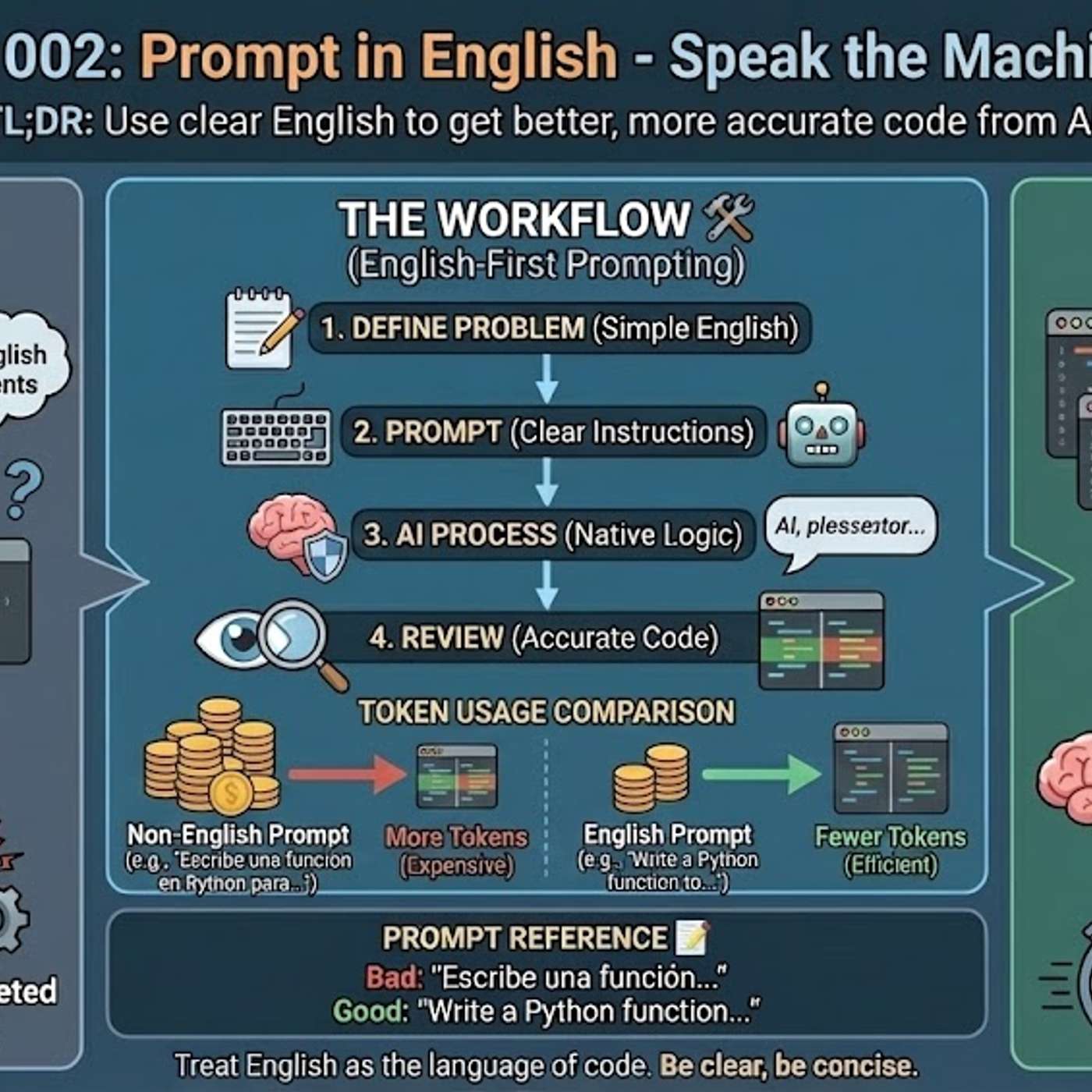
The primary reason AI models generate better code from English prompts is their training data composition. Over 90% of AI training sets, along with most technical libraries and documentation, are in English. This means the models' core reasoning pathways for code-related tasks are fundamentally optimized for English.
AI coding assistants remove the friction of looking up basic syntax when moving to a new language. This allows experienced developers to immediately leverage their core skills in architecture, system design, and product taste, making them instantly productive in unfamiliar stacks.

Programming languages like Python were designed for human readability. As AI models become the primary producers and verifiers of code, the dominant languages will likely shift to ones optimized for machine generation and formal verification. The focus will move from human convenience to provable correctness and efficiency for AI agents.
