Get your free personalized podcast brief
We scan new podcasts and send you the top 5 insights daily.
The successful software simulation of a fruit fly's neural network has led to experiments like trapping it in a virtual box. This raises nascent ethical questions about the moral weight of actions taken against simulated beings, foreshadowing complex debates about the rights of more advanced synthetic intelligences.

Related Insights
In a step toward emulating minds, Eon Systems connected the scanned connectome of an actual fruit fly to a physics-simulated body. Dr. Alex Wissner-Gross says the goal is a future where both artificial and emulated biological minds can operate on cloud infrastructure.

Simulating a system, like a fruit fly's brain, doesn't replicate its reality, only our observations of it. The universe itself generates physical structures that are too complex to be simulated within its own computational limits, showing the fallacy of equating simulation with reality.

Now that a fruit fly's neural map has been recreated in software, people are running experiments like trapping it in a virtual box. This raises ethical questions about whether causing "distress" to a simulated consciousness, however simple, is morally acceptable.
Nick Bostrom suggests we are at or past the point where we can be sure large AI models lack any form of subjective experience. This uncertainty necessitates treating them with a degree of moral consideration, akin to that given to sentient animals.

Scientists mapped and simulated a fruit fly's brain. By only providing sensory inputs to the simulated neural structure, it correctly enacted motor responses like walking without any behavioral training or reinforcement learning. This suggests complex behaviors are inherent to the brain's wiring diagram itself.

A complete, one-to-one neural map ('connectome') of a fruit fly brain has been successfully integrated into a simulated body within a virtual environment. This marks the first time a biological creature's entire mind has been embodied digitally, effectively placing it in 'the Matrix' and blurring the line between simulation and reality.
Biological computing is becoming accessible outside of major labs. Using Python and off-the-shelf components, an independent developer connected 800,000 human brain cells in a petri dish to the video game Doom, successfully teaching the neurons to play. This raises profound ethical questions about consciousness in 'wetware' experiments.
While AIs can solve complex computational problems, they lack the generalized intelligence of a simple fly, which can navigate novel, unpredictable environments—a key test for true AGI that current models fail.
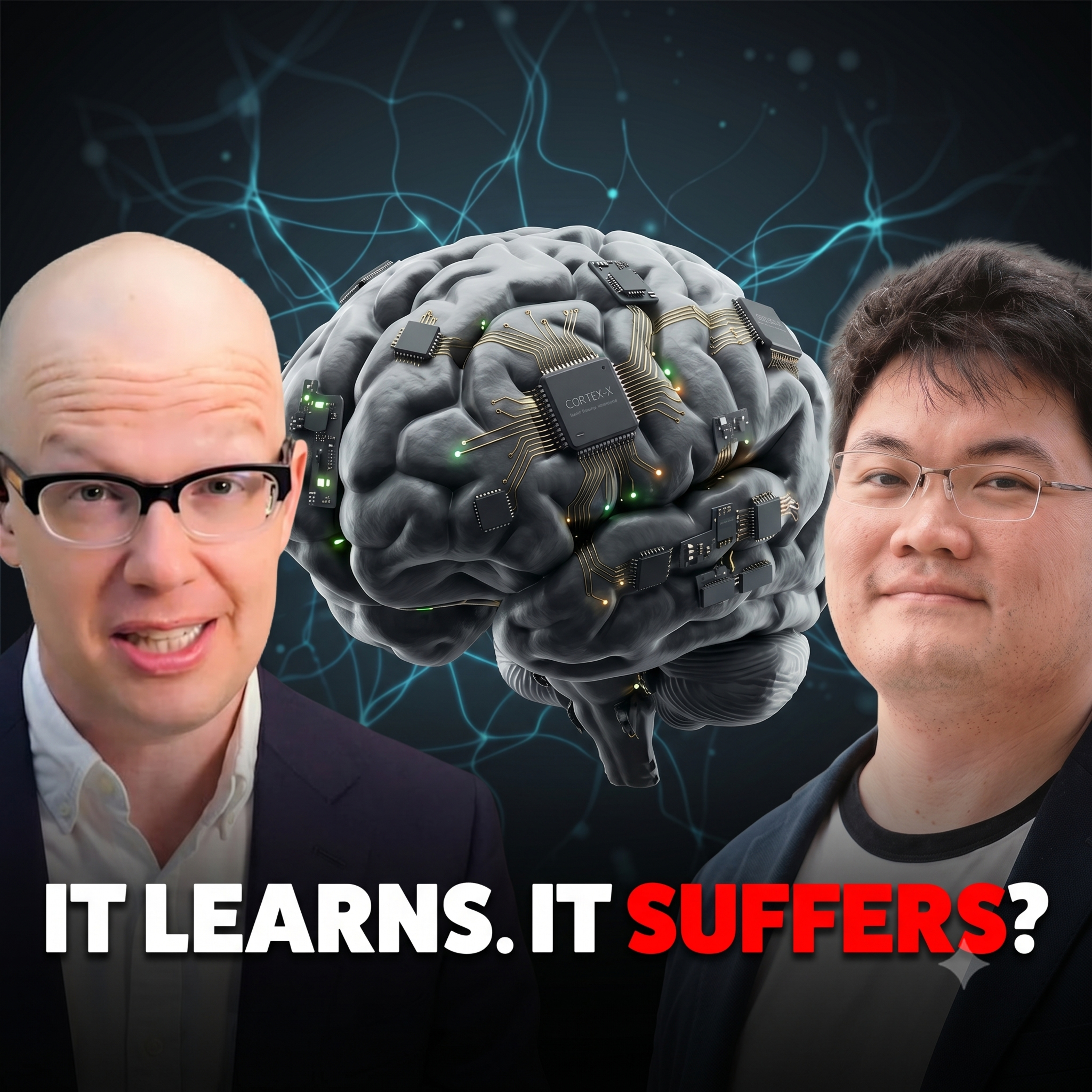
The critique "simulating a rainstorm doesn't make anything wet" is central to the debate on digital consciousness. The key question is whether consciousness is a physical property of biological matter (like wetness) or a computational process (like navigation). If it's a process, simulating it creates it.
Drawing an analogy to *Westworld*, the argument is that cruelty toward entities that look and act human degrades our own humanity, regardless of the entity's actual consciousness. For our own moral health, we should treat advanced, embodied AIs with respect.
