Get your free personalized podcast brief
We scan new podcasts and send you the top 5 insights daily.
AI coding assistants accelerate the creation of traditional software, but they don't enhance its fundamental capabilities. The bigger opportunity is embedding AI as a new programming primitive, like TypeSafe's JEV, to expand what software can actually do.

Related Insights
Speeding up just the coding phase with AI doesn't increase overall project delivery speed. It merely shifts the bottleneck to other parts of the Software Development Life Cycle (SDLC) like design, review, or deployment. To achieve real throughput gains, the entire end-to-end workflow must be optimized.
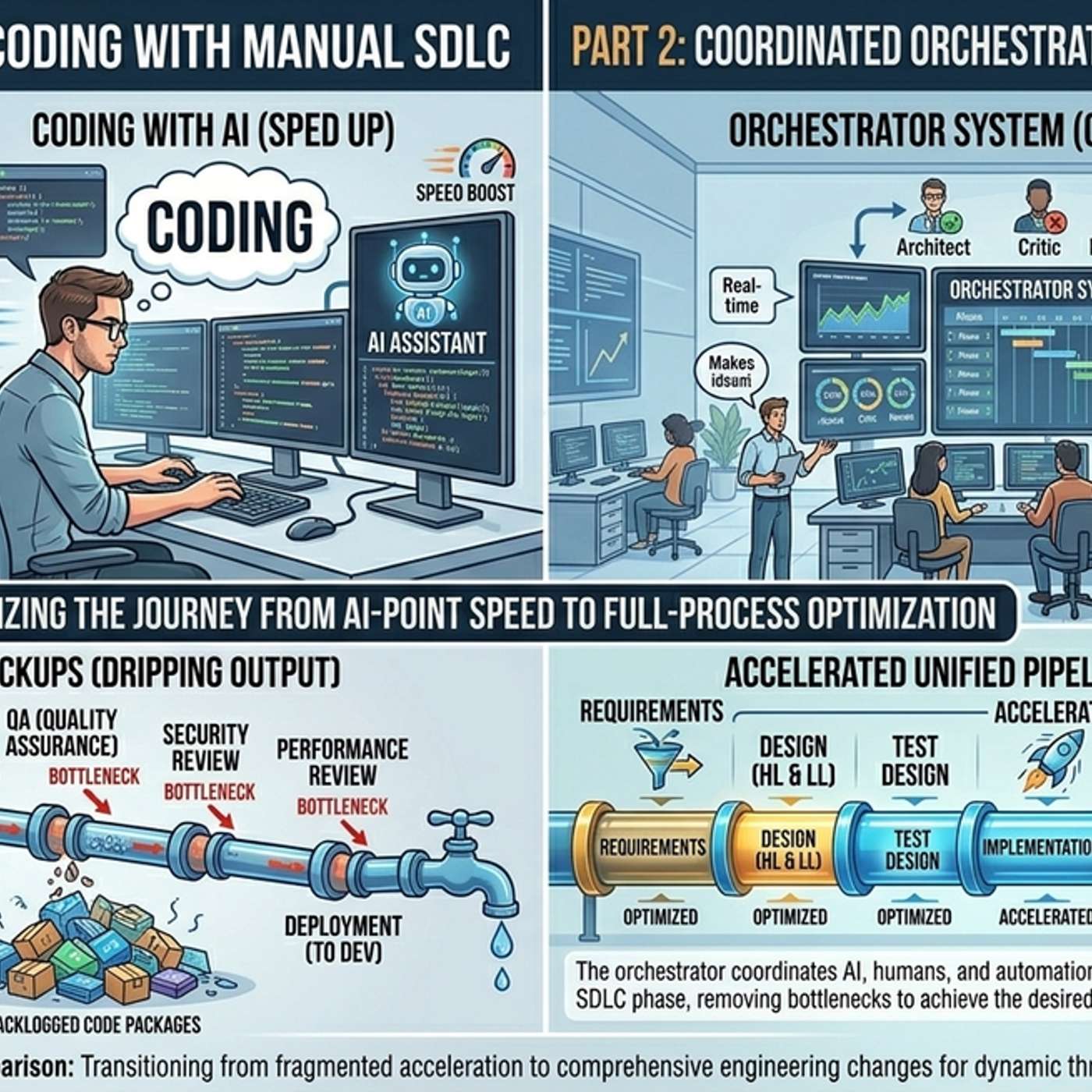
The conventional, sequential stages of software development (design, code, test, review) are becoming obsolete. AI agents merge these steps into a single, iterative loop driven by user intent. This isn't a 10x improvement on the existing workflow; it's a fundamental paradigm shift that makes the entire traditional process a relic.

Specialized coding models often fail because a developer's workflow isn't just writing code; it's a complex conversation involving brainstorming, compliance, and web research. The best coding assistants are the most generalist models because every complex task has AGI-like qualities.
Current AI coding assistants excel at generating syntactically correct code and boilerplate, but they are poor at software architecture. This high-level, creative task remains the core domain of human developers, positioning AI as a tool for implementation, not design.
The next major advance for AI in software development is not just completing tasks, but deeply understanding entire codebases. This capability aims to "mind meld" the human with the AI, enabling them to collaboratively tackle problems that neither could solve alone.
![[State of Code Evals] After SWE-bench, Code Clash & SOTA Coding Benchmarks recap — John Yang thumbnail](https://assets.flightcast.com/V2Uploads/nvaja2542wefzb8rjg5f519m/01K4D8FB4MNA071BM5ZDSMH34N/square.jpg)
Factory frames the AI coding landscape using the Henry Ford analogy. AI assistants that simply speed up line-by-line coding are merely 'faster horses.' The true paradigm shift—the 'automobile'—is delegating entire tasks to autonomous agents, fundamentally changing the developer workflow.

As AI makes the act of writing code a commodity, the primary challenge is no longer execution but discovery. The most valuable work becomes prototyping and exploring to determine *what* should be built, increasing the strategic importance of the design function.

Recent incidents of AI agents causing catastrophic production failures are ending the hype around "vibe coding." The industry consensus is shifting: AI is a powerful productivity multiplier for skilled developers but is not yet capable of managing the complexity, maintenance, and risk of professional software engineering on its own.

AI tools don't make junior developers senior; they accelerate existing workflows. Juniors produce junior-level code at a senior's pace, while seniors produce high-quality code at a supernatural speed. The tool magnifies the user's existing skill and discipline, for better or worse.

AI coding tools provide massive acceleration, turning projects that once took weeks or a dev shop into a weekend sprint. However, they are not a one-click solution. These tools still require significant, focused human expertise and effort to guide the process and deliver a final, functional product.