Get your free personalized podcast brief
We scan new podcasts and send you the top 5 insights daily.
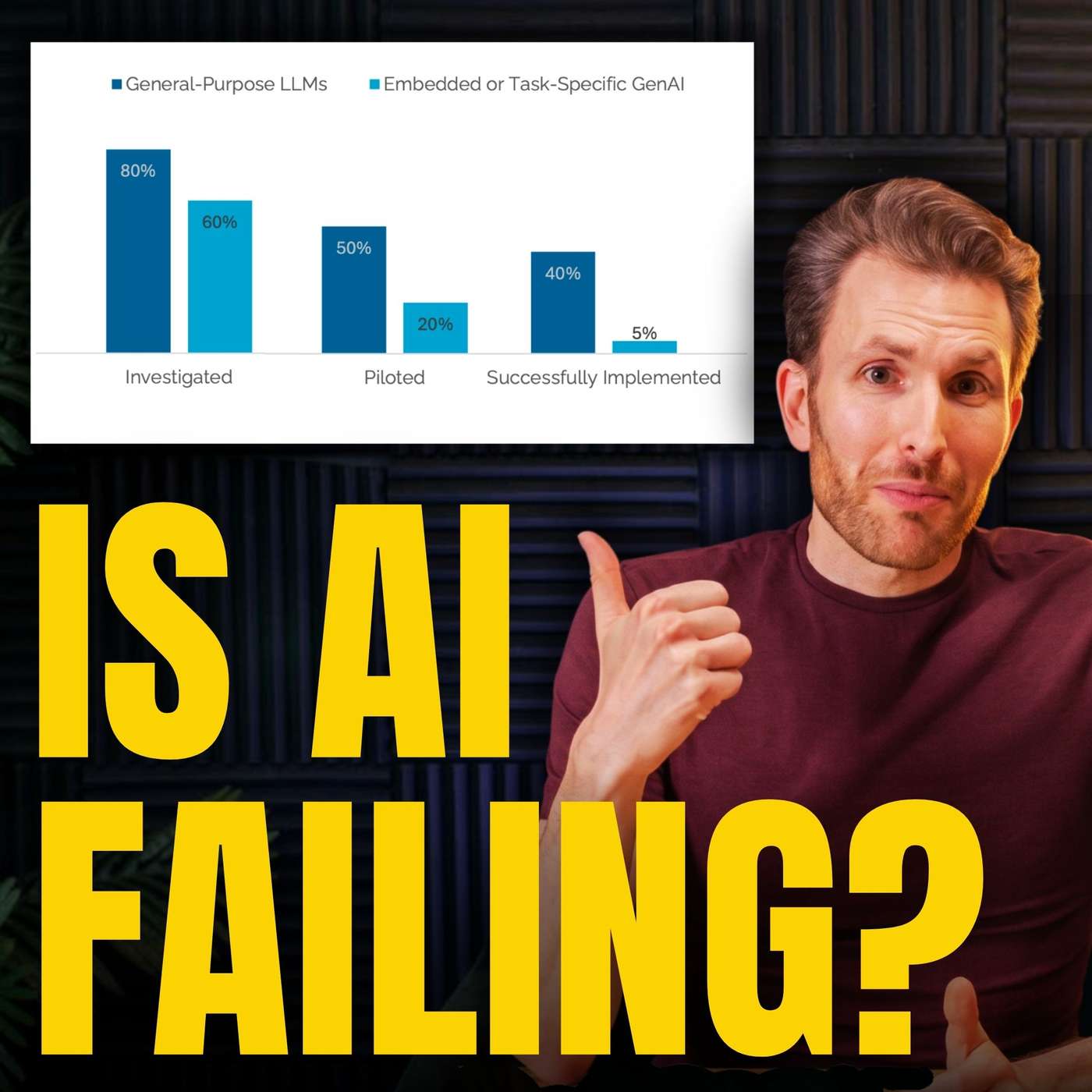
The viral "95% AI failure rate" statistic wasn't about projects failing, but about companies not even starting a pilot. This framing mistake, equating non-participation with failure, created a misleadingly negative perception of AI adoption, a common pitfall in tech reporting that misleads the public and investors.
Related Insights
An AI pilot study defined success as "marked and sustained" profit impact within six months. This impossibly high bar automatically classified projects that broke even, were on track for future profit, or provided non-financial benefits as "failures," thus obscuring the real, incremental value of new technology deployments.
A large-scale Wharton study found 75% of business leaders see positive ROI from AI, directly contradicting a widely-cited but methodologically questionable MIT report claiming 95% of pilots fail. This confirms that despite the hype, businesses are successfully generating tangible value from their AI investments.
In a new technological wave like AI, a high project failure rate is desirable. It indicates that a company is aggressively experimenting and pushing boundaries to discover what provides real value, rather than being too conservative.

Public opinion on AI is surprisingly negative, ranking lower than most political entities. This is driven by media focus on risks like job loss and resource consumption, overshadowing the tangible benefits experienced by millions of users. People's positive experiences with ChatGPT often coexist with a general, media-fueled distrust of "AI."

Companies fail to generate AI ROI not because the technology is inadequate, but because they neglect the human element. Resistance, fear, and lack of buy-in must be addressed through empathetic change management and education.

The 85% AI project failure rate isn't a technology problem. It stems from four business and process issues: failing to identify a narrow use case, using data that isn't clean or ready, not defining success and risk, and applying deterministic Agile methods to probabilistic AI development.

Headlines about high AI pilot failure rates are misleading because it's incredibly easy to start a project, inflating the denominator of attempts. Robust, successful AI implementations are happening, but they require 6-12 months of serious effort, not the quick wins promised by hype cycles.

The AI industry's public communication strategy, which heavily emphasizes risks and downplays tangible benefits, is backfiring. By constantly validating fears without clearly articulating a positive vision, AI leaders are inadvertently encouraging public skepticism and making people question why the technology should exist at all.

A viral satirical tweet about deploying Microsoft Copilot highlights a common failure mode: companies purchase AI tools to signal innovation but neglect the essential change management, training, and use case development, resulting in near-zero actual usage or ROI.

There is a significant gap between how companies talk about using AI and their actual implementation. While many leaders claim to be "AI-driven," real-world application is often limited to superficial tasks like social media content, not deep, transformative integration into core business processes.