Get your free personalized podcast brief
We scan new podcasts and send you the top 5 insights daily.
Previously, Dusty's robots required surveyor-placed control points, limiting them to large, new construction projects. A new feature allows the robot to align with existing features like walls, removing this dependency and opening up the massive, previously inaccessible market for smaller jobs and renovations.

Related Insights
When construction plans change after Dusty's robot prints a floor plan, the solution isn't digital. It's the same method used previously: a can of concrete-colored spray paint to "erase" the old lines. This illustrates how cutting-edge technology must adapt to the practical realities of the job site.
Designs that are perfect in software often fail on-site because they don't account for real-world imperfections. Dusty's portal solves this by allowing designs to be coordinated with the actual site conditions before work begins, moving a critical, error-prone step from the physical world to a digital one.
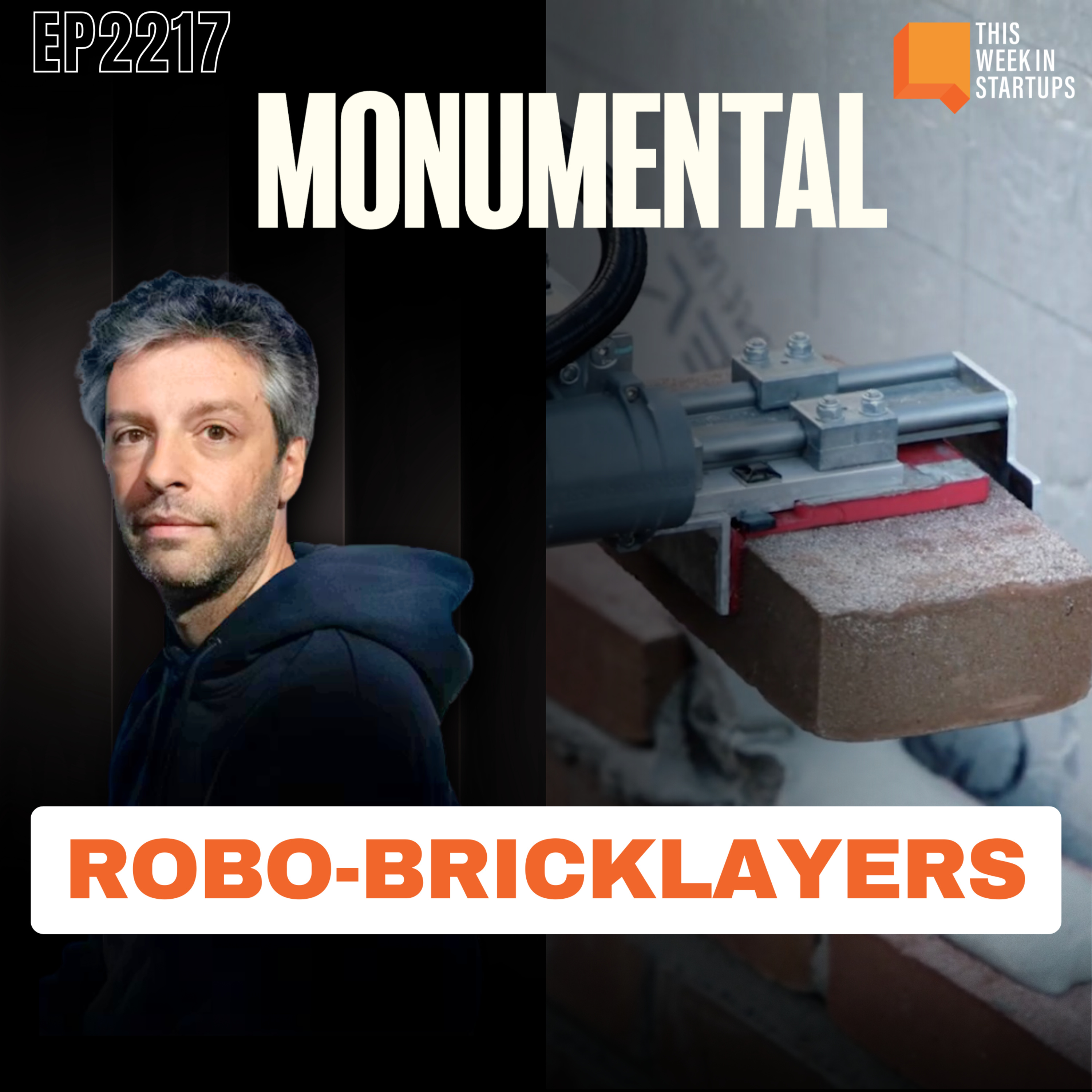
To overcome the construction industry's conservatism, Monumental operates as a subcontractor. This model is easier to sell than a large capital expenditure like a robot, as it fits existing project budgets and workflows, de-risking adoption for general contractors.
Adoption of Dusty Robotics is being driven top-down by the ultimate project owners. Recognizing the speed and accuracy benefits, major data center companies now require their general contractors to use Dusty's technology, turning it from a "nice to have" tool into a mandatory requirement.
The core bottleneck in construction isn't design intelligence but the high cost and stagnant productivity of manual labor. The most promising application of AI is not designing more clever prefabricated buildings, but powering robots to automate physical tasks, finally addressing the industry's decades-long productivity problem.

The company sees its layouts as the "linchpin" of construction. By embedding machine-readable QR codes into its floor plans, it is creating a foundational instruction set for all future robots on the job site. It is building the operating system for the automated construction site.
To incorporate site scanning, Dusty Robotics leveraged a service partner network rather than building the technology itself. These partners bundle scanning, design coordination, and Dusty's layout printing into a single, higher-value package, creating a more profitable distribution channel for the company.
High-end LiDAR systems suffer from more than just cost; they are often large, heavy, and require specialized training. Q3D's strategy to democratize access focuses on a trifecta of value propositions: a lower price point, a portable form factor that fits in difficult spaces (e.g., manholes), and a simple 'plug and play' user experience, removing the operational barriers that limit adoption to only specialized teams.

Automation in construction can do more than just lower costs for basic structures. Monumental's robots can create complex, artistic brick patterns and designs at the same speed and cost as a standard wall, potentially democratizing access to beautiful and diverse housing aesthetics.
A major source of error is "constructability"—plans that look perfect on screen but lack space for human hands to work. For example, a superintendent noted a staircase couldn't be built because workers couldn't fit their hands to install screws. Dusty's platform helps catch these issues early.