Get your free personalized podcast brief
We scan new podcasts and send you the top 5 insights daily.
The paradigm for creating software has shifted from writing code to writing natural language. Founders report a new workflow: speaking English to an AI, which then writes English prompts for other programs to generate the final code. This fundamentally changes the nature of software engineering and productivity.

Related Insights
Interacting with powerful coding agents requires a new skill: specifying requirements with extreme clarity. The creative process will be driven less by writing code line-by-line and more by crafting unambiguous natural language prompts. This elevates clear specification as a core competency for software engineers.
Unlike traditional programming, which demands extreme precision, modern AI agents operate from business-oriented prompts. Given a high-level goal and minimal context (like a single class name), an AI can infer intent and generate a complete, multi-file solution.
Cognition's Scott Wu predicts that AI will elevate software development to a new level of abstraction. Instead of reviewing code, engineers will review and iterate on English-language specifications and product decisions. The AI agent will handle the code generation, making English the new "source of truth."

The lines between IDEs and terminals are blurring as both adopt features from the other. The future developer workbench will be a hybrid prioritizing a natural language prompting interface, relegating direct code editing to a secondary, fallback role.

Leading engineers like OpenAI's Andre Karpathy describe recent AI tools not as incremental improvements but as the biggest workflow change in decades. The paradigm has shifted from humans writing code with AI help to AI writing code with human guidance.
Generative AI is making the task of writing syntactically correct code obsolete. The core value of a software engineer is shifting away from implementation details and towards the higher-level "thinking" tasks: understanding user needs and designing robust systems.
Spotify has shifted from AI as a developer 'copilot' to AI as the primary coder for senior staff. Top developers now provide natural language instructions for bug fixes or features via Slack during their commute, with an internal platform autonomously writing, validating, and deploying the code to production. This marks a profound change in the software development lifecycle.

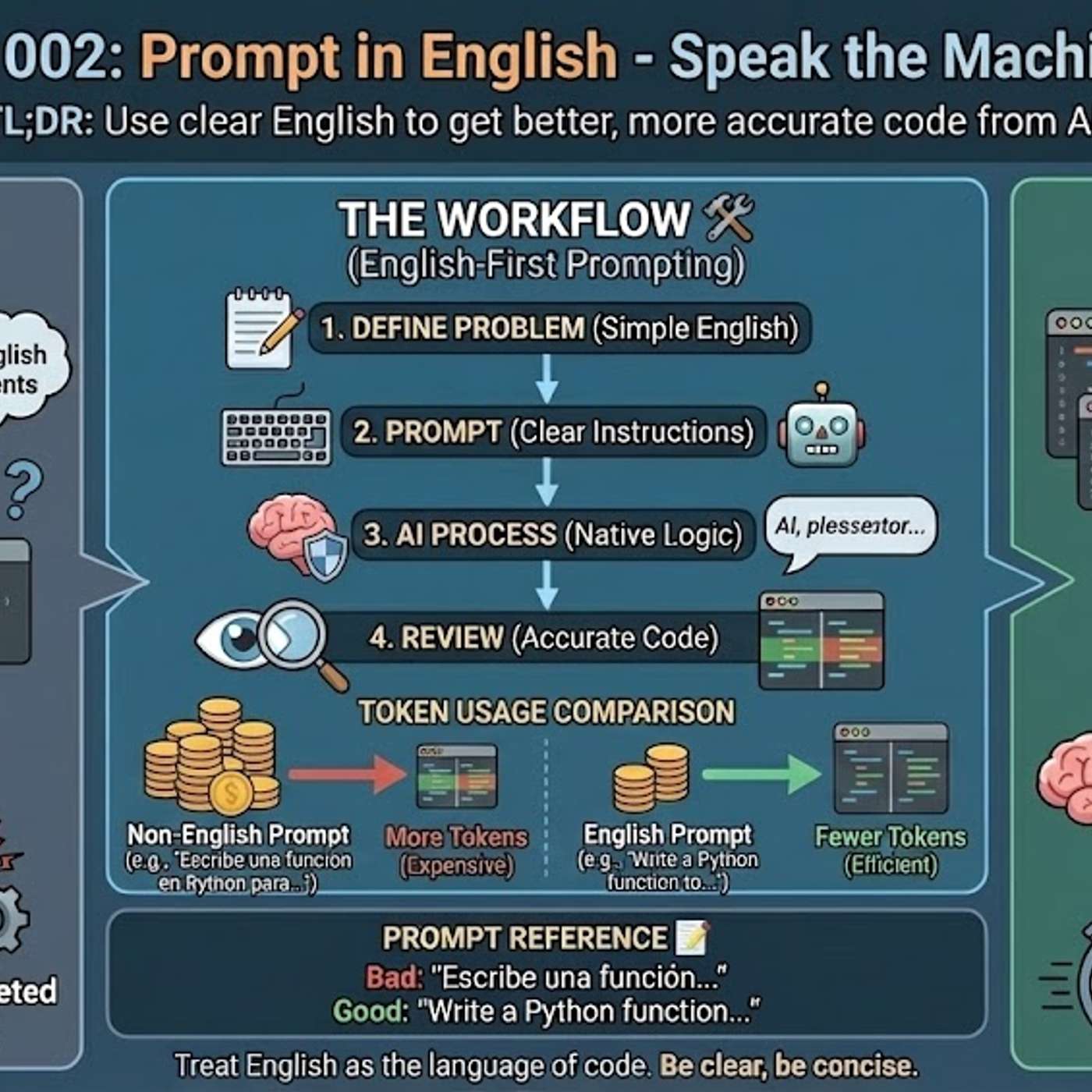
The primary reason AI models generate better code from English prompts is their training data composition. Over 90% of AI training sets, along with most technical libraries and documentation, are in English. This means the models' core reasoning pathways for code-related tasks are fundamentally optimized for English.
AI development has evolved to where models can be directed using human-like language. Instead of complex prompt engineering or fine-tuning, developers can provide instructions, documentation, and context in plain English to guide the AI's behavior, democratizing access to sophisticated outcomes.

The craft of software engineering is evolving away from precise code editing. Much like compilers abstracted away assembly language, modern AI coding tools are a new abstraction layer, turning engineers into directors who guide AI to write and edit code on their behalf.
