Get your free personalized podcast brief
We scan new podcasts and send you the top 5 insights daily.
The model has two critical silent failure modes. First, it completely ignores objects outside its 80 COCO classes without warning. Second, incorrect confidence or IOU threshold parameters will not raise errors but will silently degrade detection performance, creating a significant implementation risk.

Related Insights
The default 640px input size is not a universal solution. To reliably detect small objects, image size must be increased to 832px or 1024px at the cost of slower inference. Conversely, reducing size to 416px speeds up processing but risks missing fine-grained details.
An agent's reasoning failure won't trigger traditional alerts. Metrics like error rate and latency will appear healthy because the agent produces valid, well-formed, but semantically incorrect responses. This creates a critical monitoring blind spot where the infrastructure is fine, but the agent's logic is broken.

If all your evals pass, you don't know the current limits of your system. Evals that consistently fail act as a benchmark. When a new foundation model is released, rerunning these tests immediately reveals if it has overcome previous limitations.

While YOLO26 is stable and maintained, its successor, YOLO11n, offers superior speed and accuracy. The primary reason to choose YOLO26 is for compatibility with existing production systems. For all new development, YOLO11n is the recommended architecture to achieve better performance.
A significant hurdle for using large vision models in production is their non-deterministic nature. The same model can produce different results for the same query at different times, making it difficult to build reliable, consistent downstream systems. This unpredictability is a key challenge alongside speed and cost.

When selecting foundational models, engineering teams often prioritize "taste" and predictable failure patterns over raw performance. A model that fails slightly more often but in a consistent, understandable way is more valuable and easier to build robust systems around than a top-performer with erratic, hard-to-debug errors.

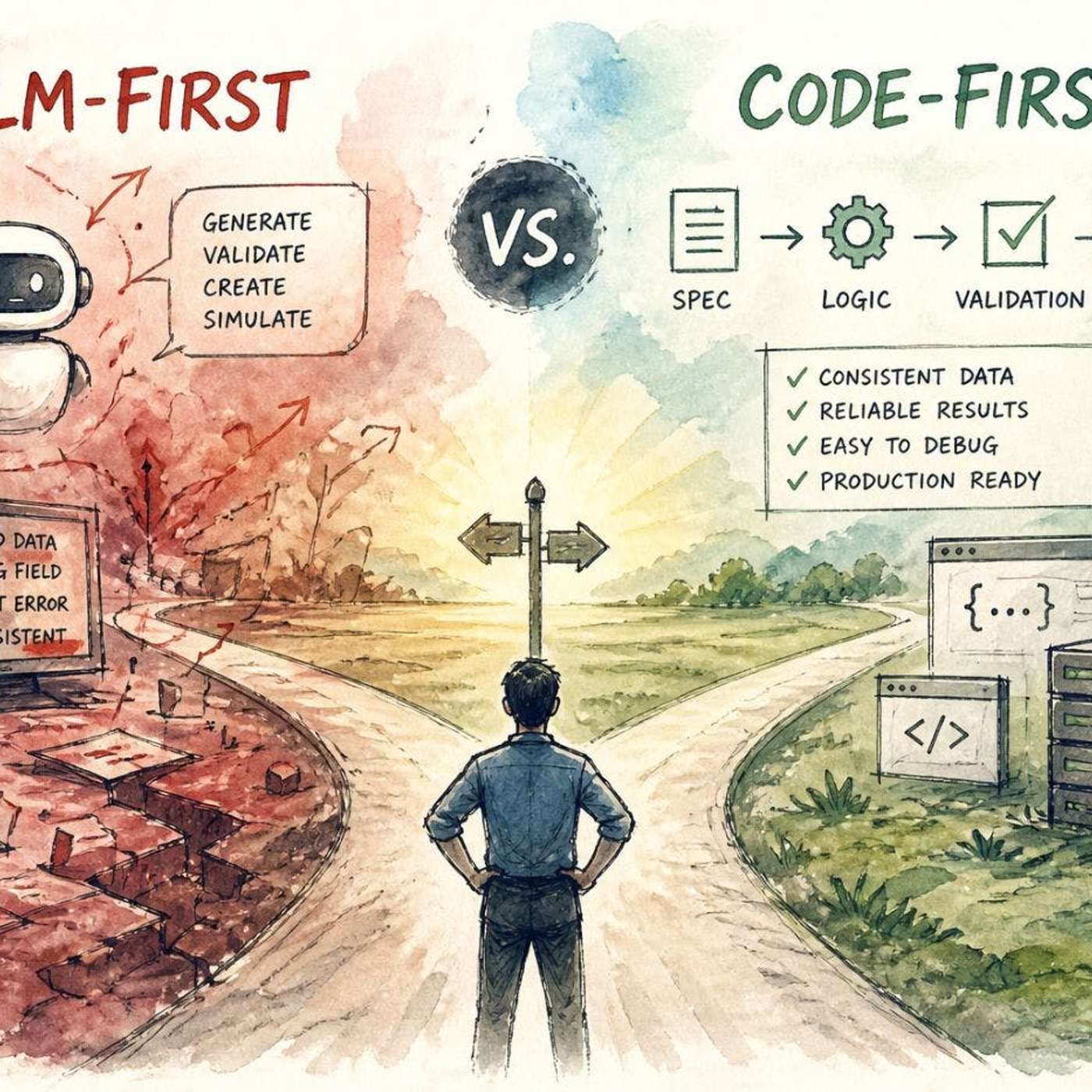
LLMs in production don't often crash spectacularly. Instead, they introduce subtle, probabilistic errors—like incorrect enum values or missing fields—that are hard to debug because they lack clear error patterns, unlike deterministic code failures.
Comprehensive model evaluation doesn't always require thousands of test cases. To diagnose a specific issue, like an image recognition failure, a focused set of just dozens of examples can be sufficient. This smaller, targeted approach is enough to prove a hypothesis and create a clear evaluation metric for researchers to iterate against.

The performance improvement when scaling YOLO26 model sizes is not linear. The accuracy jump from the Nano to the Small variant is more significant than from Small to Medium, identifying the 'Small' model as the optimal trade-off point for many applications.
Despite impressive general capabilities, top multimodal models from companies like Google and OpenAI still struggle with tasks requiring high precision. These "grounding failures" include pixel-perfect segmentation, accurate measurement, and understanding the spatial relationships between objects, as demonstrated on Roboflow's visioncheckup.com.