Get your free personalized podcast brief
We scan new podcasts and send you the top 5 insights daily.
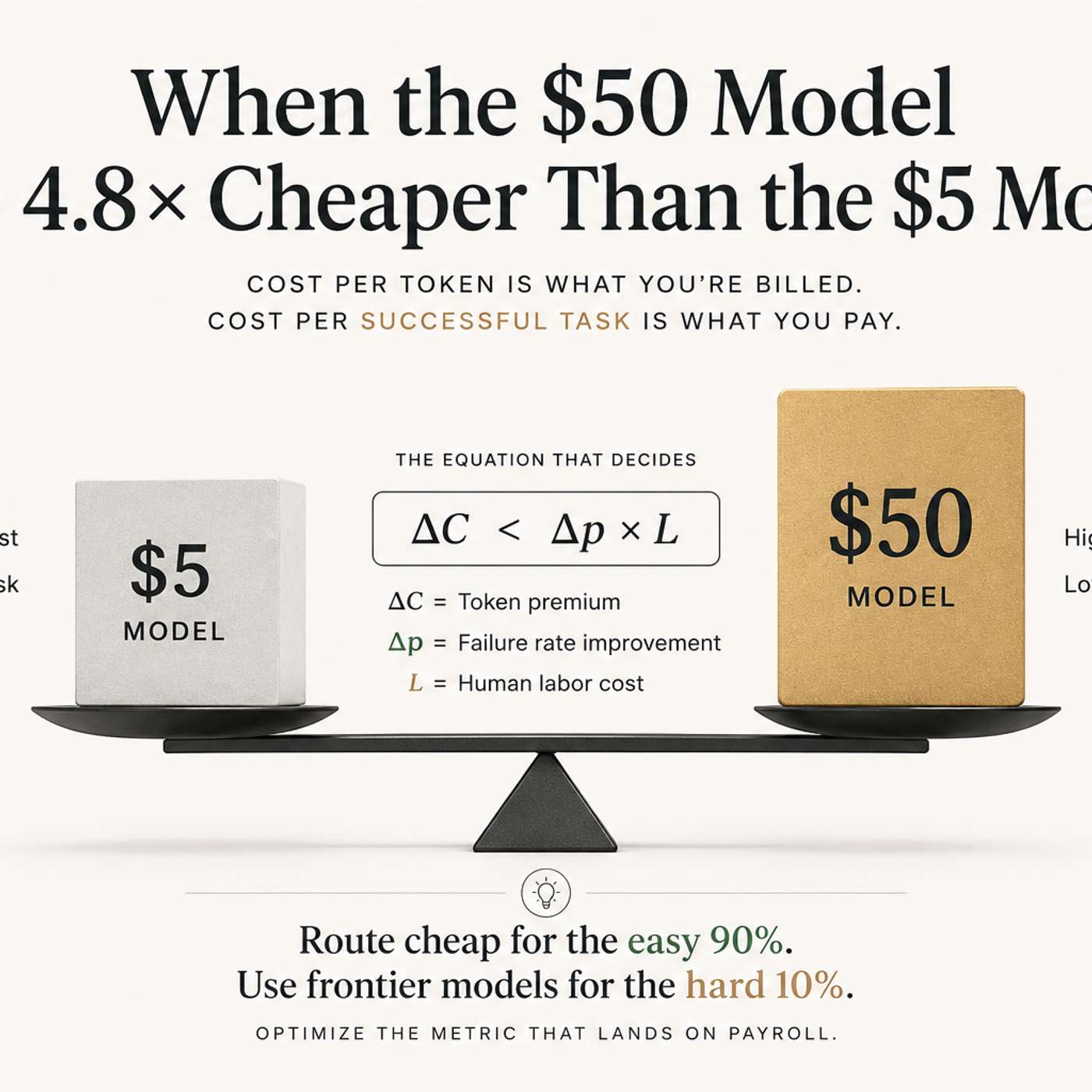
Instead of selecting one model for all tasks, a more powerful and efficient architecture uses a routing layer. This system delegates simple jobs to small, local models while escalating complex or sensitive requests to more capable ones, optimizing cost and performance.

Related Insights
Relying on a single frontier model is risky and inefficient. The next phase of AI will involve intelligently routing queries to the most appropriate model—be it cheaper, faster, or local. This will redistribute value from a few dominant labs to a long tail of specialized models, maturing the ecosystem.

According to Meta's CTO, the era of one monolithic model doing everything is over. The current frontier involves using a 'harness' that intelligently routes tasks to a collection of different, specialized models based on cost, latency, and capability.

Advanced AI architectures will use small, fast, and cheap local models to act as intelligent routers. These models will first analyze a complex request, formulate a plan, and then delegate different sub-tasks to a fleet of more powerful or specialized models, optimizing for cost and performance.
To manage AI costs effectively, companies should avoid simply capping token usage, as this kills innovation. A better strategy is to build intelligent routers that assess a task's complexity and dynamically route it to the most appropriate model—powerful models for hard tasks, cheaper ones for simple tasks.

Instead of relying on one powerful model for all tasks, the leading strategy is 'smart routing'—using a panel of models and directing each task to the most appropriate one. This compound architecture demonstrably beats single frontier models on both cost and performance.

To optimize AI costs and sustainability, UBS employs a "model garden" with various frontier and smaller models. An internal AI system then routes employee questions to the most appropriate, cost-effective model, preventing the wasteful use of powerful, expensive LLMs for simple, non-frontier problems.

Instead of relying on a single large AI model, companies are adopting "model orchestration" to control costs. This involves using a router to send prompts to the most appropriate model based on the task, often cascading from cheap, small models to more expensive ones only when necessary.
Companies are building intelligent systems that analyze a user's prompt and automatically route it to the most cost-effective model that can handle the task. This avoids using expensive frontier models for simple requests, with some companies like Coinbase successfully keeping costs flat despite exponential usage growth.

Companies like Meta and Ramp are building AI routers to automatically send simple tasks to cheaper models. This trend shows the enterprise AI market is maturing past a 'one-model-fits-all' approach, focusing instead on cost management and operational efficiency by treating models as a commodity portfolio.
An optimal AI architecture routes tasks to different models based on complexity and risk. Simple, low-stakes work like data extraction should go to the cheapest models. Ambiguous, high-stakes work like system design warrants expensive frontier models, where preventing one engineering mistake justifies the premium token cost.