Get your free personalized podcast brief
We scan new podcasts and send you the top 5 insights daily.
An analysis by Faro's AI found AI-assisted teams merged 98% more PRs, not by completing individual tasks faster, but by enabling developers to parallelize their workflow. Developers can kick off a task with an agent while simultaneously reviewing another human's work. This shows teams should optimize for throughput, not single-task velocity.

Related Insights
Speeding up just the coding phase with AI doesn't increase overall project delivery speed. It merely shifts the bottleneck to other parts of the Software Development Life Cycle (SDLC) like design, review, or deployment. To achieve real throughput gains, the entire end-to-end workflow must be optimized.
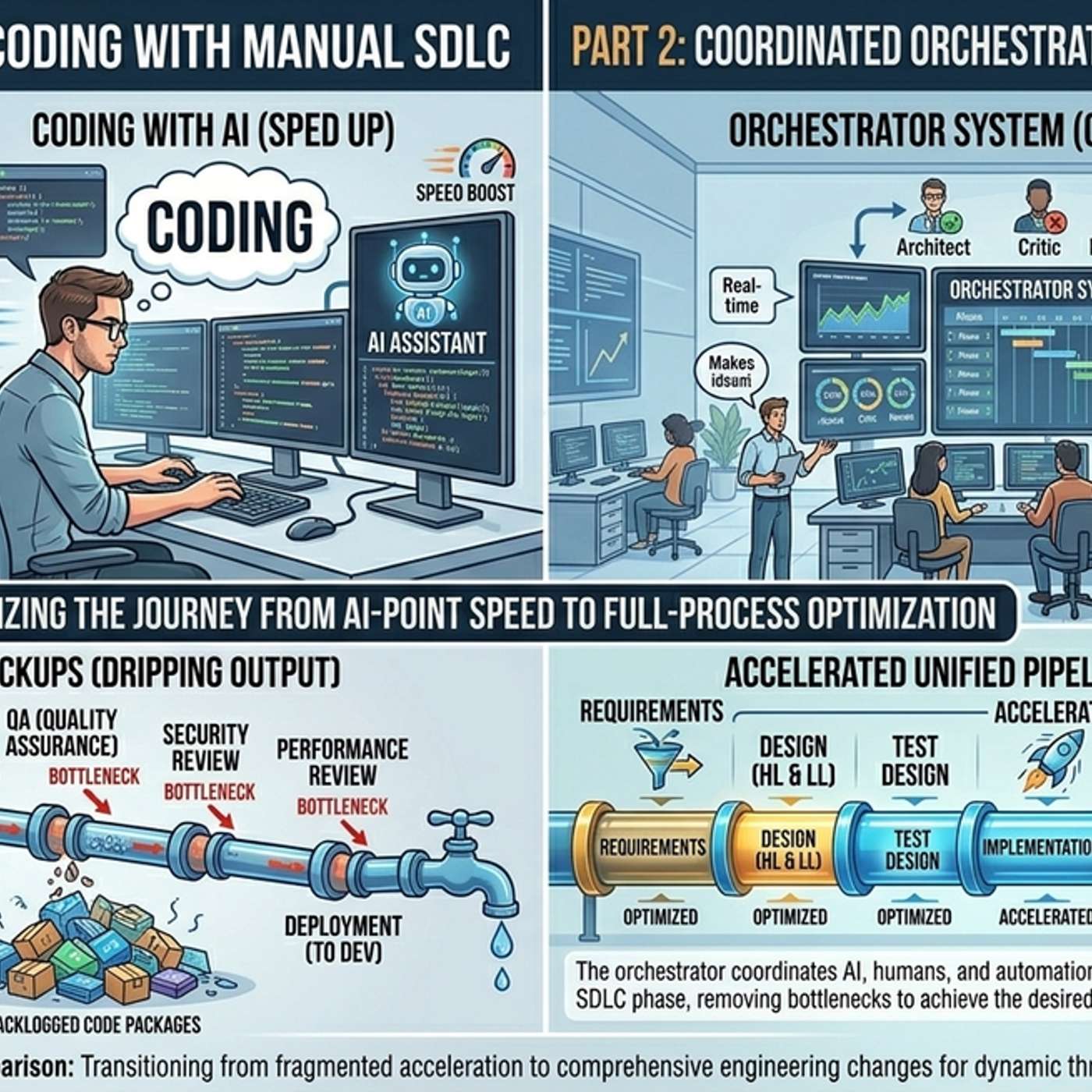
The developer's role is evolving from a linear workflow (code, submit PR, get review) to a parallel one. At Block, developers now manage multiple AI agents building numerous pull requests simultaneously, acting as an editor and context-switcher rather than the sole creator.

Intercom's CTO set a goal to 2x R&D throughput, using pull requests as a simple, albeit crude, metric. In a high-trust environment, this focused the team on adopting AI tools to increase output, leading to measurable success.

Traditional software development processes, like peer code reviews, were built for a cadence of 10-15 PRs per month. When AI agents enable a 10x increase in output, the human team becomes the bottleneck, forcing a shift towards AI-driven review and validation.

The latest AI coding assistants facilitate a massive leap in developer productivity. The host demonstrated this by merging 44 pull requests and adding nearly 93,000 lines of code in just five days, a workload that would typically take an entire team months to complete, making the scale of the impact concrete.

The most dramatic productivity gains come not from a single AI assistant, but from a human operator orchestrating multiple specialized agents concurrently. This model involves setting up 5-15 agents with specific roles and controlled tool access to perform complex tasks in parallel.
AI's true productivity leverage is not just speed but enabling more attempts. A human might get one shot at a complex task, whereas an AI-assisted workflow allows for three or more "turns at the wheel." The critical human skill shifts from initial creation to rapid review and refinement of these iterations.

In an agent-driven workflow, human review becomes the primary bottleneck. By moving reviews to after the merge, the team prioritizes agent throughput and treats human attention as a scarce resource for high-level guidance, not gatekeeping individual pull requests.
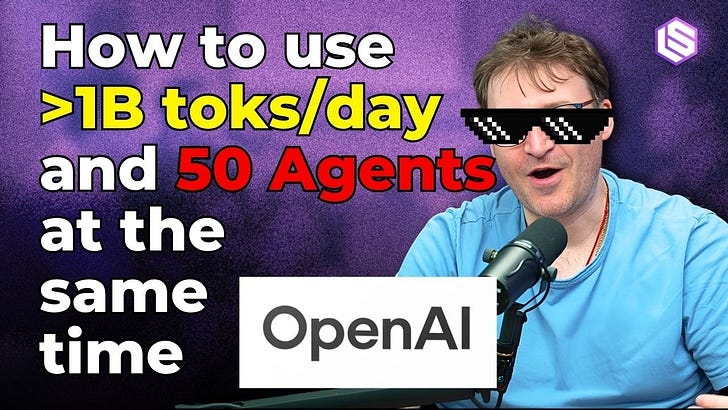
By deploying multiple AI agents that work in parallel, a developer measured 48 "agent-hours" of productive work completed in a single 24-hour day. This illustrates a fundamental shift from sequential human work to parallelized AI execution, effectively compressing project timelines.

The belief that adding people to a late project makes it later (Brooks's Law) may not apply in an AI-assisted world. Early reports from OpenAI suggest that when using agents, adding more developers actually increases velocity, a potential paradigm shift for engineering management and team scaling.