Get your free personalized podcast brief
We scan new podcasts and send you the top 5 insights daily.
Oncologists view datopotamab deruxtecan and sacituzumab govitecan as similarly effective for first-line TNBC. The choice is driven by side effect profiles: stomatitis/ILD with Dato versus alopecia/GI toxicity with SG, and logistics like infusion frequency.

Related Insights
Despite targeting the same protein (Trope-2), different ADCs like sacituzumab govitecan (SG) and sacituzumab tirumotecan (sac-TMT) exhibit unique toxicity profiles due to their different linker-payloads. Clinicians must be prepared for diarrhea with SG versus oral mucositis with sac-TMT, requiring distinct mitigation strategies for drugs that otherwise seem very similar.

When choosing between sacituzumab govitecan (SG) and datopotamab deruxtecan (Datto-DXd), oncologists prioritize the differing side effect profiles (diarrhea/neutropenia vs. stomatitis/ocular) and administration schedules (weekly infusions vs. every three weeks) to match patient lifestyle and comorbidities, rather than focusing solely on efficacy.

Though TROP2 antibody-drug conjugates share a mechanism, their adverse event profiles differ significantly. Datopotamab-deruxtecan commonly causes stomatitis, while Sacituzumab govitecan is associated with high rates of neutropenia, necessitating drug-specific management.

When choosing between TROP2-directed ADCs like sacituzumab govitecan and datopotamab deruxtecan, the decision often hinges on side effect profiles and scheduling convenience, not superior efficacy. Datopotamab has more oral/ocular issues but is given every three weeks, while sacituzumab causes more neutropenia and requires visits two out of every three weeks.

In metastatic TNBC, using sacituzumab govitecan (SG) first-line provides a progression-free survival (PFS) advantage that cannot be regained by using it second-line after initial chemotherapy. The PFS2 data from ASCENT trials shows starting with SG is definitively better than a chemo-first sequence.
When efficacy and safety profiles are comparable between ADCs like sacituzumab and datopotamab, the final choice can be guided by patient logistics. Factors include infusion frequency (Day 1 & 8 vs. every 3 weeks) and total time spent at the infusion center.
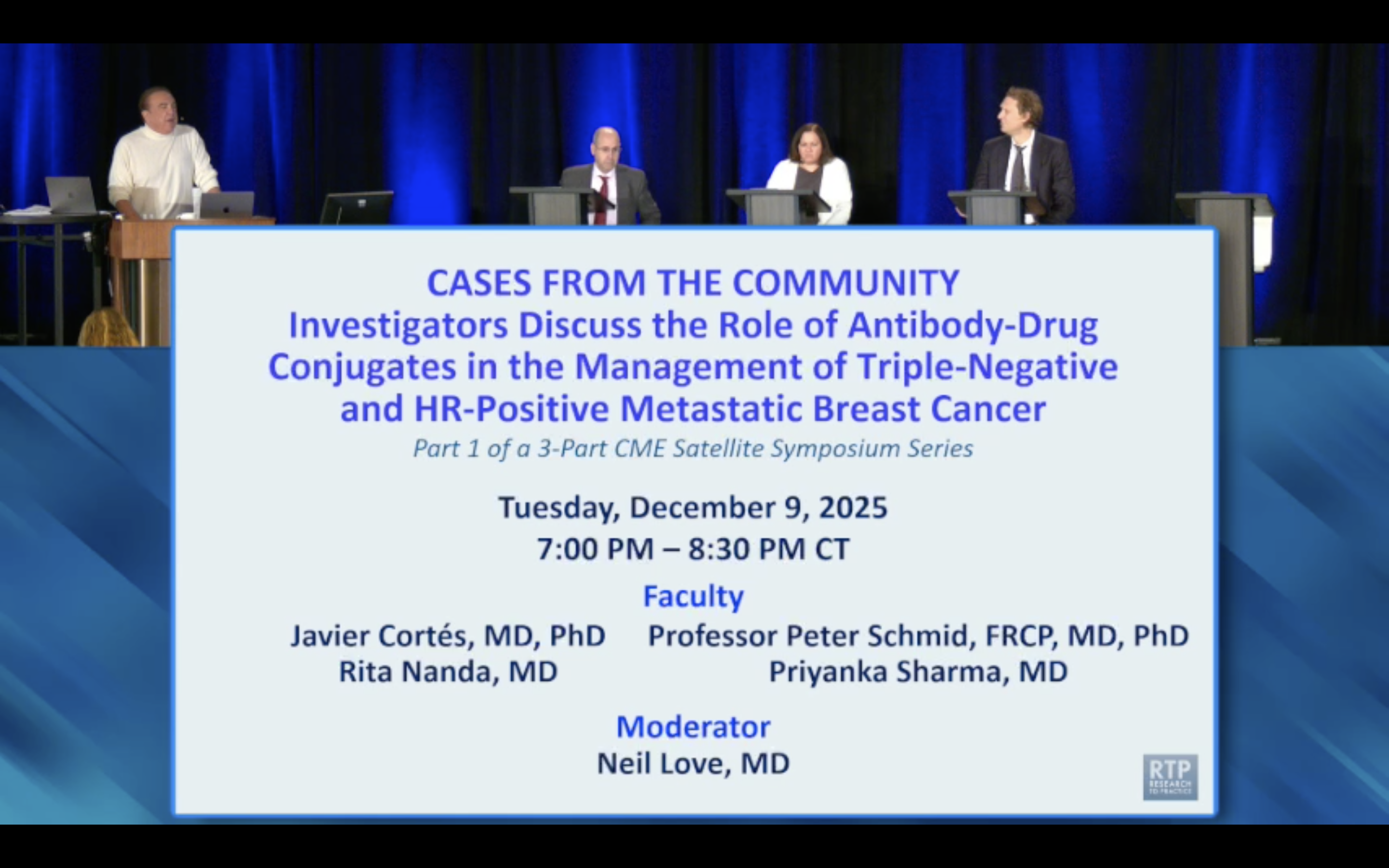
Despite both being Trop-2 targeted antibody-drug conjugates, Sacituzumab Govitecan and Datopotomab duroxotein have distinct side effects due to different linkers and payloads. Sacituzumab causes neutropenia and diarrhea, while Datopotomab is linked to stomatitis and ocular issues, requiring unique management strategies.

Managing side effects of antibody-drug conjugates is not one-size-fits-all. Sazetuzumab-govatecan requires managing GI issues, while Datopotamab-deruxtecan has unique risks like ophthalmologic problems and ILD, necessitating pre-treatment specialist evaluation. Proactive patient education and tailored mitigation are key to maintaining treatment continuity and efficacy.

With two newly approved, effective ADCs (Sacituzumab govitecan and Datopotamab deruxtecan) for first-line PD-L1 negative TNBC, clinicians face a state of "equipoise." Lacking head-to-head data, treatment selection hinges on physician experience and patient factors like side effect tolerance and schedule, not superior efficacy.
Clinical trial data shows that despite specific toxicities, antibody-drug conjugates (ADCs) can be better tolerated overall than standard chemotherapy. For example, trials for both sacituzumab govitecan and dato-DXd reported fewer patients discontinuing treatment in the ADC arm compared to the chemotherapy arm.