Get your free personalized podcast brief
We scan new podcasts and send you the top 5 insights daily.
Constraining a powerful, creative AI to perform a single, simple task reliably is counterintuitively harder than letting it be a general-purpose tool. Your team will spend most of its time building guardrails, checks, and other reliability code around the core model.

Related Insights
While AI can attempt complex, hour-long tasks with 50% success, its reliability plummets for longer operations. For mission-critical enterprise use requiring 99.9% success, current AI can only reliably complete tasks taking about three seconds. This necessitates breaking large problems into many small, reliable micro-tasks.

A major bottleneck in AI progress is the gap between research and production. Researchers produce powerful models but often lack software engineering discipline. This results in code that is not portable, extensible, or robust, hindering the transition from a novel idea to a scalable, reliable product.

Consumer AI tools rely on motivated users to correct errors. For products targeting users who expect perfection, your team must engineer this "reliability layer" to handle AI inconsistencies, which adds significant cost and effort that is often overlooked.
Don't give LLMs full control. Use deterministic code for core logic, validation, and enforcing rules. Delegate only tasks requiring flexibility or understanding of unstructured input to the LLM, treating it as a specialized component, not the entire system.
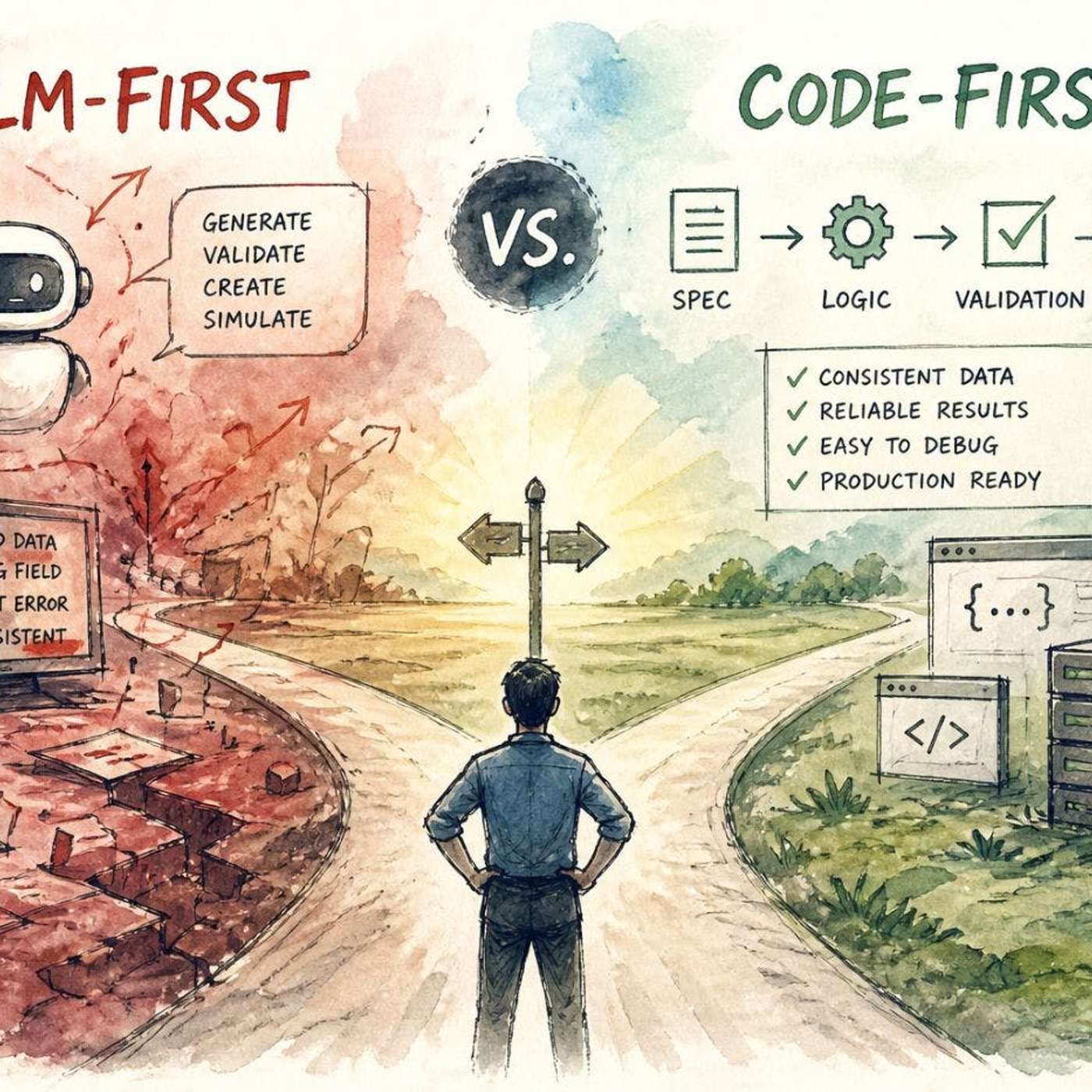
The key to creating effective and reliable AI workflows is distinguishing between tasks AI excels at (mechanical, repetitive actions) and those it struggles with (judgment, nuanced decisions). Focus on automating the mechanical parts first to build a valuable and trustworthy product.

High productivity isn't about using AI for everything. It's a disciplined workflow: breaking a task into sub-problems, using an LLM for high-leverage parts like scaffolding and tests, and reserving human focus for the core implementation. This avoids the sunk cost of forcing AI on unsuitable tasks.

The 'move fast and break things' mantra is counterproductive for complex AI development. Tools and philosophies prioritizing correctness and thoughtful architecture over raw speed are better suited for building meaningful, non-trivial AI features that don't become overwhelming to manage.

Generative AI has made building a functional demo faster than ever. However, the journey to a scalable, production-ready product is more complex due to new challenges like ensuring consistent answer reliability and data privacy, which are harder to solve than traditional software bugs.

General-purpose AI assistants produce inconsistent output. Instead, define AI agents with specific roles, boundaries, and quality gates, much like onboarding a new engineer with a clear job description. This disciplined approach leverages how LLMs are trained, leading to more reliable and predictable results within the SDLC.

The primary obstacle to creating a fully autonomous AI software engineer isn't just model intelligence but "controlling entropy." This refers to the challenge of preventing the compounding accumulation of small, 1% errors that eventually derail a complex, multi-step task and get the agent irretrievably off track.