Get your free personalized podcast brief
We scan new podcasts and send you the top 5 insights daily.
A study across 500 engineering organizations revealed that AI spending grew 28-fold alongside rising AI-authored code, yet overall innovation remained flat. The rapid code generation introduces new friction in code review and validation, counteracting early velocity gains.

Related Insights
While AI accelerates code generation, it creates significant new chokepoints. The high volume of AI-generated code leads to "pull request fatigue," requiring more human reviewers per change. It also overwhelms automated testing systems, which must run full cycles for every minor AI-driven adjustment, offsetting initial productivity gains.

Speeding up just the coding phase with AI doesn't increase overall project delivery speed. It merely shifts the bottleneck to other parts of the Software Development Life Cycle (SDLC) like design, review, or deployment. To achieve real throughput gains, the entire end-to-end workflow must be optimized.
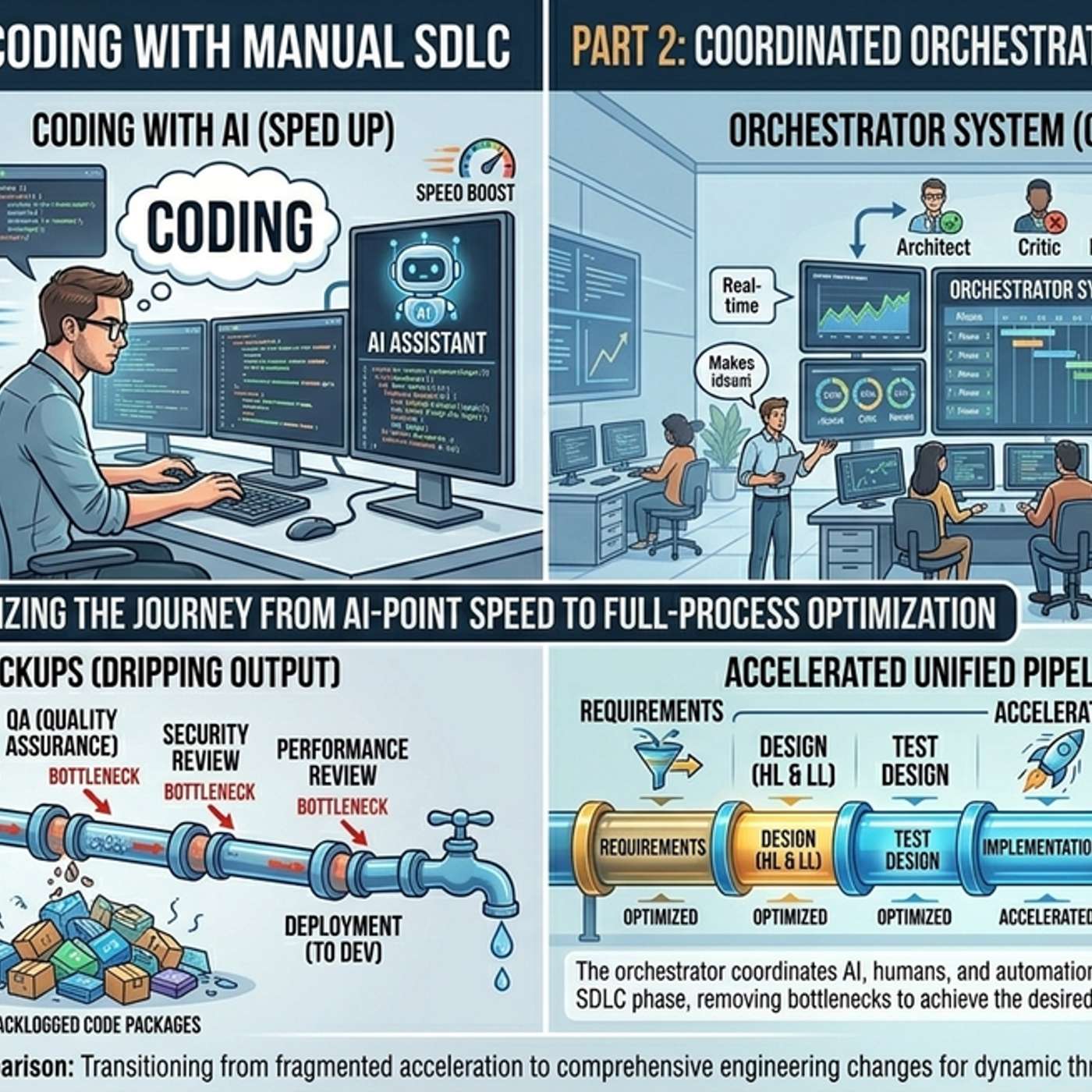
As AI agents and copilots accelerate code creation from numerous sources, the primary challenge for engineering teams becomes validating this massive influx of pull requests. This makes the code review process the new critical choke point in the software development lifecycle.

With AI generating 1,300 pull requests weekly at Stripe, the critical path is shifting. When coding becomes a commodity, the bottleneck moves to human review and validation. Engineering teams must refocus from pure creation to oversight and quality assurance at scale.

Simply deploying AI to write code faster doesn't increase end-to-end velocity. It creates a new bottleneck where human engineers are overwhelmed with reviewing a flood of AI-generated code. To truly benefit, companies must also automate verification and validation processes.

CEOs expect AI to massively increase feature output, but data from tools like Jellyfish shows AI-generated code often requires much longer review cycles. This can slow a team's overall momentum despite the high volume of code produced, creating a disconnect between executive expectation and engineering reality.

The explosion in AI-generated code creates a new quality assurance bottleneck. Shopify's CTO insists that pull request reviews must use the largest, most expensive models to maintain quality and prevent a surge in bugs, noting that smaller, faster models are insufficient for the task.

With AI agents autonomously generating pull requests, the primary constraint in software development is no longer writing code but the human capacity to review it. Companies like Block are seeing PRs per engineer increase massively, creating a new challenge for engineering managers to solve.

Prompting AI agents without a strict framework increases an individual's code output but leads to inconsistent standards. This makes code reviews a nightmare for teams, creating a collaborative bottleneck that cancels out the initial speed advantage.
Despite AI's promise to reduce menial work, developers still spend 23-25% of their week on repetitive tasks. The nature of this "toil" has simply changed from writing boilerplate code to the more complex and time-consuming task of validating and debugging plausible-looking AI-generated code.