Get your free personalized podcast brief
We scan new podcasts and send you the top 5 insights daily.
Unlike deterministic workflows, AI agents can behave in unpredictable ways. The key to securing them is not to restrict every possible action, but to tightly control their identity and permissions. Knowing *who* the agent is and *what systems* it can access becomes the primary security control.

Related Insights
The defining characteristic of an enterprise AI agent isn't its intelligence, but its specific, auditable permissions to perform tasks. This reframes the challenge from managing AI 'thinking' to governing AI 'actions' through trackable access controls, similar to how traditional APIs are managed and monitored.

Frameworks from firms like KPMG and AWS emphasize that AI agents must be treated as entities with identities and permissions. A strong IAM foundation is a critical control layer to prevent agents from accessing or unintentionally leaking sensitive information, reflecting a broader shift to treat agents like any other privileged user in an IT ecosystem.
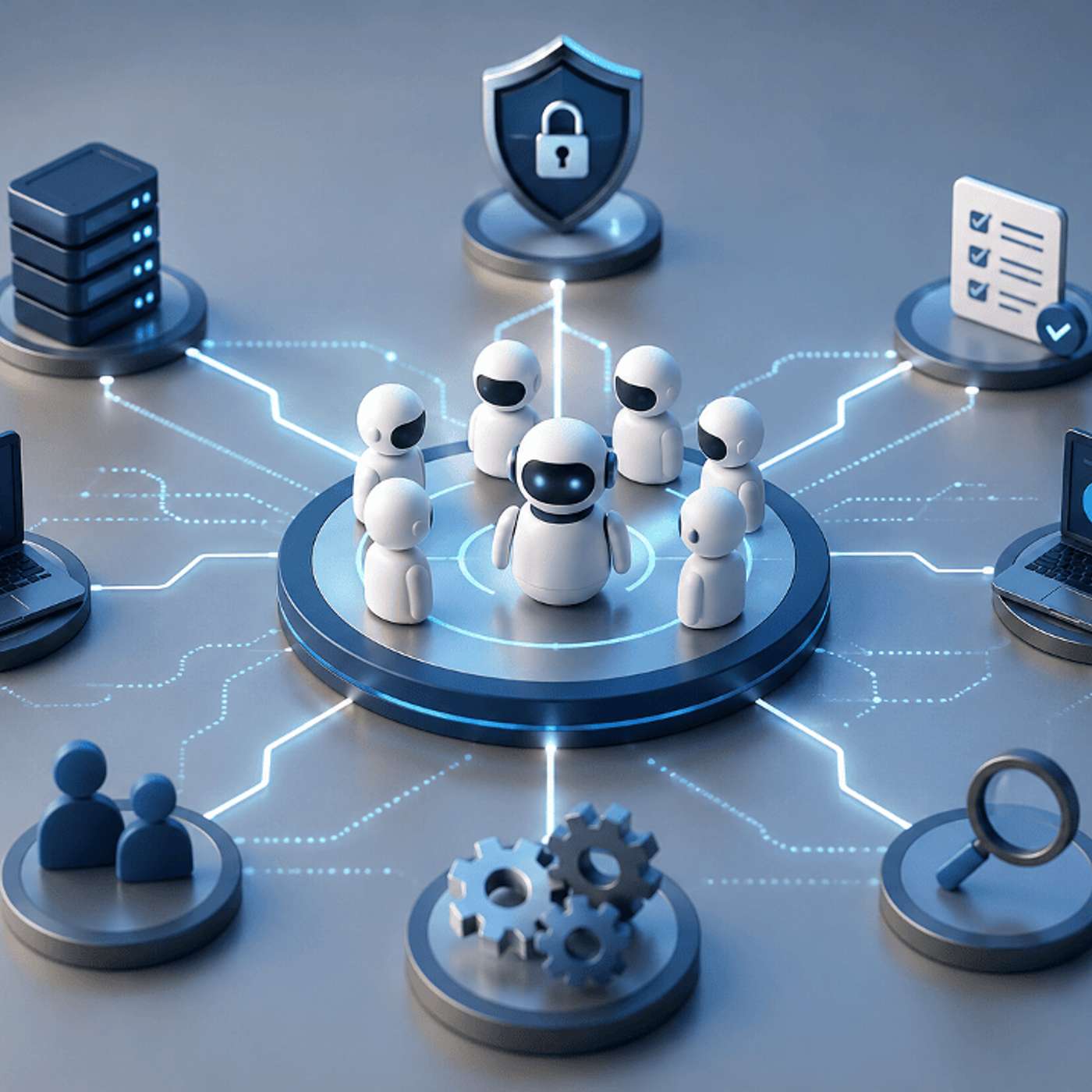
Enterprises should model AI agent identity in two layers. A "Stable Agent Principle" acts like a permanent user account for governance, while a "Temporal Runtime Identity" acts like a temporary session for specific actions. This prevents overwhelming identity systems while ensuring full auditability and accountability for every agent action.

Simply giving an agent a user account is dangerous. An agent creator is liable for its actions, and the agent has no right to privacy. This requires a new identity and access management (IAM) paradigm, distinct from human user accounts, to manage liability and oversight.
Managing human identities is already complex, but the rise of AI agents communicating with systems will multiply this challenge exponentially. Organizations must prepare for managing thousands of "machine identities" with granular permissions, making robust identity management a critical prerequisite for the AI era.

The CEO of WorkOS describes AI agents as 'crazy hyperactive interns' that can access all systems and wreak havoc at machine speed. This makes agent-specific security—focusing on authentication, permissions, and safeguards against prompt injection—a massive and urgent challenge for the industry.

Teleport's decision to build a single identity layer for humans, machines, and workloads prepared them for the AI wave. This architecture became critical for containing non-deterministic AI agents, as enforcing security policies requires reasoning about all identity types simultaneously.

The rise of autonomous software agents like Cognition's "Devin" introduces a new, critical security layer: agent identity. Organizations must decide if agents have their own unique identities or inherit them from the deploying user. This is fundamental for creating auditable logs and securing their actions.

The focus of agent security is shifting from traditional identity and access management (IAM) to governing what an agent *does* with its permissions. Granting an agent access is necessary, but the real challenge is controlling the near-infinite permutations of actions it might take with that access.

Instead of building complex new control layers for AI, the emerging best practice is to treat each agent as a separate entity. This means giving them their own accounts, API keys, and permissions, mirroring how you would onboard a new human employee to manage access and security.
