Get your free personalized podcast brief
We scan new podcasts and send you the top 5 insights daily.
The focused, text-based nature of the terminal, free from the distractions of dragging and dropping in a GUI, helps technical users achieve a state of deep, uninterrupted work known as "flow." This psychological benefit is a key reason for its persistent preference among developers.

Related Insights
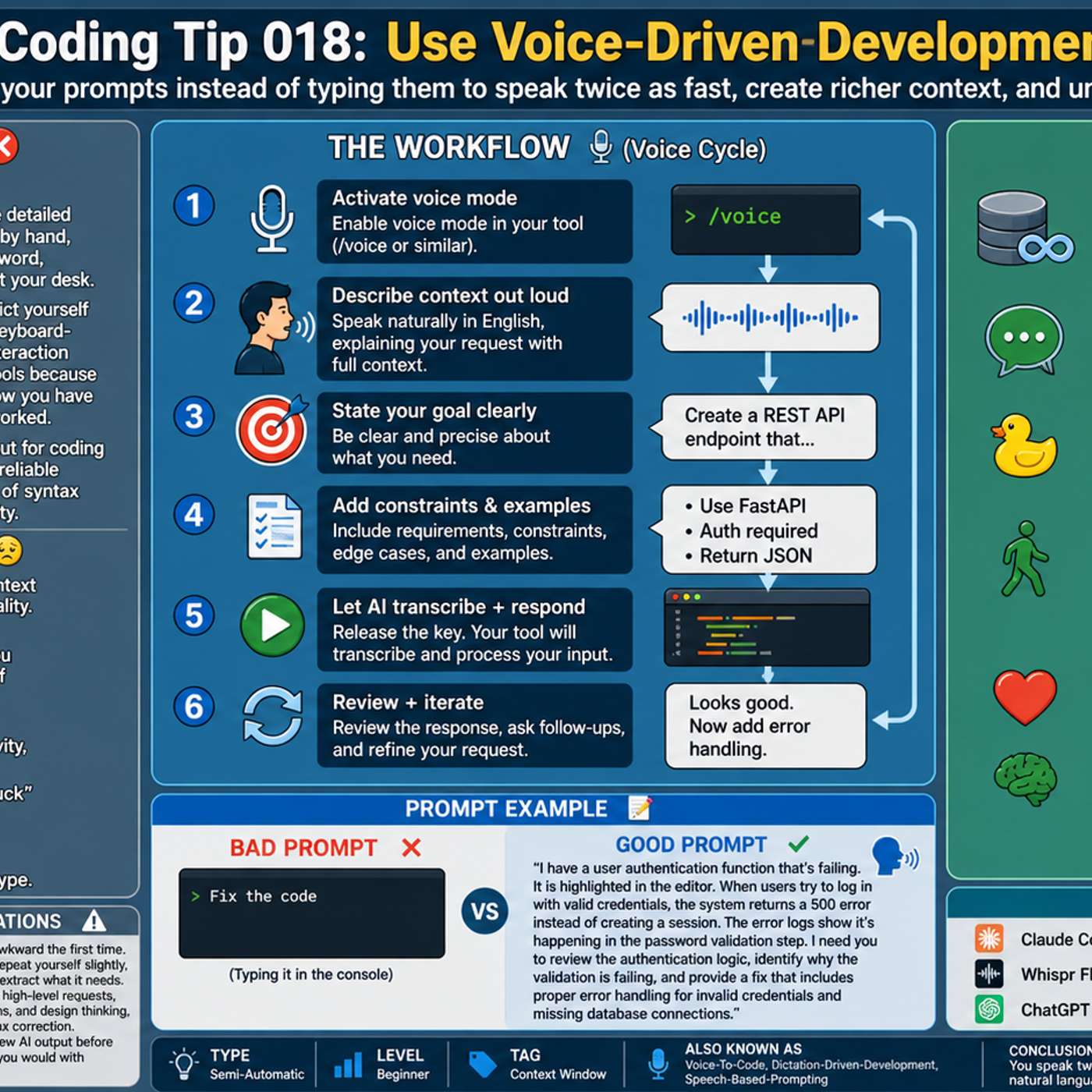
Dictating allows developers to remain in a "thinking mode" focused on the problem, rather than context-switching to the mechanical task of typing. This maintains uninterrupted mental focus on the problem, improving ideation and problem-solving.
While GUIs were built for humans, the terminal is more "empathetic to the machine." Coding agents are more effective using CLIs because it provides a direct, scriptable, and universal way to interact with a system's tools, leveraging vast amounts of pre-trained shell command data.
The lines between IDEs and terminals are blurring as both adopt features from the other. The future developer workbench will be a hybrid prioritizing a natural language prompting interface, relegating direct code editing to a secondary, fallback role.

True productivity comes from proactively removing all potential distractions, not from trying to resist them in the moment. This means turning off all desktop and phone notifications entirely. The power to focus is not about exercising willpower; it is about engineering an environment where willpower isn't needed.

Traditionally, engineers need long, uninterrupted blocks to achieve flow state. By managing context and generating code, AI helps engineers get into flow faster. This makes shorter, 45-minute work blocks viable and productive again, restructuring the ideal engineering workday.

When prototyping new AI-powered ideas, build them as command-line interface (CLI) tools instead of web apps. The constrained UI of the terminal forces you to focus on the core workflow and logic, preventing distraction from visual design and enabling faster shipping of a functional version.

The most effective way to improve focus is not to add new tools or 'hacks,' but to ruthlessly subtract distractions. By creating an environment with minimal stimuli, the intended task naturally becomes the most compelling thing, making work unavoidable. This is more effective than medication or willpower alone.

Contrary to the stereotype of advanced developers preferring the command line (CLI), the emerging "vibe coding" community is shifting towards Graphical User Interfaces (GUIs). Proponents argue tools like Conductor make orchestrating AI agents more effective and that the CLI is now the "Stone Age" for this new workflow.

Designing for a command-line interface (CLI) isn't about pixels. It's about defining the core user mental model, interaction primitives, and the "invisible thinking" that makes a product intuitive, even in a text-based environment.
The hosts correct a prior prediction, asserting that the terminal—not a specific IDE like Cursor—is the true emerging interface for modern work. It serves as the central hub for orchestrating various AI agents and MCPs (Multi-Claude Providers), making it the primary control panel for getting work done.
