Get your free personalized podcast brief
We scan new podcasts and send you the top 5 insights daily.
AlphaSeq re-engineers yeast mating so surface-displayed protein interactions drive cell fusion. Younger says bulk selection and next-generation sequencing read out pairwise affinities, letting one flask measure a million interactions instead of one well measuring a single interaction, avoiding traditional one-at-a-time protein purification and characterization.

Related Insights
The cost to generate the volume of protein affinity data from a single multi-week A-AlphaBio experiment using standard methods like surface plasmon resonance (SPR) would be an economically unfeasible $100-$500 million. This staggering cost difference illustrates the fundamental barrier that new high-throughput platforms are designed to overcome.
By labeling each cell with a unique DNA barcode, all clones can be grown together in a single, manufacturing-relevant bioreactor. This shifts the core challenge from laborious individual cell measurements to a high-throughput sequencing and data analysis task, dramatically increasing efficiency and data richness.
Because DNA encoded libraries are built combinatorially from building blocks, millions of molecules differ by only one or two changes. This structured variation enables machine learning models to isolate exactly which chemical fragments drive target binding while keeping the rest of the molecule constant.

To break the data bottleneck in AI protein engineering, companies now generate massive synthetic datasets. By creating novel "synthetic epitopes" and measuring their binding, they can produce thousands of validated positive and negative training examples in a single experiment, massively accelerating model development.
To build truly dynamic "virtual cells," two key technological hurdles must be overcome. First, developing high-throughput methods for measuring proteins, the cell's functional units. Second, inventing a sequencing technology that can measure the state of the *same cell* at multiple time points without destroying it.
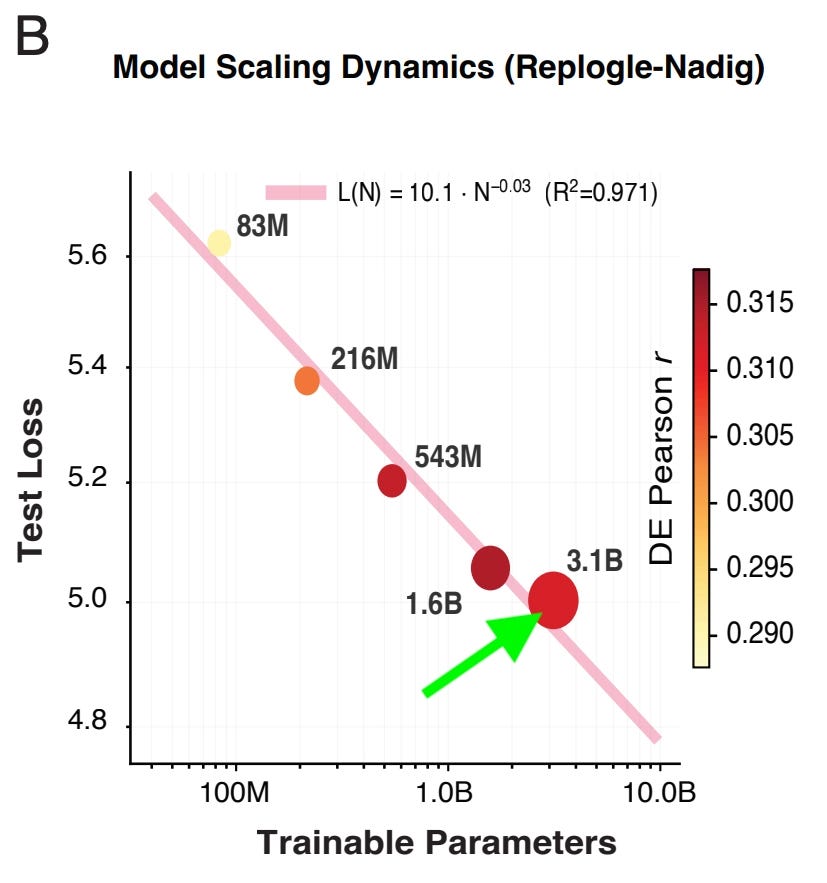
High-throughput biology uses techniques like PerturbSeq to run thousands of genetic perturbation experiments simultaneously in a single "pool" of cells. This method is highly scalable and, crucially, avoids the batch effects that plague traditional experiments, creating clean, uniform data essential for training large-scale AI models.
Traditional antibody optimization is a slow, iterative process of improving one property at a time, taking 1-3 years. By using high-throughput data to train machine learning models, companies like A-AlphaBio can now simultaneously optimize for multiple characteristics like affinity, stability, and developability in a single three-month process.
Instead of relying on gene co-expression data, a technique using cell permeabilization and proximity biotinylation can identify the specific cellular machinery physically interacting with and supporting a biologic's production. This reveals critical chaperones and support proteins needed for high titers, moving beyond correlation to causation.
The initial motivation for BindCraft wasn't just to design better proteins, but to avoid the laborious, low-yield process of yeast display screening. This personal frustration with an inefficient workflow drove the development of a computational tool that dramatically increased hit rates from 1-in-1000 to 7-in-10.

The company's core technology, AlphaSeq, uses engineered yeast mating as a proxy for protein binding. The rate of mating corresponds to the binding affinity of proteins on the cell surfaces. By sequencing the resulting cells, the company can count genetic barcodes to quantitatively measure millions of protein-protein interactions at once.