Get your free personalized podcast brief
We scan new podcasts and send you the top 5 insights daily.
At American Housing Corp, engineers who design components also manufacture them in the factory and assemble them in the field. This forces them to experience the "pain" of their design decisions firsthand, creating a rapid, visceral feedback loop that leads to faster and more effective product improvements.

Related Insights
While competitors analyze exhaustively before building, SpaceX invests upfront in prototypes to discover problems that analysis can't predict. This treats reality as the primary validation tool, using failures as data points to eliminate uncertainty through doing, not just planning.

A product manager's casual comment to an engineer about combining parts led to the engineer building a functional prototype overnight using existing components and a 3D printer. This tangible model quickly gained executive attention and became the basis for a formal project, bypassing typical ideation hurdles.

At Rainbird, engineers build the first 'production intent' units for field trials themselves, on the actual assembly line. This serves two critical functions: it produces the necessary test units and simultaneously allows the engineering team to validate and debug the manufacturing process before scaling up.
Instead of letting designers complete a holistic, end-to-end design, Dylan Field advises stopping them one-third of the way through. The team should then immediately build a prototype of that core component. Using this prototype reveals the 'physics' of the system, providing crucial learnings that will correctly guide the rest of the design.

Impulse Space accelerates development by being 'extremely vertically integrated.' Co-locating the machine shop, assembly areas, and a test area enables a tight 'build, assemble, test' loop, allowing the team to iterate on hardware designs with maximum speed.

AHC treated its first prototype house as a "sandbox," designing and building it one floor at a time. After assembling the first floor, they used the learnings to redesign the second, and again for the third. This sequential iteration within a single project dramatically accelerated process improvements, cutting assembly time by 70% from the first to third floor.
The conventional software feedback loop is 'can I sell it?' Palantir's forward deployed engineers use a stronger loop: 'did it deliver the outcome?' This requires embedding obsessive, technical problem-solvers on the factory floor or in the foxhole to continuously solve backward and generalize learnings into the product.
![Shyam Sankar - Celebrating Heretics - [Invest Like the Best, EP.462] thumbnail](https://megaphone.imgix.net/podcasts/9dee904c-1bbf-11f1-a1a6-0b200fdaa525/image/57910f03f82ede99259c53f5e5404f6a.jpg?ixlib=rails-4.3.1&max-w=3000&max-h=3000&fit=crop&auto=format,compress)
To drive a production-focused culture in R&D, implement a daily "shift pass-down" report. This manufacturing practice forces the team to document what they accomplished versus what they planned, and explain the deltas. It brings factory-floor accountability and rigor to the traditionally less structured R&D process.

Boom Supersonic accelerates development by manufacturing its own parts. This shrinks the iteration cycle for a component like a turbine blade from 6-9 months (via an external supplier) to just 24 hours. This rapid feedback loop liberates engineers from "analysis paralysis" and allows them to move faster.

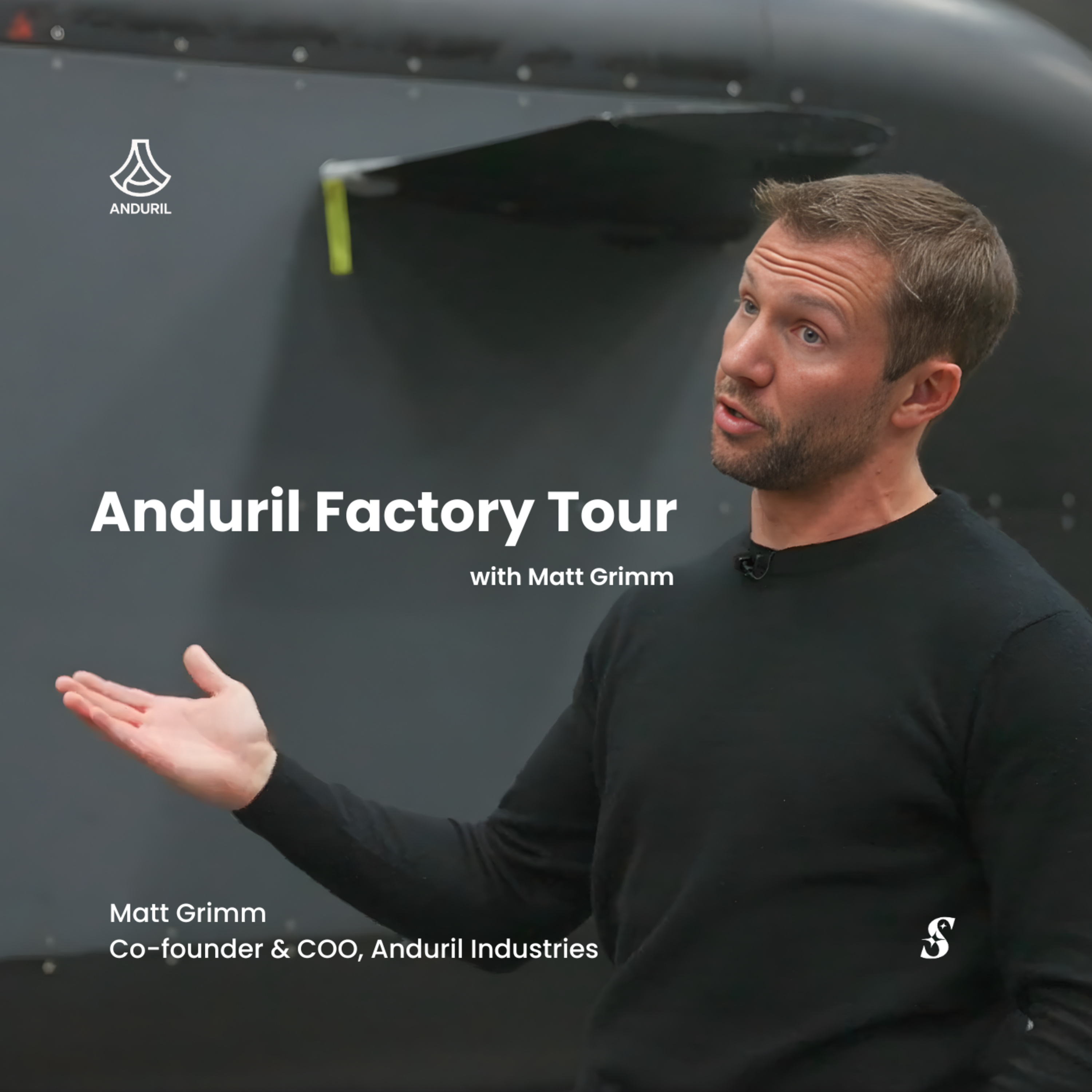
Anduril's R&D building houses machine shops, labs, and a 'dev test area' designed specifically to break products. By putting engineers across the parking lot from facilities that can rapidly prototype and test for failures (e.g., saltwater corrosion, vibration), they create an extremely tight feedback loop, speeding up iteration.