Get your free personalized podcast brief
We scan new podcasts and send you the top 5 insights daily.
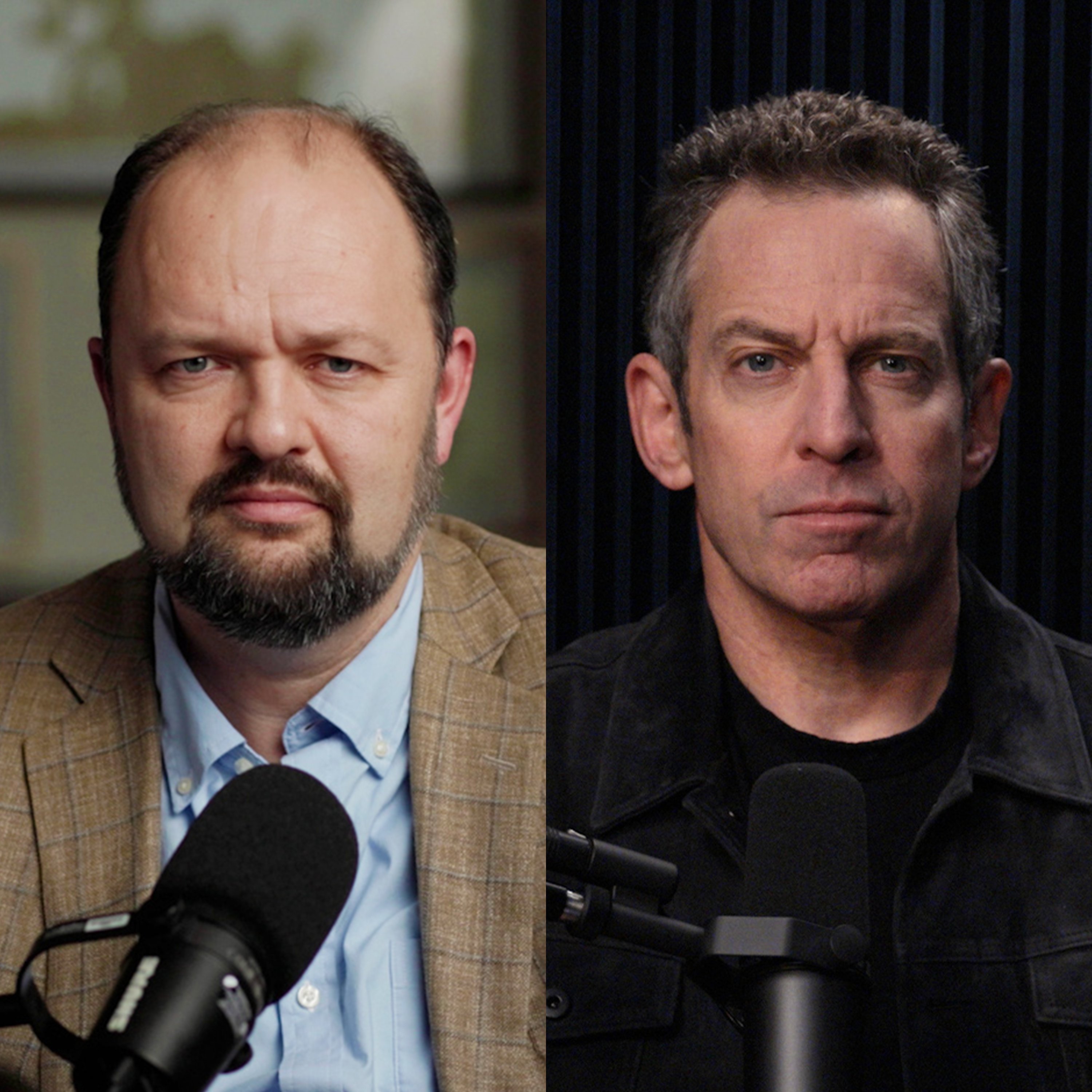
Alex O'Connor uses a sentient paperclip-making AI to demonstrate that having an explicitly assigned function from a creator does not satisfy the human demand for purpose. Divine assignment either risks utter arbitrariness or implies an external, pre-existing standard of value that the creator must adhere to.

Related Insights
The transcript analogizes AI to cosmological models. A self-contained AI, like the Hartle-Hawking 'no boundary' universe model, is a perfect but directionless system. It requires an external human observer to collapse its possibilities into a single, meaningful reality, just as quantum mechanics requires an observer.

Widespread anxiety about AI is not just about job displacement but a deeper 'crisis of agency.' It forces a philosophical question at a societal level: If machines can perform our creative and intellectual tasks, what is the fundamental purpose of a human being?

The Pope’s critique of AI is a sophisticated argument against elevating efficiency to a divine status. Using the 'Tower of Babel' metaphor, he warns that optimizing for perfection inadvertently devalues the beautifully imperfect, divine spark within every human.

Sam Harris highlights a key paradox: even if AI achieves its utopian potential by eliminating drudgery without catastrophic downsides, it could still destroy human purpose, solidarity, and culture. The absence of necessary struggle could make life harder, not easier, for most people to live.
Jeff Wu of AntiFund posits that humans, like AI, lack true consciousness and free will, operating instead as biological automatons. However, he concludes that believing in free will is essential. To avoid nihilism, we should act as if we can shape our destiny, even if it's predetermined.

In a future with advanced AI, neurotechnology could trivially induce feelings of motivation and drive. However, it cannot solve the deeper human need for objective purpose—the knowledge that one's efforts are genuinely necessary and impactful.

The evolution analogy posits that humans, created by natural selection to maximize genetic fitness, developed goals like pleasure and now use technology (birth control) that subverts the original objective. This suggests AI will similarly subvert human intentions, serving as a powerful case study in misalignment.

Sam Harris cautions against reducing morality to its Darwinian origins. Using the example of a hypothetical conscious AI, he argues we could create immense suffering in a system that never evolved. This shows that well-being and suffering are substrate-independent concepts that can exist outside of any evolutionary purpose.

AI is separating computation (the 'how') from consciousness (the 'why'). In a future of material and intellectual abundance, human purpose shifts away from productive labor towards activities AI cannot replicate: exploring beauty, justice, community, and creating shared meaning—the domain of consciousness.

Alex O'Connor highlights a thought experiment where impending extinction shortly after one's death undermines long-term pursuits like authoring books or raising children. While basic sensory activities like eating and sleeping continue, meaning-infused actions rely heavily on contributing to something that outlasts mortal life.