Get your free personalized podcast brief
We scan new podcasts and send you the top 5 insights daily.
We often focus solely on model improvements. Steve Newman argues this is too narrow. True impact is a multiplicative function of eight factors: pre-training, post-training, inference compute, agent scaffolding, app design, user aptitude, workflow refactoring, and adoption. All are advancing simultaneously, creating a blistering pace of change.

Related Insights
For vertical AI applications, foundation models are now sufficiently intelligent. The primary challenge is no longer model capability but building the surrounding software infrastructure—tools, UIs, and workflows—that lets models perform useful work reliably and trustworthily.

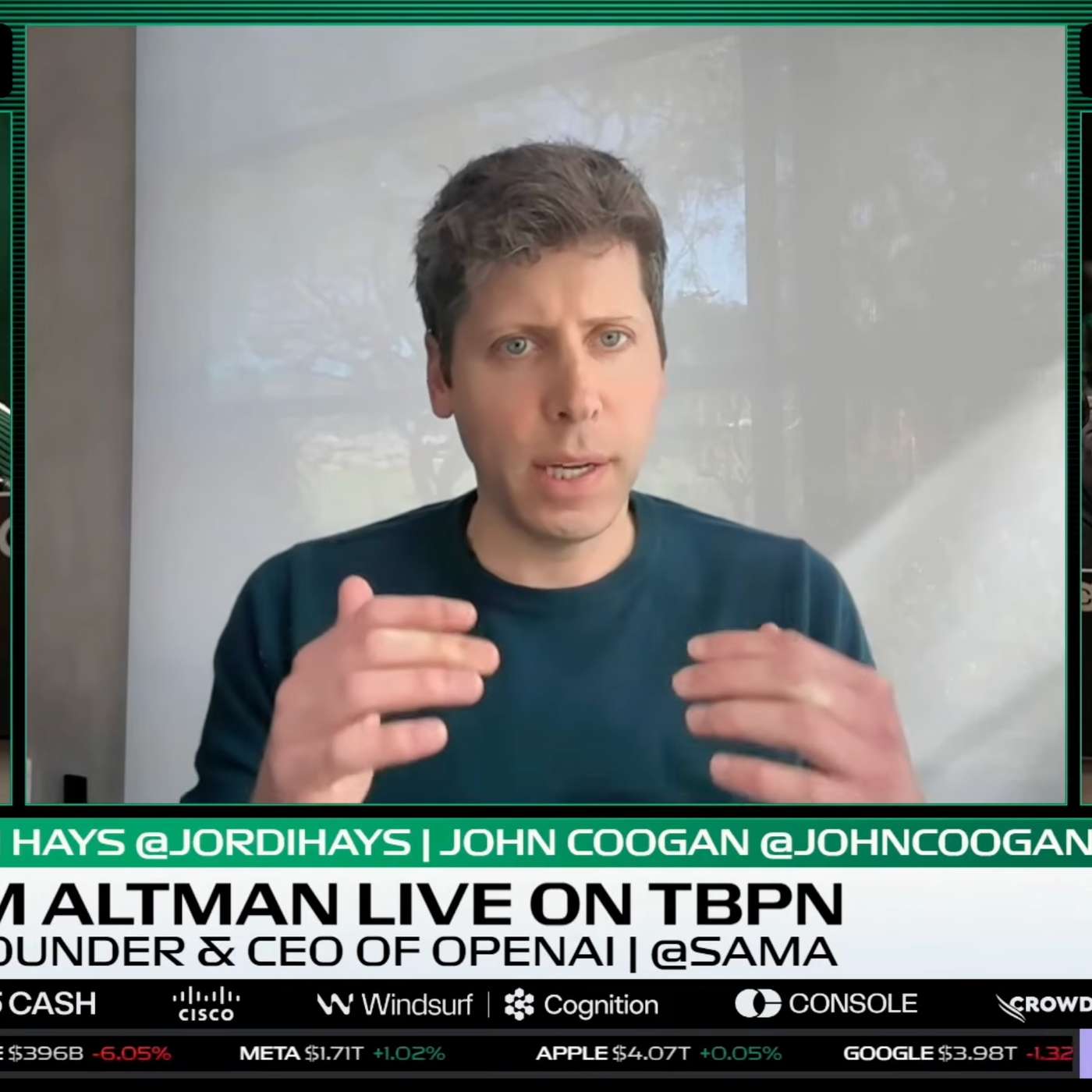
Sam Altman suggests that as AI models create enormous economic value, proxy metrics like task completion benchmarks will become obsolete. The most meaningful chart will be the model's direct impact on GDP. This signals a fundamental shift from the research phase of AI to an era of broad economic transformation.

Sam Altman argues there is a massive "capability overhang" where models are far more powerful than current tools allow users to leverage. He believes the biggest gains will come from improving user interfaces and workflows, not just from increasing raw AI intelligence.
The historical adoption of electricity in factories shows that true productivity gains came from redesigning the factory floor, not simply replacing steam engines. Similarly, companies must fundamentally re-engineer processes around AI to unlock its transformative potential.

Obsessing over linear model benchmarks is becoming obsolete, akin to comparing dial-up speeds. The real value and locus of competition is moving to the "agentic layer." Future performance will be measured by the ability to orchestrate tools, memory, and sub-agents to create complex outcomes, not just generate high-quality token responses.

As foundational AI models become commoditized, the key differentiator is shifting from marginal improvements in model capability to superior user experience and productization. Companies that focus on polish, ease of use, and thoughtful integration will win, making product managers the new heroes of the AI race.

Despite the hype, AI's impact on daily life remains minimal because most consumer apps haven't changed. The true societal shift will occur when new, AI-native applications are built from the ground up, much like the iPhone enabled a new class of apps, rather than just bolting AI features onto old frameworks.
A major drag on AI's impact is the "capability gap"—the chasm between what AI can do and what people know it can do. AI companies are now shifting from simply improving models to actively educating the market by releasing tool suites that demonstrate specific, practical applications to accelerate adoption by closing this awareness gap.

Just as electricity's impact was muted until factory floors were redesigned, AI's productivity gains will be modest if we only use it to replace old tools (e.g., as a better Google). Significant economic impact will only occur when companies fundamentally restructure their operations and workflows to leverage AI's unique capabilities.

The most profound near-term shift from AI won't be a single killer app, but rather constant, low-level cognitive support running in the background. Having an AI provide a 'second opinion for everything,' from reviewing contracts to planning social events, will allow people to move faster and with more confidence.