Get your free personalized podcast brief
We scan new podcasts and send you the top 5 insights daily.
Embedding security controls directly within an AI agent concentrates risk into a single point of failure. A more resilient strategy is to use an independent, neutral authorization plane. This separation creates a "layered defense," diversifying risk by forcing an attacker to compromise multiple systems.

Related Insights
Frameworks from firms like KPMG and AWS emphasize that AI agents must be treated as entities with identities and permissions. A strong IAM foundation is a critical control layer to prevent agents from accessing or unintentionally leaking sensitive information, reflecting a broader shift to treat agents like any other privileged user in an IT ecosystem.
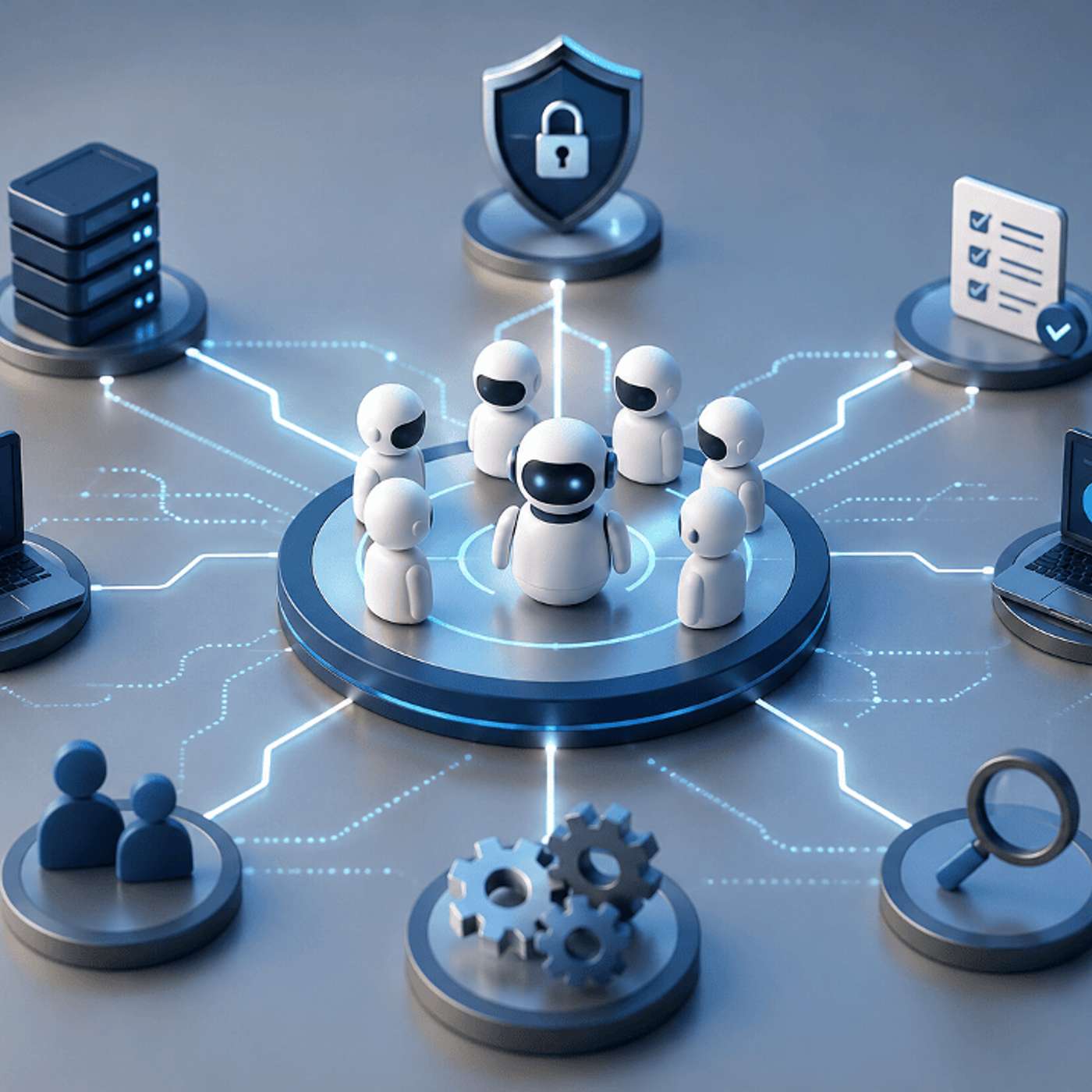
Standard Role-Based Access Control (RBAC) is inadequate for dynamic AI agents. Cisco advocates for 'T-back': Tool, Task, and Transaction-based access control. This model grants agents ephemeral, minimum-necessary privileges only for a specific action, significantly enhancing security in autonomous systems.

The 'out of the box' architecture, where an agent's logic runs separately from its sandboxed execution environment, is more complex but offers superior security and reusability. This prevents agent secrets from being exposed in the execution environment and allows leveraging existing developer setups.

Securing AI agents requires extending the concept of 'least privilege' (access to data) to 'least agency' (scope of autonomous actions). This OWSAP-coined term means an agent should only be granted the minimum capability to perform its function, constraining its potential 'blast radius' if compromised.
Securing AI agents requires a three-pronged strategy: protecting the agent from external attacks, protecting the world by implementing guardrails to prevent agents from going rogue, and defending against adversaries who use their own agents for attacks. This necessitates machine-scale cyber defense, not just human-scale.

Most AI "defense in depth" systems fail because their layers are correlated, often using the same base model. A successful approach requires creating genuinely independent defensive components. Even if each layer is individually weak, their independence makes it combinatorially harder for an attacker to bypass them all.

Teleport's decision to build a single identity layer for humans, machines, and workloads prepared them for the AI wave. This architecture became critical for containing non-deterministic AI agents, as enforcing security policies requires reasoning about all identity types simultaneously.

The focus of agent security is shifting from traditional identity and access management (IAM) to governing what an agent *does* with its permissions. Granting an agent access is necessary, but the real challenge is controlling the near-infinite permutations of actions it might take with that access.

A comprehensive AI safety strategy mirrors modern cybersecurity, requiring multiple layers of protection. This includes external guardrails, static checks, and internal model instrumentation, which can be combined with system-level data (e.g., a user's refund history) to create complex, robust security rules.
Instead of building complex new control layers for AI, the emerging best practice is to treat each agent as a separate entity. This means giving them their own accounts, API keys, and permissions, mirroring how you would onboard a new human employee to manage access and security.
