Get your free personalized podcast brief
We scan new podcasts and send you the top 5 insights daily.
The software layer that manages an LLM's context, actions, and outputs—termed the 'harness'—is becoming the standard architecture for AI apps, akin to the LAMP stack for web development. While the framework is consistent, its specific implementation will vary significantly across different business domains, creating opportunities for specialized value.

Related Insights
The reason diverse tech products from Linear to Notion are building similar AI agent capabilities is the emergence of a "general harness" architecture. This common pattern—a loop of context engineering, model calls, and tool usage—is a general-purpose framework for solving problems, leading to a convergence of product features across different domains.

Simply offering the latest model is no longer a competitive advantage. True value is created in the system built around the model—the system prompts, tools, and overall scaffolding. This 'harness' is what optimizes a model's performance for specific tasks and delivers a superior user experience.

An AI coding agent's performance is driven more by its "harness"—the system for prompting, tool access, and context management—than the underlying foundation model. This orchestration layer is where products create their unique value and where the most critical engineering work lies.

Early agent development used simple frameworks ("scaffolds") to structure model interactions. As LLMs grew more capable, the industry moved to "harnesses"—more opinionated, "batteries-included" systems that provide default tools (like planning and file systems) and handle complex tasks like context compaction automatically.
Performance comes from a "harness" surrounding the AI model, which includes curated data, tools, and rich context. This harness, which can be open and multi-model, is where the hard work lies—prepping the context layer so that a model's plan can execute efficiently.
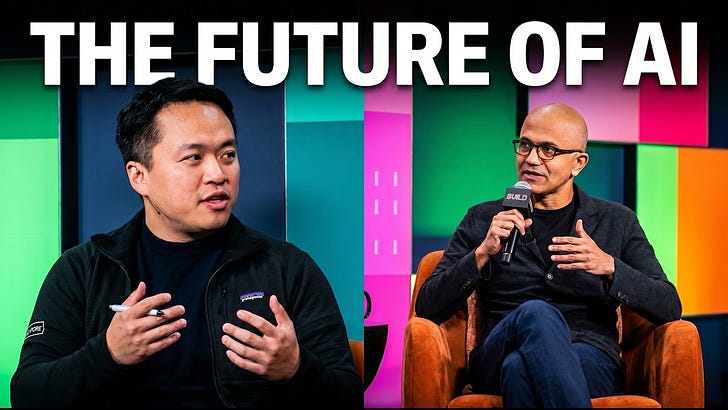
Nadella introduces the 'harness'—the integrated system of data, tools, and context preparation surrounding a model. He posits this harness, which enables multi-model strategies and efficient execution, is where companies create unique value, rather than in the base model alone.

The competitive edge in AI tools is moving beyond access to powerful LLMs. The real value now lies in creating a specialized "harness" or framework—an "Ironman suit" for the model—that enables it to perform narrow, high-value tasks with precision and industry-specific nuance.

Top-tier language models are becoming commoditized in their excellence. The real differentiator in agent performance is now the 'harness'—the specific context, tools, and skills you provide. A minimalist, well-crafted harness on a good model will outperform a bloated setup on a great one.

The planned Superapp combining coding, browsing, and chat is more than a UI consolidation. The deeper, more critical goal is to merge multiple backend systems into a single, unified 'AI harness' that manages context, actions, and interaction loops. This creates a powerful, efficient AI layer for various applications.

Raw AI models are not useful on their own. A critical new software layer, dubbed a 'harness,' has emerged to make them effective. These harnesses (like OpenClaw or Codex) provide the structure for models to think in patterns and accomplish complex tasks, acting like an operating system for AI.
