Get your free personalized podcast brief
We scan new podcasts and send you the top 5 insights daily.
Linear's data reveals that non-engineering roles, particularly PMs, show the largest increase in using agentic AI features. AI empowers them to independently perform tasks like data analysis or competitive research that they previously had to delegate, increasing their autonomy and speed.

Related Insights
AI agents will automate PM tasks like competitive analysis, user feedback synthesis, and PRD writing. This efficiency gain could shift the standard PM-to-developer ratio from 1:6-10 to 1:20-30, allowing PMs to cover a much broader product surface area and focus on higher-level strategy.
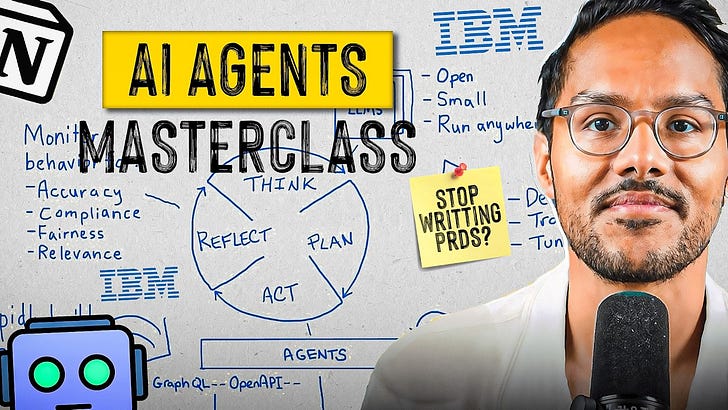
AI automates tactical tasks, shifting the PM's role from process management to de-risking delivery by developing deep customer insights. This allows PMs to spend more time confirming their instincts about customer needs, which engineering teams now demand.

Product managers can use coding agents like Codex for self-service technical discovery. Instead of interrupting engineers with questions, they can ask the AI about the codebase, feature status, or implementation details, increasing their autonomy and team efficiency.

The primary beneficiaries of AI prototyping are not developers, but Product Managers. These tools give PMs a 'get-out-of-no-developers' card, allowing them to independently create functional prototypes for user testing and ideation without waiting for engineering resources.

AI's rapid capability growth makes top-down product specs obsolete. Product Managers now work bottoms-up with engineers, prototyping and even checking in code using AI tools. This blurs traditional roles, shifting the PM's focus to defining high-level customer needs and evaluating outcomes rather than prescribing features.
![Gokul Rajaram - Lessons from Investing in 700 Companies - [Invest Like the Best, EP.456] thumbnail](https://megaphone.imgix.net/podcasts/a35cb364-fc94-11f0-a24d-836fa963ece3/image/f64963c59af651cbb2d022f3a0dd7199.jpg?ixlib=rails-4.3.1&max-w=3000&max-h=3000&fit=crop&auto=format,compress)
AI won't replace product managers but will elevate their role. PMs will shift from executing tasks like financial forecasting to managing a team of specialized AI agents, forcing them to focus on high-level strategy and assumption-checking.

The PM role is shifting to that of a 'product builder.' Instead of manually sifting through data, they can use AI agents to scrape sources like Gong, Slack, and Intercom. This provides an aggregated 'voice of the customer' and a data-backed strategy in minutes, not weeks.

AI's value for PMs is augmentation, not replacement. By automating tactical tasks that consume most of a PM's day (e.g., "six out of eight hours"), AI frees up critical capacity for higher-level strategic, creative, and innovative work—the core functions of a product leader.

The rise of AI tools isn't replacing the PM role, but transforming it. PMs who embrace an "AI-enhanced" workflow for research, docs, and prototyping will gain a massive productivity advantage, ultimately displacing those who stick to traditional methods.
The PM role will expand beyond leveraging off-the-shelf AI. They will be responsible for creating and training specialized AI agents. This involves instilling agents with deep, company-specific knowledge of business models, customers, and strategy, just as they would onboard a new human team member.
