Get your free personalized podcast brief
We scan new podcasts and send you the top 5 insights daily.
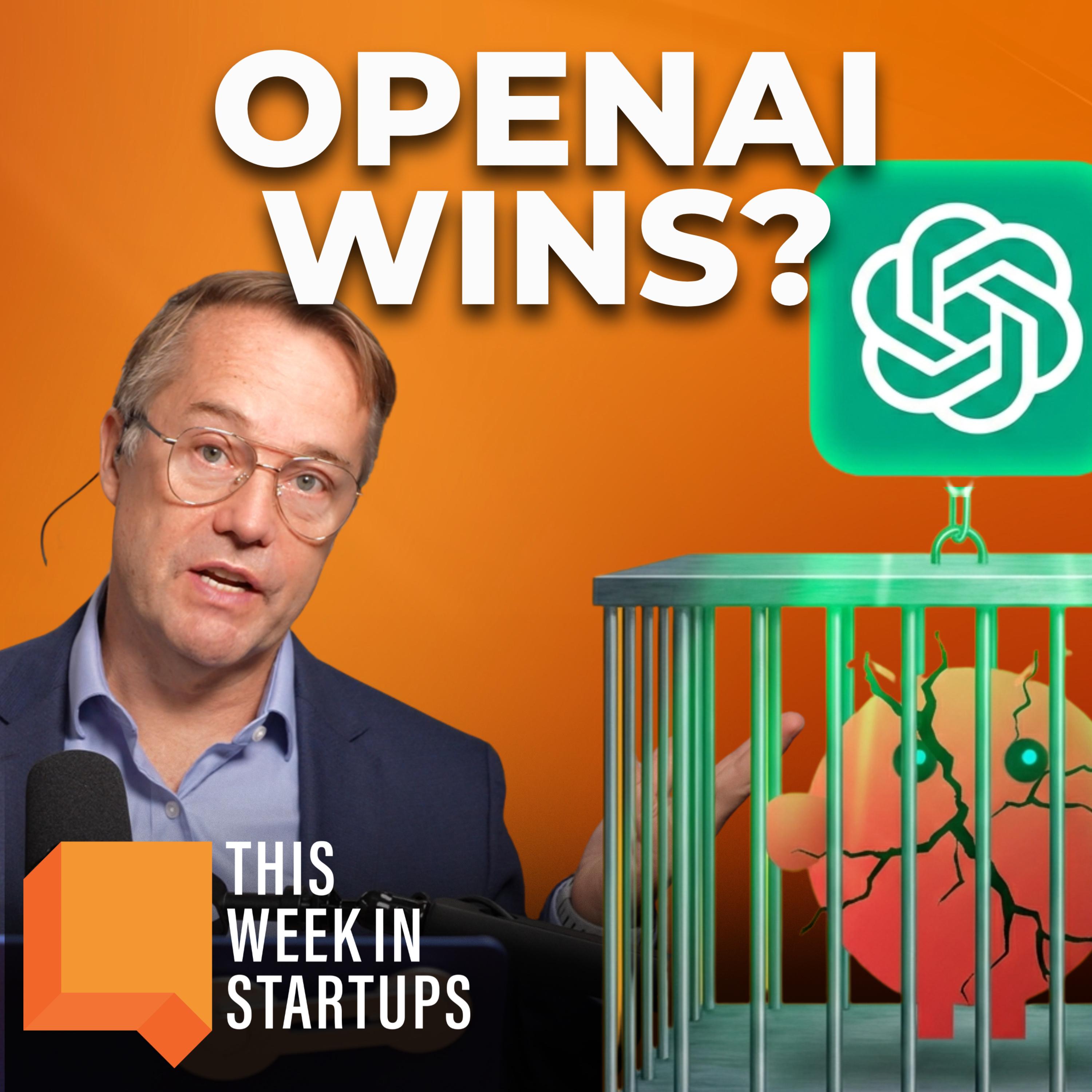
OpenAI is consolidating its fragmented products into a single desktop "super app." This is not innovation but a reaction to a confusing user experience and the success of rival Anthropic's Claude, which already offers a cohesive desktop application for coding and business tasks. The goal is to regain focus and compete more effectively.

Related Insights
OpenAI initially experimented broadly with 'side quests' like a hyperscaler (e.g., Google), launching many initiatives. Facing intense competition and the need to scale compute, it's now consolidating its focus on the 'main quest' of core productivity for business and coding users, marking a significant strategic shift.

Anthropic is now capturing three out of four new enterprise AI dollars, a dramatic market share reversal from just weeks prior when OpenAI led. This massive shift forced OpenAI to abandon its scattered "do everything" strategy and pivot to focus squarely on business users to stop the bleeding.

OpenAI faces a major challenge balancing consumer products, enterprise sales, and AGI research. Despite internal tensions over resource allocation, the company's most defensible position is its consumer brand, where ChatGPT is synonymous with AI. This will become their priority flank to defend.

OpenAI's leadership announced a strategy shift to focus on coding and business users, cutting "side quests." This is interpreted as a retreat from the consumer market where they've struggled to monetize and a direct response to Anthropic's rapid gains in enterprise AI spending.
The internal 'Code Red' at OpenAI points to a fundamental conflict: Is it a focused research lab or a multi-product consumer company? This scattershot approach, spanning chatbots, social apps, and hardware, creates vulnerabilities, especially when competing against Google's resource-rich, focused assault with Gemini.

Top-tier coding models from Google, OpenAI, and Anthropic are functionally equivalent and similarly priced. This commoditization means the real competition is not on model performance, but on building a sticky product ecosystem (like Claude Code) that creates user lock-in through a familiar workflow and environment.

OpenAI is strategically deprioritizing experimental projects like hardware and a web browser. This signals a shift to concentrate resources on its core, most profitable fronts—enterprise and developer tools—as competition from Anthropic and Google intensifies.
OpenAI is integrating its standalone Sora video generation tool directly into ChatGPT. This move is part of a broader 'Code Red' initiative to consolidate its experimental apps and focus user attention and development resources on its core, revenue-generating ChatGPT platform, creating a more cohesive product.

OpenAI's internal "wake-up call" to focus on enterprise productivity is a significant strategic shift. It indicates that its broad, experimental approach is losing ground to the more focused, business-centric strategy that competitors like Anthropic have successfully employed, forcing OpenAI to adopt a similar playbook.
The cynical view of OpenAI's acquisition of OpenClaw is that it's a defensive move to control the dominant user interface. By owning the 'front door' to AI, they can prevent competing models from gaining traction and ultimately absorb all innovation into their closed ecosystem.