Get your free personalized podcast brief
We scan new podcasts and send you the top 5 insights daily.
Microsoft altered its data center lease accounting from a 15-year to a 25-year lifespan. This shifted expenses from the heavily scrutinized CapEx line to OpEx, allowing them to continue massive AI investment while appearing more disciplined to Wall Street. It highlights how financial reporting is now a tool to manage market perception in the AI arms race.

Related Insights
Big tech companies are accounting for AI data centers over a 25-year lifespan. However, the core components, like GPUs, have a much shorter 2-3 year innovation cycle. This discrepancy creates a significant financial risk, as companies could be left with billions in overvalued, obsolete assets on their books.
Traditional accounting metrics misrepresent the financial health of AI companies. Their largest expenditure, acquiring compute power, should be viewed as an investment in a valuable, appreciating asset, not as a typical operating expense. This reframes the narrative around their massive cash burn.

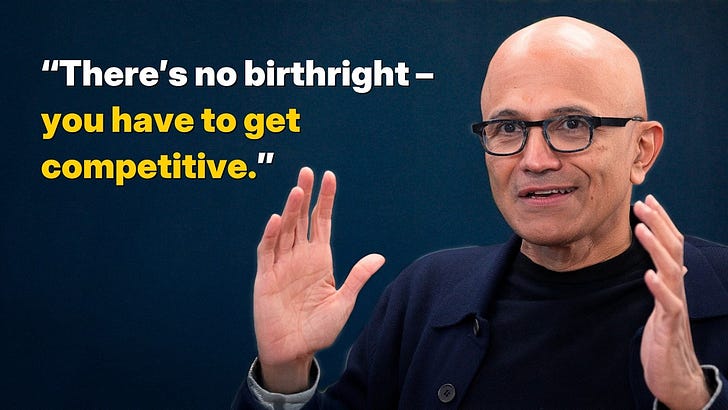
To navigate the massive capital requirements of AI, Nadella reframes the investment in cutting-edge training infrastructure. Instead of being purely reactive to customer demand, a significant portion is considered R&D, allowing for sustained, order-of-magnitude scaling necessary for breakthroughs.
The end of subsidized AI pricing is forcing companies to confront its true operational expense. As AI bills begin to rival payroll, a fundamental transition is occurring where capital expenditure on silicon (CapEx) is displacing operational expenditure on human neurons (OpEx), reshaping corporate budgets.

Hyperscalers are extending depreciation schedules for AI hardware. While this may look like "cooking the books" to inflate earnings, it's justified by the reality that even 7-8 year old TPUs and GPUs are still running at 100% utilization for less complex AI tasks, making them valuable for longer and validating the accounting change.

The market no longer rewards companies for just announcing massive AI spending. Each tech giant—Google, Microsoft, Amazon, and Meta—is now judged on its unique AI narrative and its ability to connect CapEx directly to near-term revenue, whether through enterprise adoption, cloud infrastructure, or ad performance.

Historically, tech giants spent ~20% of operating cash flow on CapEx. The AI buildout has pushed this to ~100%, fundamentally transforming their financial models. This move from capital-light to capital-intensive means future growth requires external funding, a major shift.

To appear more financially viable, major AI companies are accused of booking their GPUs with a 5-6 year lifespan, despite experts claiming the real functional obsolescence is 2-3 years. This accounting maneuver intentionally hides massive losses and inflates valuations ahead of IPOs.

Meta uses subcontractors like CoreWeave to build out AI compute capacity without the full capital expenditure hitting its own balance sheet. This financial maneuver allows Meta to compete with the infrastructure scale of giants like Microsoft and Google while presenting a more palatable spending figure to investors, effectively managing market perception.

Microsoft's staggering $625 billion in Remaining Performance Obligations (RPO), largely from long-term compute contracts, serves as a key financial justification for its heavy AI CapEx. This metric shows that it's not just Microsoft forecasting growth, but the entire industry committing to future compute needs.
