Get your free personalized podcast brief
We scan new podcasts and send you the top 5 insights daily.
In a 2,000-team Kaggle challenge using a 4-billion interaction dataset, models performed adequately when test molecules shared building blocks or core hubs with the training set. However, when evaluated against completely orthogonal chemical libraries with distinct chemistry, no model beat random chance.

Related Insights
Modeling small molecules might seem easier than large proteins, but the chemical search space for drug-like small molecules is astronomical (10^60). This vastness makes finding a correct binding match computationally far more complex than for more specific protein-protein interactions.

Public datasets primarily show successful protein interactions, starving AI models of crucial "negative data"—plausible but incorrect interactions. A-Alpha Bio finds that providing this data on what fails is just as important for training predictive and generalizable models.

Models trained on public repositories like ChEMBL achieve high accuracy merely by predicting the creator of a molecule from its structure rather than learning chemical physics. Replacing molecular formulas with a vector indicating the probability of the chemist author yields identical predictive performance on target activity.
Because DNA encoded libraries are built combinatorially from building blocks, millions of molecules differ by only one or two changes. This structured variation enables machine learning models to isolate exactly which chemical fragments drive target binding while keeping the rest of the molecule constant.
Sorting public dataset molecules by molecular weight alone matches top machine learning models in binding prediction. This correlation arises purely from chemist behavior: as a starting molecule shows activity, chemists iteratively tack on functional groups to optimize affinity and solubility, inflating the size of active compounds.
Public scientific corpora reflect survival bias by publishing only successful experiments. Enterprise lab platforms containing internal 'failed' trial data can train domain retrieval models that beat broad foundation models by orders of magnitude.

While LLMs possess vast 'Wikipedia-level' chemical knowledge, they struggle with specific, constrained tasks that expert chemists find trivial, such as designing a molecule with an exact number of atoms. This highlights a critical gap between general knowledge and applied, creative design in AI.
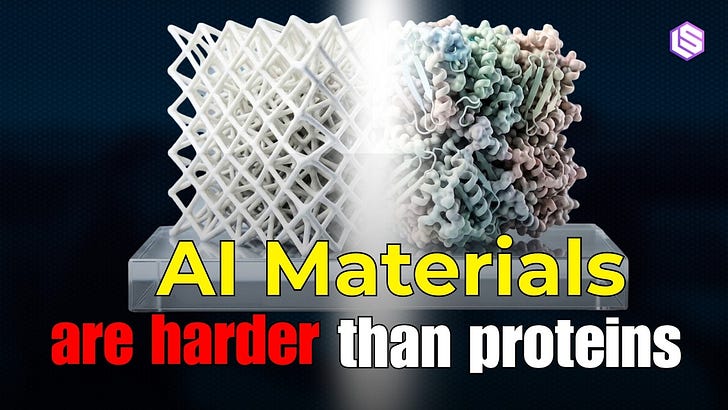
The bottleneck for AI in drug development isn't the sophistication of the models but the absence of large-scale, high-quality biological data sets. Without comprehensive data on how drugs interact within complex human systems, even the best AI models cannot make accurate predictions.

Unlike fields with vast training data like image recognition, effective drug discovery has too few successful examples for AI to learn from alone. To be useful, AI models must be explicitly taught the foundational principles and complex rules of medicinal chemistry that human experts use.

AI thrives on learning from the vast, structured data evolution provides for proteins. Molly Gibson explains that small molecules lack this clear "language" or evolutionary history. This fundamental data gap is a primary reason generative AI has been slower to transform small molecule drug discovery compared to biologics.