Get your free personalized podcast brief
We scan new podcasts and send you the top 5 insights daily.
Long training cycles mean too many variables change between models, making it impossible to attribute improvements. By training smaller models end-to-end more frequently (e.g., in weeks, not months), research teams can better understand which specific "ingredients" led to better outcomes, enabling a more scientific process.

Related Insights
LoRa training focuses computational resources on a small set of additional parameters instead of retraining the entire 6B parameter z-image model. This cost-effective approach allows smaller businesses and individual creators to develop highly specialized AI models without needing massive infrastructure.

The primary driver of success in large-scale model training is the ability to conduct numerous experiments daily. A robust infrastructure that minimizes cycle time for testing hypotheses provides a greater advantage than focusing solely on developing new algorithms.

AI labs like Anthropic find that mid-tier models can be trained with reinforcement learning to outperform their largest, most expensive models in just a few months, accelerating the pace of capability improvements.
While early AI development requires constant testing of new models, Conative.ai found they eventually reached a stable architecture. The focus then shifted from wholesale model replacement to fine-tuning existing layers with specific data, reducing the pressure to chase every new innovation.

The true cost of fine-tuning isn't the initial training but the ongoing maintenance. Base foundation models experience significant capability improvements every 2-3 months. This pace means a custom fine-tuned model can quickly fall behind, forcing a continuous and expensive re-tuning cycle.

For low-latency applications, start with a small model to rapidly iterate on data quality. Then, use a large, high-quality model for optimal tuning with the cleaned data. Finally, distill the capabilities of this large, specialized model back into a small, fast model for production deployment.

When scaling AI-driven experiments, the key metric is not raw throughput but iteration time. Rapid, sequential learning cycles, even on a smaller scale, compound knowledge more effectively for the AI model than large, slow, and noisy multiplexed experiments.
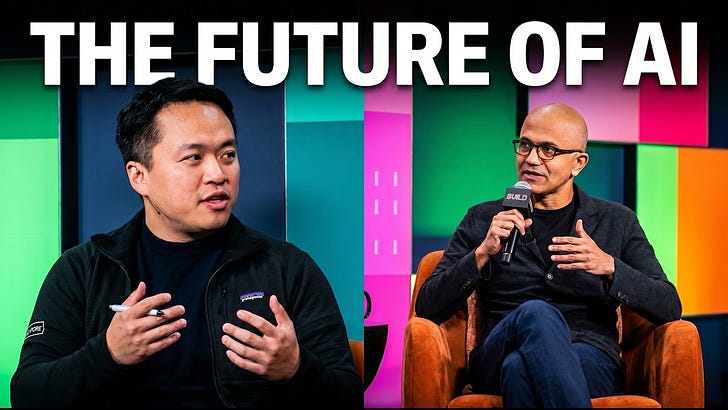
Nadella describes a new frontier strategy: using a large, generalist model to generate initial traces for a specific task. These high-quality traces are then used to fine-tune a much smaller, specialized model, allowing it to achieve superior performance on that single task.
Mature AI applications are not static calls to a single large model. They are complex systems of many models that require a continuous "AI loop": tracing performance, identifying areas for improvement (cost, speed, accuracy), and constantly iterating by swapping models, fine-tuning, or refining prompts.
Instead of running hundreds of brute-force experiments, machine learning models analyze historical data to predict which parameter combinations will succeed. This allows teams to focus on a few dozen targeted experiments to achieve the same process confidence, compressing months of work into weeks.
