Get your free personalized podcast brief
We scan new podcasts and send you the top 5 insights daily.
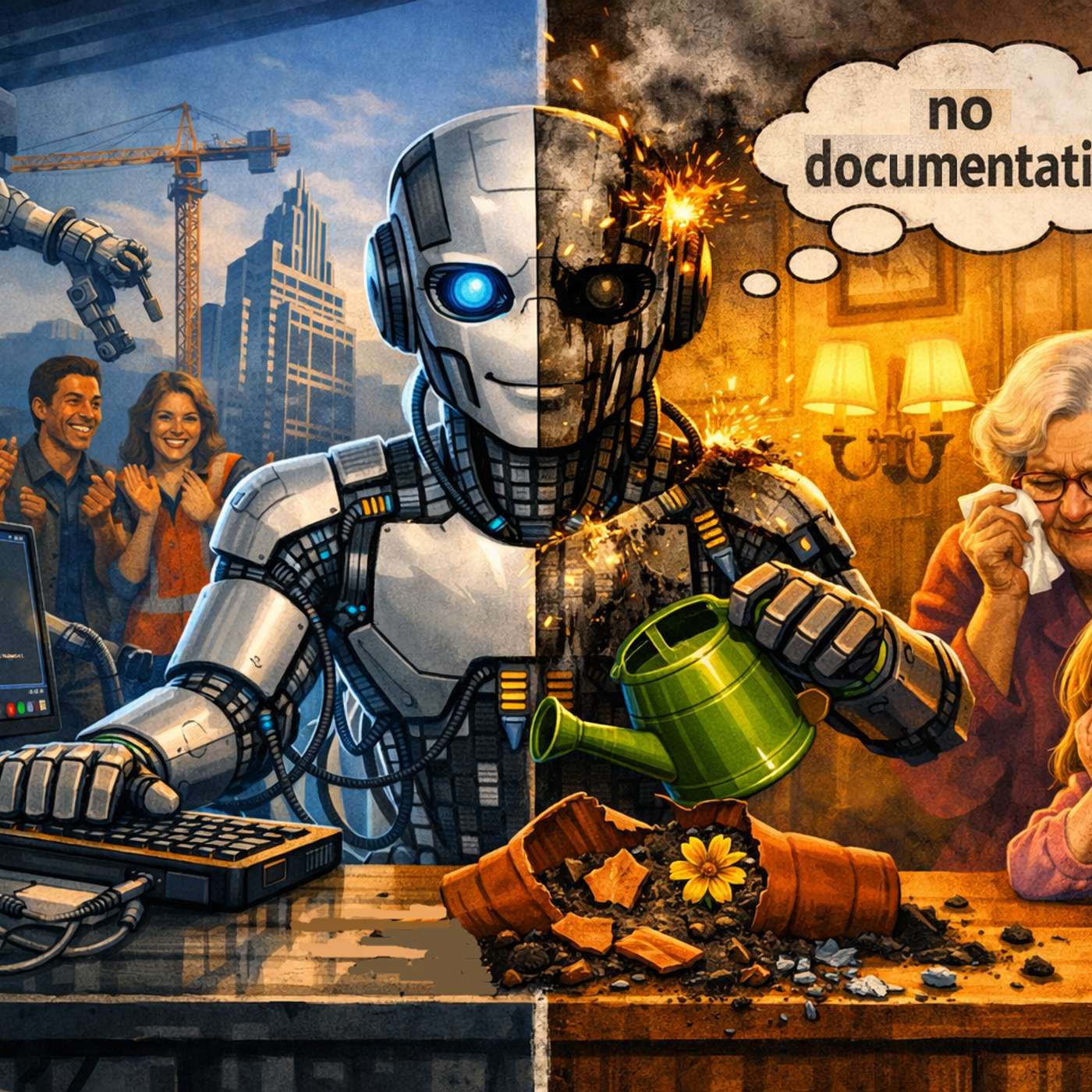
Contrary to human intuition, a massive, well-documented domain makes an AI's job easier, not harder. More documentation provides more 'maps' for the AI to navigate. In contrast, a simple human conflict is unsolvable for an AI because its context isn't formalized or archived, creating a void of information.
Related Insights
Warp's founder argues that as AI masters the mechanics of coding, the primary limiting factor will become our own inability to articulate complex, unambiguous instructions. The shift from precise code to ambiguous natural language reintroduces a fundamental communication challenge for humans to solve.

Today's AI boom is fueled by scaling computation, which is a known engineering challenge. The alternative, embedding nuanced, human-like inductive biases, is far harder as it requires a deep understanding of the problem space. This difficulty gap explains why massive models dominate AI development over more targeted, efficient ones—scaling is simply the more straightforward path.

AI coding assistants rapidly conduct complex technical research that would take a human engineer hours. They can synthesize information from disparate sources like GitHub issues, two-year-old developer forum posts, and source code to find solutions to obscure problems in minutes.

The "bitter lesson" in AI research posits that methods leveraging massive computation scale better and ultimately win out over approaches that rely on human-designed domain knowledge or clever shortcuts, favoring scale over ingenuity.

Unlike coding, where context is centralized (IDE, repo) and output is testable, general knowledge work is scattered across apps. AI struggles to synthesize this fragmented context, and it's hard to objectively verify the quality of its output (e.g., a strategy memo), limiting agent effectiveness.

AI thrives in domains with fixed, written rules and searchable histories, like programming. In ambiguous areas like organizational conflict or political negotiation, where context is unwritten and lives in people's heads, its performance plummets. Its confident output masks this unreliability, posing a danger to decision-makers.
AI excels at solving problems with clear, verifiable answers, like advanced math, allowing for effective training. It struggles with complex societal issues like unemployment because there is no single, universally agreed-upon "correct" solution to train against, making it difficult to evaluate the AI's path.

Today's AI systems mirror Douglas Hofstadter's prophetic concept of a 'smart, stupid' machine. They exhibit high competence in complex domains like coding or writing essays but can make surprising, nonsensical errors, revealing a significant gap between their surface performance and genuine understanding.

AI's ability to code seems like advanced reasoning, but it's actually just navigating the most complete archive of human knowledge ever created. Programming's version control, documentation, and forums provide a perfectly mapped territory for AI to search, not a complex problem for it to solve through intelligence.
As AI rapidly generates code, the challenge shifts from writing code to comprehending and maintaining it. New tools like Google's Code Wiki are emerging to address this "understanding gap," providing continuously updated documentation to keep pace with AI-generated software and prevent unmanageable complexity.