Get your free personalized podcast brief
We scan new podcasts and send you the top 5 insights daily.
During a record-setting, zero-intervention autonomous drive across the US, driver Alex Roy found that the biggest time losses came from human mistakes. Specifically, his attempts to manually override and optimize Tesla's navigation and charging schedule consistently resulted in slower travel times, proving the algorithm superior to human intuition.

Related Insights
During a San Francisco power outage, Waymo's map-based cars failed while Teslas were reportedly unaffected. This suggests that end-to-end AI systems are less brittle and better at handling novel "edge cases" than more rigid, heuristic-based autonomous driving models.
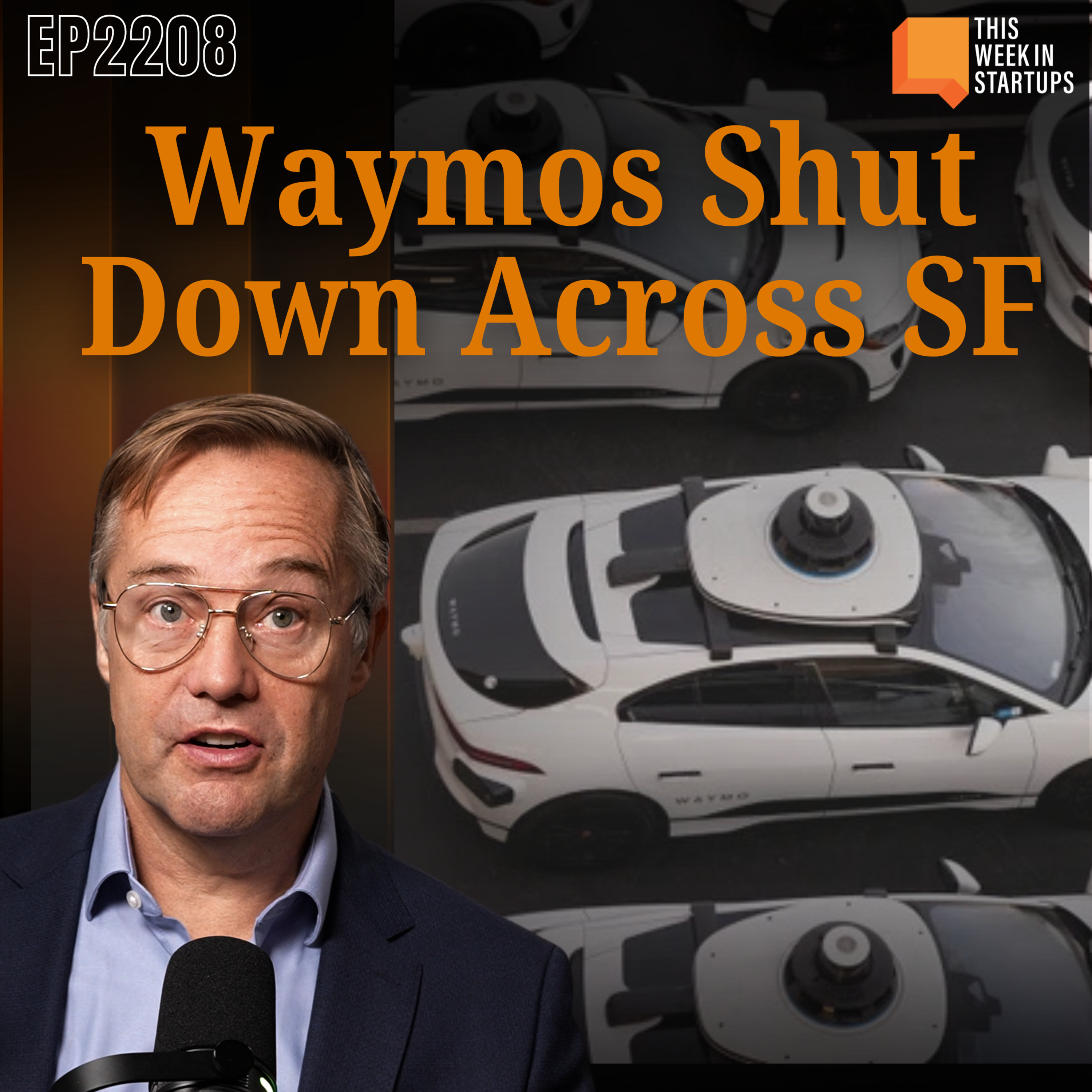
After proving its robo-taxis are 90% safer than human drivers, Waymo is now making them more "confidently assertive" to better navigate real-world traffic. This counter-intuitive shift from passive safety to calculated aggression is a necessary step to improve efficiency and reduce delays, highlighting the trade-offs required for autonomous vehicle integration.

Early self-driving cars were too cautious, becoming hazards on the road. By strictly adhering to the speed limit or being too polite at intersections, they disrupted traffic flow. Waymo learned its cars must drive assertively, even "aggressively," to safely integrate with human drivers.
Rivian's CEO explains that early autonomous systems, which were based on rigid rules-based "planners," have been superseded by end-to-end AI. This new approach uses a large "foundation model for driving" that can improve continuously with more data, breaking through the performance plateau of the older method.

Drawing from his Tesla experience, Karpathy warns of a massive "demo-to-product gap" in AI. Getting a demo to work 90% of the time is easy. But achieving the reliability needed for a real product is a "march of nines," where each additional 9 of accuracy requires a constant, enormous effort, explaining long development timelines.

Autonomous systems can perceive and react to dangers beyond human capability. The example of a Cybertruck autonomously accelerating to lessen the impact of a potential high-speed rear-end collision—a car the human driver didn't even see—showcases a level of predictive safety that humans cannot replicate, moving beyond simple accident avoidance.

The evolution of Tesla's Full Self-Driving offers a clear parallel for enterprise AI adoption. Initially, human oversight and frequent "disengagements" (interventions) will be necessary. As AI agents learn, the rate of disengagement will drop, signaling a shift from a co-pilot tool to a fully autonomous worker in specific professional domains.
Initially criticized for forgoing expensive LIDAR, Tesla's vision-based self-driving system compelled it to solve the harder, more scalable problem of AI-based reasoning. This long-term bet on foundation models for driving is now converging with the direction competitors are also taking.

A human driver's lesson from a mistake is isolated. In contrast, when one self-driving car makes an error and learns, the correction is instantly propagated to all other cars in the network. This collective learning creates an exponential improvement curve that individual humans cannot match.
The primary obstacle to creating a fully autonomous AI software engineer isn't just model intelligence but "controlling entropy." This refers to the challenge of preventing the compounding accumulation of small, 1% errors that eventually derail a complex, multi-step task and get the agent irretrievably off track.
