Get your free personalized podcast brief
We scan new podcasts and send you the top 5 insights daily.
Instead of prompting a generic LLM, create a custom GPT pre-loaded with your preferred Product Requirements Document (PRD) template and writing style. This generates consistent, high-quality, personalized documentation in seconds by simply feeding it a feature list from your research phase.
Related Insights
To get superior results from AI coding agents, treat them like human developers by providing a detailed plan. Creating a Product Requirements Document (PRD) upfront leads to a more focused and accurate MVP, saving significant time on debugging and revisions later on.

AI prototyping doesn't replace the PRD; it transforms its purpose. Instead of being a static document, the PRD's rich context and user stories become the ideal 'master prompt' to feed into an AI tool, ensuring the initial design is grounded in strategic requirements.
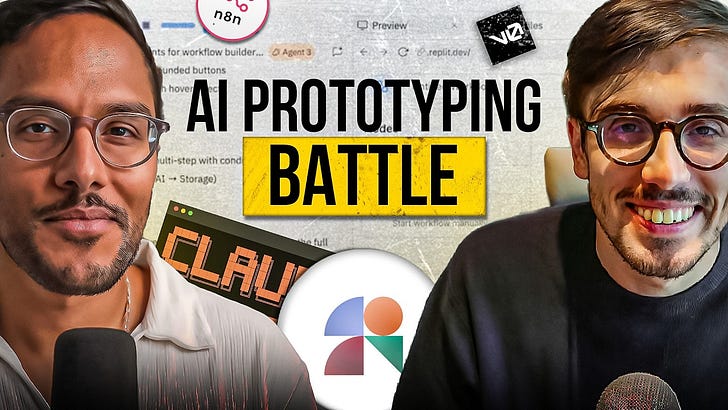
Instead of prompting a specialized AI tool directly, experts employ a meta-workflow. They first use a general LLM like ChatGPT or Claude to generate a detailed, context-rich 'master prompt' based on a PRD or user story, which they then paste into the specialized tool for superior results.
Even for a simple personal project, starting with a Product Requirements Document (PRD) dramatically improves the output from AI code generation tools. Taking a few minutes to outline goals and features provides the necessary context for the AI to produce more accurate and relevant code, saving time on rework.
Create a custom GPT and feed it 10 of your company's best job descriptions. It learns your format, tone, and key requirements. This allows anyone on the talent team to generate a high-quality, company-specific job description in minutes by providing a simple brief.

The effectiveness of AI tools like ChatGPT depends entirely on the quality of the initial inputs. To get exceptional results, "brief" the AI by uploading foundational documents like your company manifesto, jobs-to-be-done, and brand positioning. A lazy or generic prompt yields generic results.

Codex lacks formal custom commands. You can achieve the same result by storing detailed prompts and templates in local files (e.g., meeting summaries, PRD structures). Reference these files with the '@' symbol in your prompts to apply consistent instructions and formatting to your tasks.
For each potential buyer, create a new ChatGPT project. Upload your standard offer template, product overview, and all prospect-specific data (CRM info, call transcripts). Prompt the AI to synthesize these documents into a unique proposal that directly addresses the buyer's expressed pain points and priorities.

Instead of just asking an AI to write a PRD, first provide it with a "Socratic questioning" template. The LLM will then act as a thinking partner, asking challenging, open-ended questions about the problem and solution. This upfront thinking process results in a significantly more robust final document.
To scale the CEO's feedback, his EA created a custom GPT trained on his feedback style, strategy docs, and company norms. Team members use this 'CEO clone' to stress-test their proposals before official review, improving document quality and saving executive time.