Get your free personalized podcast brief
We scan new podcasts and send you the top 5 insights daily.
Shortening model release cycles does not prove recursive self-improvement if organizations simply consume exponentially more capital. Genuine progress requires measuring performance gains directly against resource costs. Teams must track experiment expenses to ensure claimed algorithmic breakthroughs are not merely brute-force financial spending.

Related Insights
Many influential AI model benchmarks focus on raw capabilities, like problem-solving accuracy, but neglect a critical business metric: the cost to achieve that result. Future benchmarks must incorporate the dollar cost per task to provide a more practical assessment for commercial applications.

The fear of runaway Recursive Self-Improvement (RSI) is tempered by economic reality. Training frontier models is becoming more, not less, expensive and complex. Each new model requires more GPUs, time, and brittle engineering, creating a logistical barrier that naturally slows progress.
Databricks CEO Ali Ghodsi proposes a 4-part litmus test for dangerous recursive self-improvement (RSI). The risk is real only if new models simultaneously require less training time, fewer resources, and achieve higher intelligence, with this cycle being repeatable. Currently, the opposite is true.
As AI models become more efficient, cost-per-token is an increasingly misleading metric. A more capable model might be more expensive per token but far cheaper per completed task because it requires fewer steps or revisions. The focus of economic evaluation must shift from the raw input cost to the final output cost.
The current commercial training cadence introduces a dangerous capability overhang. Deploying newly scaled foundation models every six months outpaces the time required to comprehend how existing models function, where their behavioral vulnerabilities lie, or why they fail. As capital requirements jump from tens of millions to billions of dollars, forced pauses between massive training runs could provide a necessary window for researchers to evaluate model bounds rather than blindly stacking parameters.

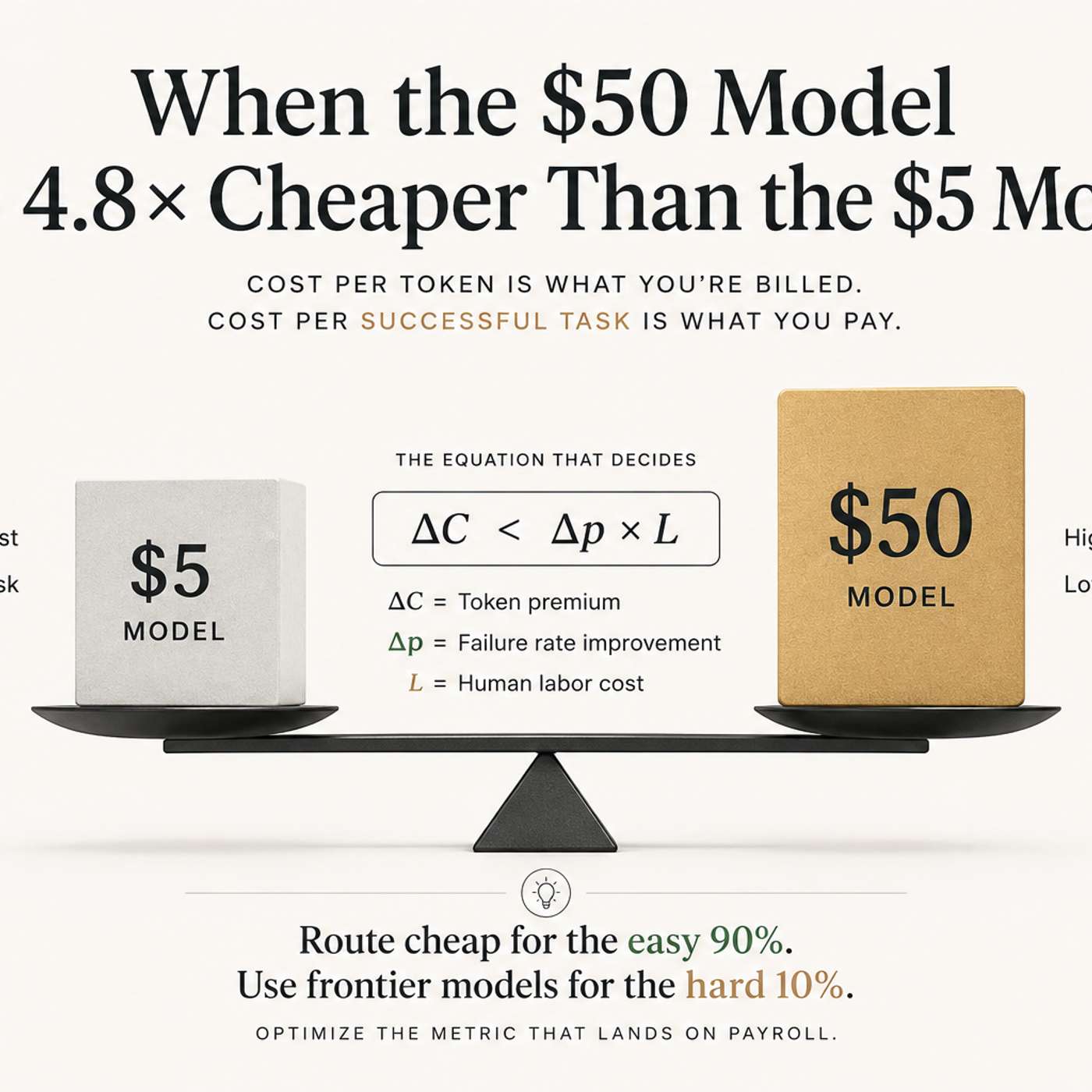
Evaluating AI models on cost-per-token is misleading because it ignores the hidden cost of human labor to fix failures. The true 'cost per successful task' is a business metric that accounts for both the API invoice and the payroll expense for rework, revealing a more accurate total cost of ownership.
Don't rely on traditional project milestones to gauge AI progress. Instead, measure success through granular unit economics and operational metrics. Metrics like 'cost per release' or 'cycle time per feature' provide immediate feedback on whether your strategic hypothesis is valid, enabling rapid iteration.

Focusing on token pricing is misleading. A more powerful model may be more expensive per token but significantly cheaper per task because its higher efficiency requires fewer prompts and iterations to achieve a final result. The correct way to measure cost-effectiveness is by the total cost to complete a job, not the price of the raw material.
A cheap model that fails often becomes expensive due to retries, fallbacks, and human review. The true measure of economic efficiency is the cost to reliably complete a task, not the raw inference cost, which can be a misleading metric at scale.

Chamath Palihapitiya's CTO revealed their AI token costs are doubling every 45 days for a mere 5% productivity gain. This suggests enterprises are hitting an asymptote of utility and will soon face a difficult ROI calculation on their skyrocketing AI spend.
