Get your free personalized podcast brief
We scan new podcasts and send you the top 5 insights daily.
Despite AI's rapid progress, David Sinclair states that fully simulating a single biological cell from the atomic level is beyond near-future computing. The quantum effects and sheer number of molecular interactions present a challenge that will likely require quantum computers.

Related Insights
A classical, bottom-up simulation of a cell is infeasible, according to John Jumper. He sees the more practical path forward as fusing specialized models like AlphaFold with the broad reasoning of LLMs to create hybrid systems that understand biology.

Startups and major labs are focusing on "world models," which simulate physical reality, cause, and effect. This is seen as the necessary step beyond text-based LLMs to create agents that can truly understand and interact with the physical world, a key step towards AGI.
AI is moving beyond simply identifying patterns in existing research papers. It is now able to extrapolate fundamental biological principles, enabling it to understand complex systems from the ground up, like the relationship between atoms, molecules, and proteins.
The most significant breakthroughs will no longer come from traditional wet lab experiments alone. Instead, progress will be driven by the smarter application of AI and simulations, with future bioreactors being as much digital as they are physical.

The current, tangible role of AI in medicine is its ability to detect subtle patterns in large datasets, radically accelerating drug discovery. Breakthroughs like AlphaFold, which predicts protein shapes, are the true near-term game-changers for aging research, while molecular manufacturing remains distant.

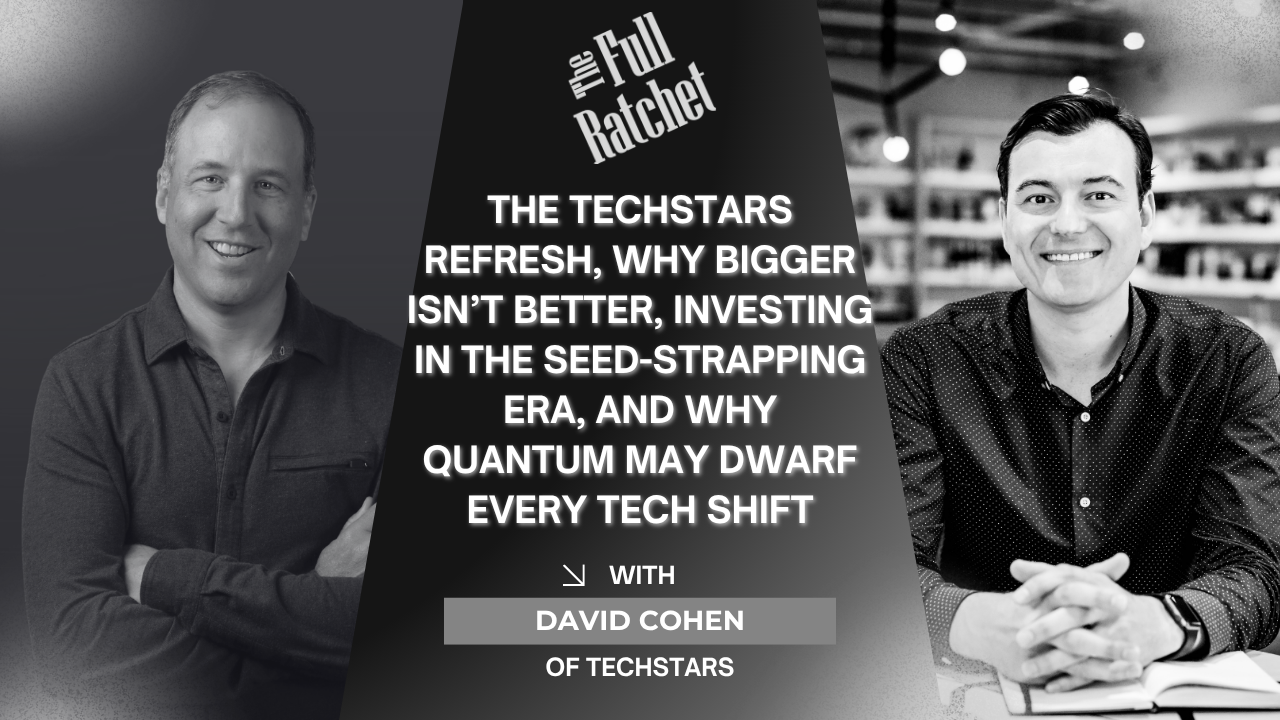
While AI dominates current conversations, Techstars' David Cohen believes Quantum Computing represents a far larger future paradigm shift. He posits that a single quantum computer will eventually surpass the combined power of all AI-driven classical computers. The "killer app" for this new era will be in healthcare, enabling truly personalized medicine.
While today's computers cannot achieve AGI, it is not theoretically impossible. Creating a generally intelligent system will require a new physical substrate—likely biological or chemical—that can replicate the brain's enormous, dynamic configurational space, which silicon architecture cannot.

Following the success of AlphaFold in predicting protein structures, Demis Hassabis says DeepMind's next grand challenge is creating a full AI simulation of a working cell. This 'virtual cell' would allow researchers to test hypotheses about drugs and diseases millions of times faster than in a physical lab.

While petabytes of observational DNA sequence data exist, it's insufficient for the next wave of AI. The key to creating powerful, functional models is generating causal data—from experiments that systematically test function—which is a current data bottleneck.

The primary impact of quantum computing won't just be faster calculations. It will be its ability to generate entirely new insights into complex systems like molecules—knowledge that is currently out of reach. This new data can then be fed into AI models, creating a powerful synergistic loop of discovery.