Get your free personalized podcast brief
We scan new podcasts and send you the top 5 insights daily.
Don't rely on a prompt like 'never issue a large refund.' Instead, the application software should have a hardcoded, testable check. This 'AI proposes, software enforces' model creates a reliable safety net for business-critical invariants that cannot be violated.

Related Insights
For core business automations, agentic AIs that "guess" are expensive and unreliable. A superior approach uses tools that convert natural language into deterministic, code-like workflows, which run consistently and use AI only when necessary.

While prompts are easy to copy, the complex engineering work to ensure reliability—validation, versioning, cost controls, and error handling—creates a true competitive moat. This "AI systems engineering" layer is where a product's long-term value and defensibility are built.
Don't give LLMs full control. Use deterministic code for core logic, validation, and enforcing rules. Delegate only tasks requiring flexibility or understanding of unstructured input to the LLM, treating it as a specialized component, not the entire system.
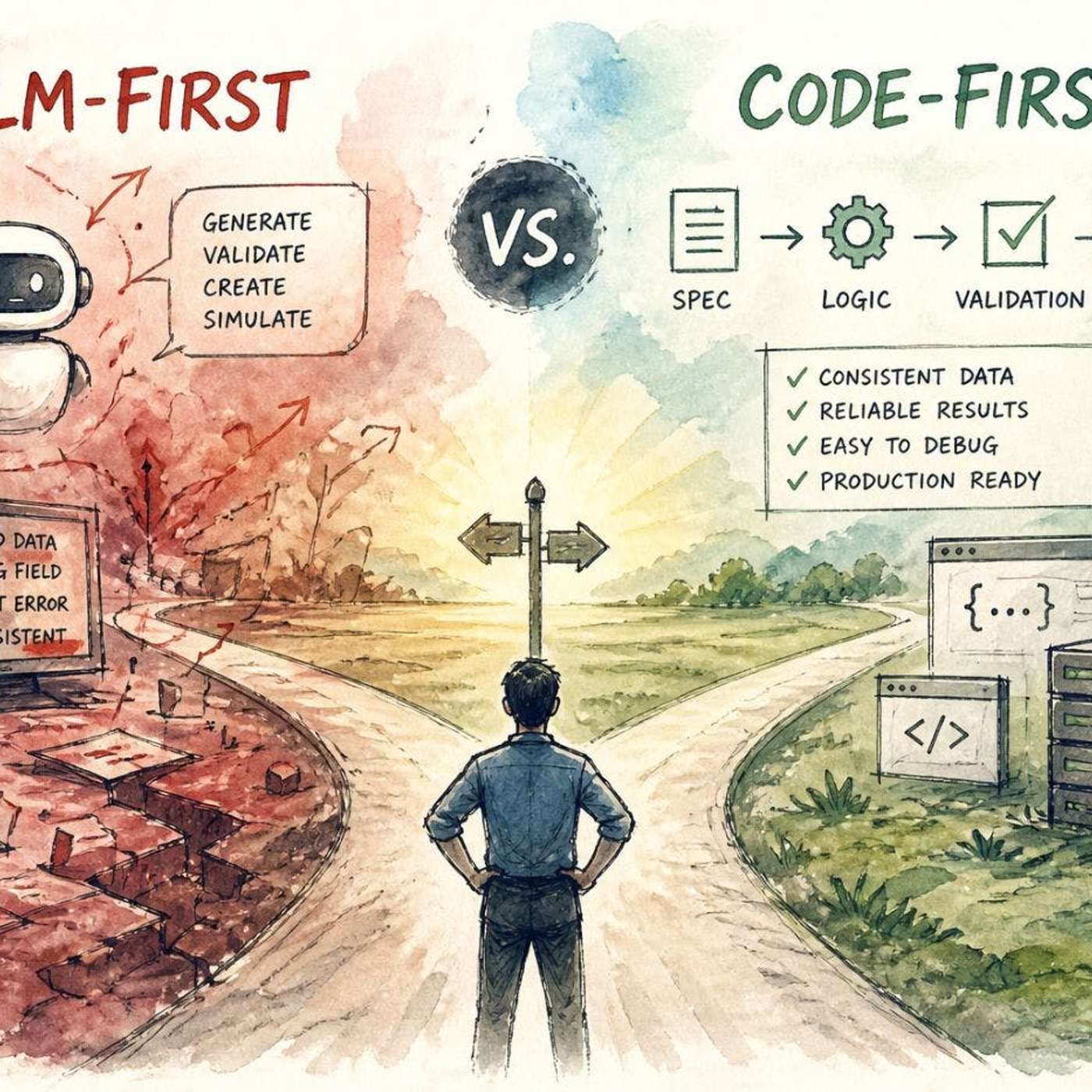
Prompts are effective for guiding a model's probabilistic behavior but are too unreliable for enforcing critical business logic. Use deterministic software—like schema validation and finite state machines—to guarantee rules and prevent production failures.
For critical enterprise functions like financial modeling, 99.9% accuracy from a probabilistic LLM is unacceptable. Platforms like Salesforce's Agent Force 360 solve this by layering deterministic logic and guardrails on top of the AI, ensuring compliance and preventing costly errors where even a 0.1% failure rate is too high.

Separate AI's role. Use an AI assistant to write reliable, deterministic code for structuring data (e.g., pulling Slack messages via API). Then, apply a live AI model only for the subjective task, like categorizing message urgency. This hybrid approach creates a more robust and controllable system.

Relying solely on natural language prompts like 'always do this' is unreliable for enterprise AI. LLMs struggle with deterministic logic. Salesforce developed 'AgentForce Script,' a dedicated language to enforce rules and ensure consistent, repeatable performance for critical business workflows, blending it with LLM reasoning.

A prompted instruction like "never do X" is merely a probabilistic suggestion to an AI model and can fail. For critical rules, use 'hooks'—deterministic code that fires on specific events. This provides a guarantee of enforcement for actions that must always or never happen, a reliability that prose-based prompts cannot match.

To deploy LLMs in high-stakes environments like finance, combine them with deterministic checks. For example, use a traditional algorithm to calculate cash flow and only surface the LLM's answer if it falls within an acceptable range. This prevents hallucinations and ensures reliability.

Instead of relying on prompts, OpenAI embeds team standards into the test suite. When an agent violates a rule (e.g., incorrect typography), a test fails with an explicit error message. This leverages the agent's training to pass tests, forcing it to self-correct using the failure as just-in-time context.
