Get your free personalized podcast brief
We scan new podcasts and send you the top 5 insights daily.
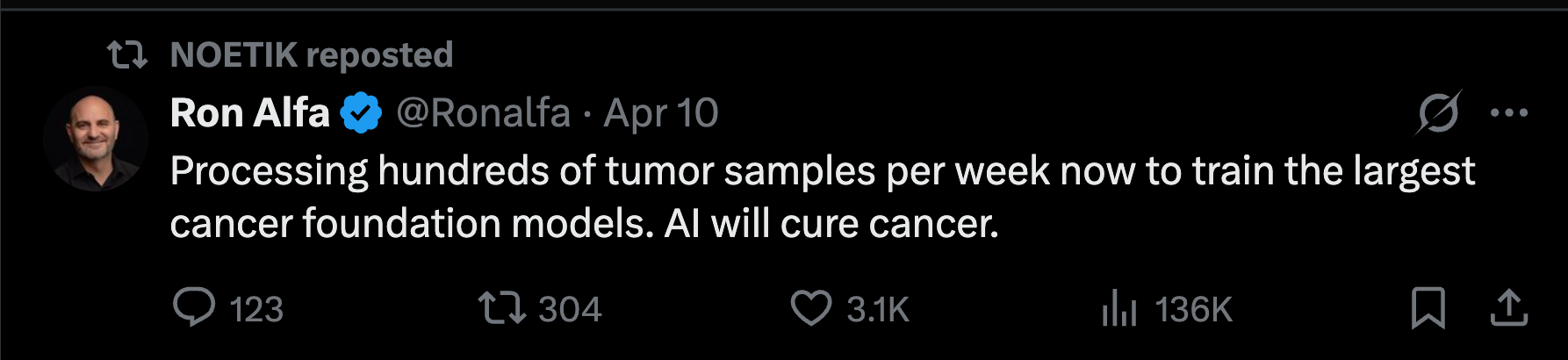
Demonstrating extreme conviction, Noetik invested a year and a half in lab setup, tumor sourcing, and data processing before having a dataset large enough to train its first models. This highlights the immense upfront investment and risk required for a data-first approach in bio-AI, where no off-the-shelf data exists.
Related Insights
Foundational biological datasets, like the first Human Cell Atlas, take immense time and capital to create (10 years). However, this initial effort creates tooling and knowledge that allows subsequent, larger-scale projects to be completed exponentially faster and at a fraction of the cost.

The bottleneck for AI in drug discovery is not the algorithm but the lack of high-quality, large-scale biological data. New platforms are needed to generate this necessary "substrate" for AI models to learn from, challenging the narrative that better models alone are the solution.

The next leap in biotech moves beyond applying AI to existing data. CZI pioneers a model where 'frontier biology' and 'frontier AI' are developed in tandem. Experiments are now designed specifically to generate novel data that will ground and improve future AI models, creating a virtuous feedback loop.

The primary bottleneck for creating powerful foundation models in biology is the lack of clean, large-scale experimental data—orders of magnitude less than what's available for LLMs. This creates a major opportunity for "data foundries" that use robotic labs to generate high-quality biological data at scale.

To break the data bottleneck in AI protein engineering, companies now generate massive synthetic datasets. By creating novel "synthetic epitopes" and measuring their binding, they can produce thousands of validated positive and negative training examples in a single experiment, massively accelerating model development.

Building the first large-scale biological datasets, like the Human Cell Atlas, is a decade-long, expensive slog. However, this foundational work creates tools and knowledge that enable subsequent, larger-scale projects to be completed exponentially faster and cheaper, proving a non-linear path to discovery.
Xaira's core strategy involves creating massive, proprietary datasets that reveal causal biology. By systematically perturbing every gene in a cell to observe its effects, they generate unique training data for their models, quadrupling the world's supply of such information with a single publication.

The future of valuable AI lies not in models trained on the abundant public internet, but in those built on scarce, proprietary data. For fields like robotics and biology, this data doesn't exist to be scraped; it must be actively created, making the data generation process itself the key competitive moat.

A new 'Tech Bio' model inverts traditional biotech by first building a novel, highly structured database designed for AI analysis. Only after this computational foundation is built do they use it to identify therapeutic targets, creating a data-first moat before any lab work begins.

Unlike general AI which leverages vast, existing datasets, Noetik believes progress in biology requires designing and generating specific, high-quality data with foresight into the models that will be trained. They compare this to the intentional, decades-long creation of the PDB dataset for protein folding.