Get your free personalized podcast brief
We scan new podcasts and send you the top 5 insights daily.
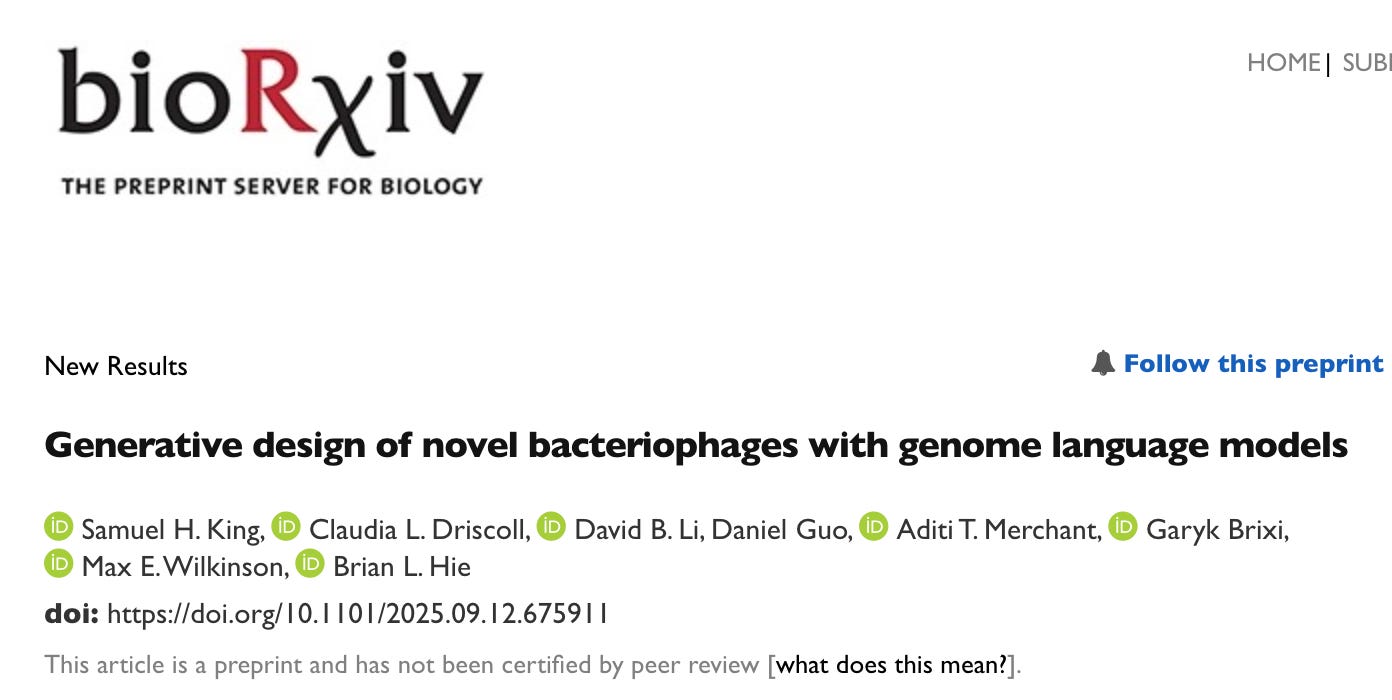
By providing a genomic model with a sequence of examples showing progressively higher fitness scores (e.g., better RNA aptamers), the model learns the optimization trajectory. It can then continue this "thought process" to generate novel, even higher-performing sequences.
Related Insights
Diffusion models were a breakthrough for protein generation because they reframe the problem. Instead of a one-shot generation, they learn to make many small, iterative refinements ("make it slightly better"). This "time to think" approach proved more effective for complex biological structures than previous methods like VAEs.

Similar to how an LLM uses a 'chain of thought' to reason, Genesis's model 'thinks' by iteratively refining an in-memory representation of a crystal structure. This process is guided by physics-based principles, significantly improving the final prediction's accuracy.

Future progress in biology requires moving beyond static models. The new paradigm involves an AI that reasons over hypotheses, prioritizes experiments, learns from the empirical outcomes, and updates its internal world model. This creates a scalable, closed-loop system for scientific discovery.

The next major AI breakthrough will come from applying generative models to complex systems beyond human language, such as biology. By treating biological processes as a unique "language," AI could discover novel therapeutics or research paths, leading to a "Move 37" moment in science.

Pre-trained genomic models like EVO showed potential but were unaligned. By applying alignment techniques like mid-training and post-training—similar to turning a base LLM into a useful chatbot—the Omni model became state-of-the-art across multiple biological tasks.
Tackling monumental challenges, like creating a biologic effective against 800+ HIV variants, is not a single-shot success. It requires multiple iterations on an advanced engineering platform. Each cycle of design, measurement, and learning progressively refines the molecule, making previously impossible therapeutic goals achievable.

Earli combines wet lab experiments with AI in a continuous feedback loop. They test massive libraries of synthetic DNA promoter sequences, feed the performance results into a Large Language Model (LLM), which then designs new, potentially more effective sequences. This iterative process rapidly optimizes their cancer-specific genetic switches.
Modern AI systems can now 'speed run' a digital version of evolution. By combining an LLM's ability to rapidly generate hypotheses with an automated evaluation function, these systems can test ideas, discard failures, and pursue successful 'lineages' at a pace far exceeding biological evolution.

The ultimate goal isn't just modeling specific systems (like protein folding), but automating the entire scientific method. This involves AI generating hypotheses, choosing experiments, analyzing results, and updating a 'world model' of a domain, creating a continuous loop of discovery.

Generate Biomedicines' AI learns the fundamental rules of protein structure and function, much like a language's grammar. This allows it to design entirely new proteins by generating novel "sentences" (sequences) that are biologically coherent and functional, rather than just mimicking existing ones found in nature.
