Get your free personalized podcast brief
We scan new podcasts and send you the top 5 insights daily.
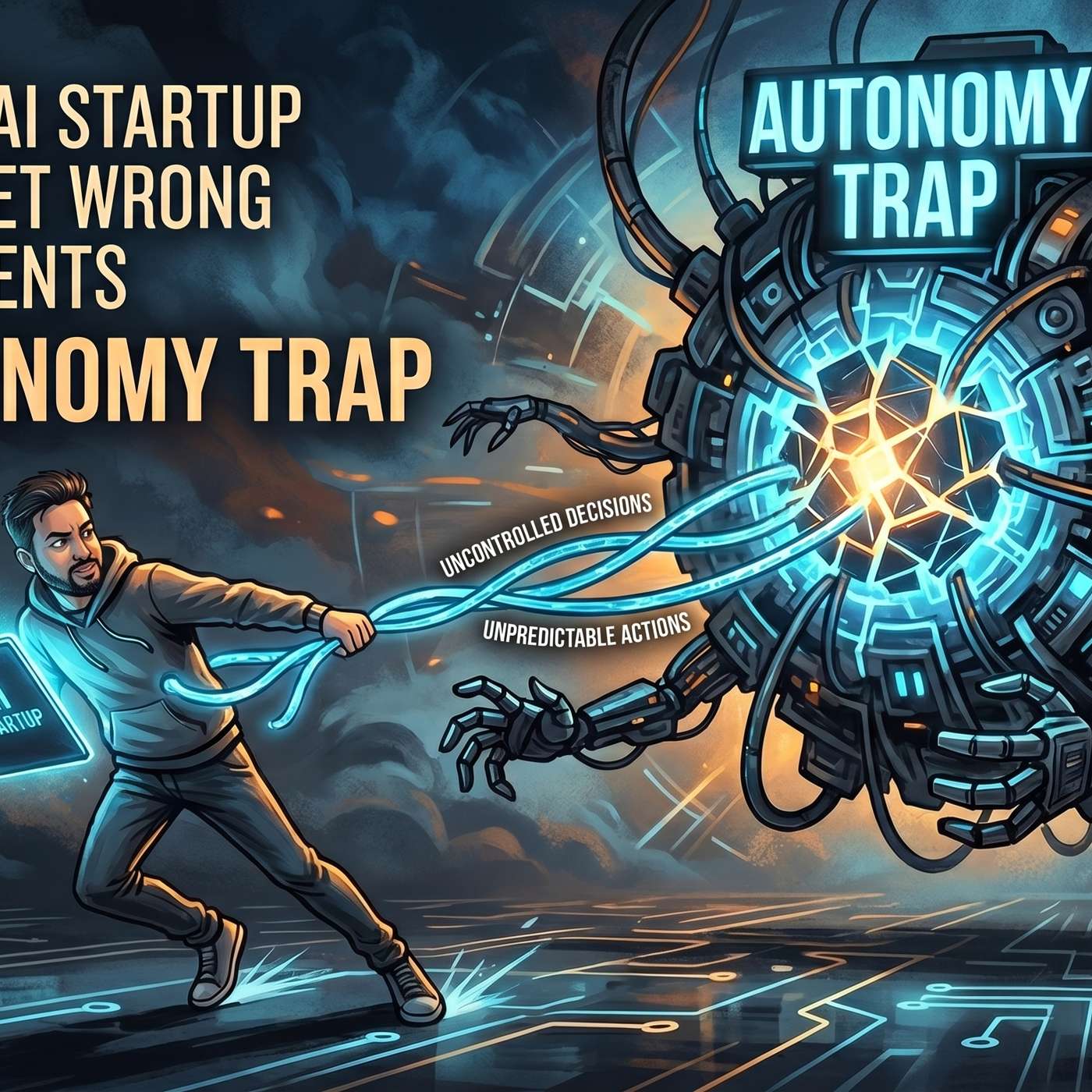
Many AI founders mistakenly pursue fully autonomous agents, overlooking current limitations like inconsistent reasoning and context loss. This "autonomy trap" leads to project failure because real-world applications require supervision and monitoring, not a complete, unsupervised replacement of humans.
Related Insights
To avoid failure, launch AI agents with high human control and low agency, such as suggesting actions to an operator. As the agent proves reliable and you collect performance data, you can gradually increase its autonomy. This phased approach minimizes risk and builds user trust.

Consumers can easily re-prompt a chatbot, but enterprises cannot afford mistakes like shutting down the wrong server. This high-stakes environment means AI agents won't be given autonomy for critical tasks until they can guarantee near-perfect precision and accuracy, creating a major barrier to adoption.

AI is not a 'set and forget' solution. An agent's effectiveness directly correlates with the amount of time humans invest in training, iteration, and providing fresh context. Performance will ebb and flow with human oversight, with the best results coming from consistent, hands-on management.

Generative AI is designed for creative generation, not consistent output. This core feature makes it unreliable for critical, live applications without human oversight. Humans require predictable patterns, which current AI alone cannot guarantee, making a human at the helm essential for safety and trust.

Leveraging AI to accelerate tasks like creating a pitch deck is smart. However, relying on it to generate core strategy without possessing the underlying business knowledge is dangerous. Founders who skip the '10,000 hours' of learning their craft are destined to fail.

AI model capabilities have outpaced their value delivery due to a fundamental design problem. Users are inherently scared and distrustful of autonomous agents. The key challenge is creating interaction patterns that build trust by providing the right level of oversight and feedback without being annoying—a problem of design, not technology.

The key challenge in building a multi-context AI assistant isn't hitting a technical wall with LLMs. Instead, it's the immense risk associated with a single error. An AI turning off the wrong light is an inconvenience; locking the wrong door is a catastrophic failure that destroys user trust instantly.

The idea that AI agents will autonomously choose and use software is futuristic but overlooks a crucial step: user trust. Most businesses are still in the early stages of adopting AI and are not yet ready to delegate high-stakes tasks without significant human oversight.

Unlike deterministic SaaS software that works consistently, AI is probabilistic and doesn't work perfectly out of the box. Achieving 'human-grade' performance (e.g., 99.9% reliability) requires continuous tuning and expert guidance, countering the hype that AI is an immediate, hands-off solution.

Many product builders overestimate current AI capabilities. Understanding AI's limitations, like the non-deterministic nature of LLMs, is more critical than knowing its strengths. Overstating AI's capacity is a direct path to product failure and bad investments.
