Get your free personalized podcast brief
We scan new podcasts and send you the top 5 insights daily.
The model's unified architecture eliminates handoffs between separate speech recognition, language model, and text-to-speech components, achieving a low 450ms latency. However, this monolithic design prevents users from swapping in specialized or superior components, a key advantage of older, cascaded systems.

Related Insights
Significant latency in voice agents comes from the handoffs between disparate services (STT, LLM, TTS). Each vendor hop adds network boundaries, round-trip latency, and potential points of failure. Consolidating the pipeline or co-locating services removes these 'seams' and reduces compounded delays.

Most teams focus on LLM and TTS speed to reduce voice agent latency. However, the biggest improvements come from optimizing end-of-turn detection, moving from fixed silence timeouts to intelligent models that analyze intonation and cadence, often saving 300-500ms per turn.
Voice-to-voice AI models promise more natural, low-latency conversations by processing audio directly. However, they are currently impractical for many high-stakes enterprise applications due to a hallucination rate that can be eight times higher than text-based systems.
![Jesse Zhang - Building Decagon - [Invest Like the Best, EP.443] thumbnail](https://megaphone.imgix.net/podcasts/2cc4da2a-a266-11f0-ac41-9f5060c6f4ef/image/7df6dc347b875d4b90ae98f397bf1cb1.jpg?ixlib=rails-4.3.1&max-w=3000&max-h=3000&fit=crop&auto=format,compress)
While direct speech-to-speech models are faster (lower latency), they are less reliable and "dumber." ElevenLabs bets on a "cascaded" approach that uses text as an intermediate layer, providing greater accuracy, visibility, and control—features that are critical for most enterprise applications.
Despite being a headline feature, the model's ability to execute tools is unreliable for complex scenarios. Performance for parallel tool execution drops as low as 27.5%, and argument accuracy is only 44.2%, severely limiting its use in applications requiring sophisticated, multi-step voice workflows.
Prioritizing speech-to-text speed over accuracy is a false economy. An inaccurate transcript forces the user into a correction loop, adding round trips of the entire pipeline. This additional latency from user corrections obliterates any milliseconds saved by a faster, less accurate model.
By converting audio into discrete tokens, the system allows a large language model (LLM) to generate speech just as it generates text. This simplifies architecture by leveraging existing model capabilities, avoiding the need for entirely separate speech synthesis systems.

The model is not platform-agnostic, requiring specific high-end NVIDIA GPUs, Linux, and the mandatory VLLM inference engine. This lack of flexibility creates significant vendor lock-in, preventing deployment on cheaper or more common hardware and driving up cloud or on-premise infrastructure costs.
Models like GPT Live prioritize low latency and natural interaction, making them feel more human. However, this is a specific optimization target that differs from deep, strategic reasoning. Users must understand they are interacting with a conversational layer, which may not have the same raw intelligence as the underlying frontier model it calls upon.

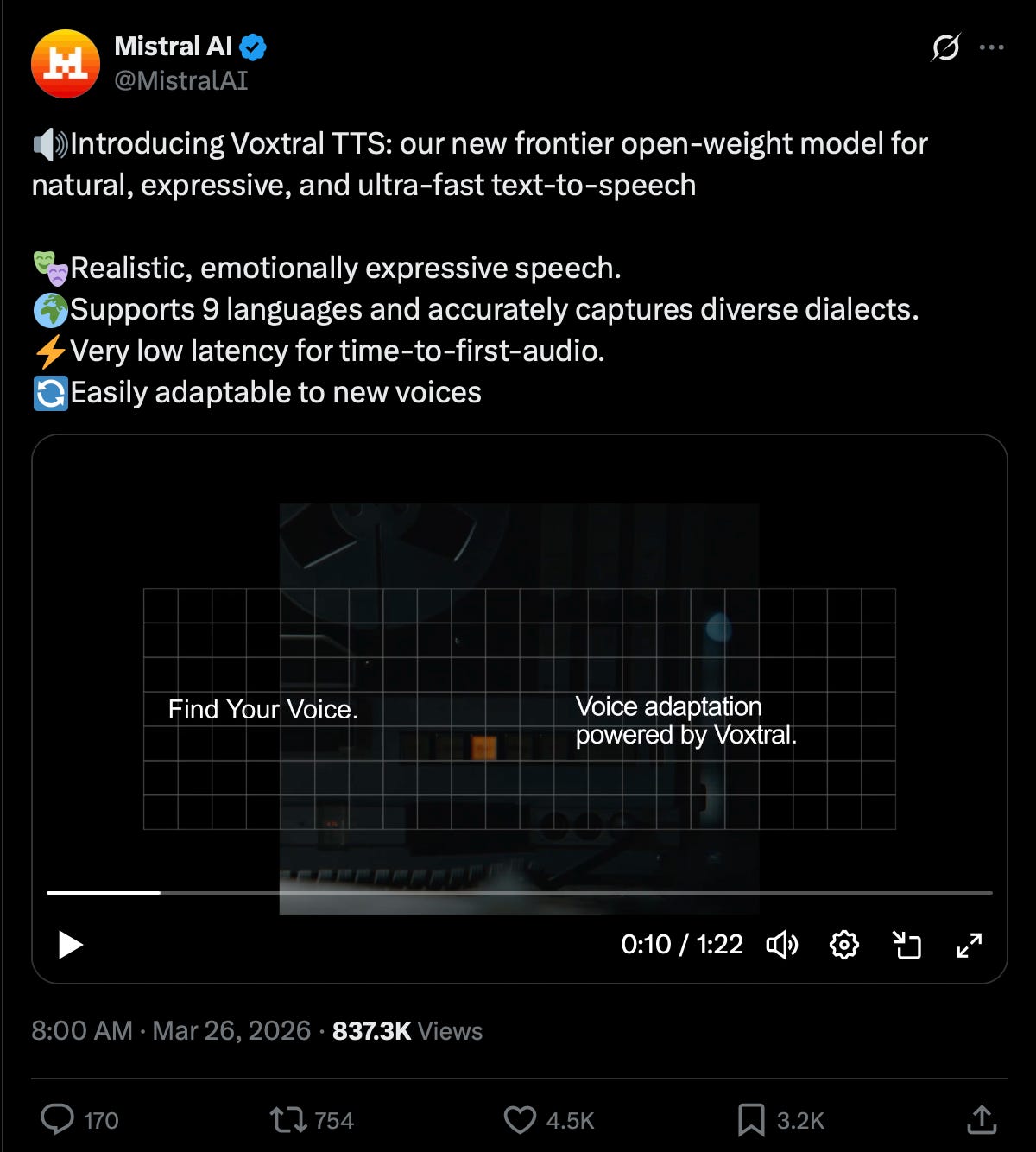
Mistral developed a new TTS architecture combining autoregressive flow matching with a custom neural audio codec. This approach aims to model speech inflections more efficiently than depth transformers or full diffusion models, targeting real-time voice agent use cases.