Get your free personalized podcast brief
We scan new podcasts and send you the top 5 insights daily.
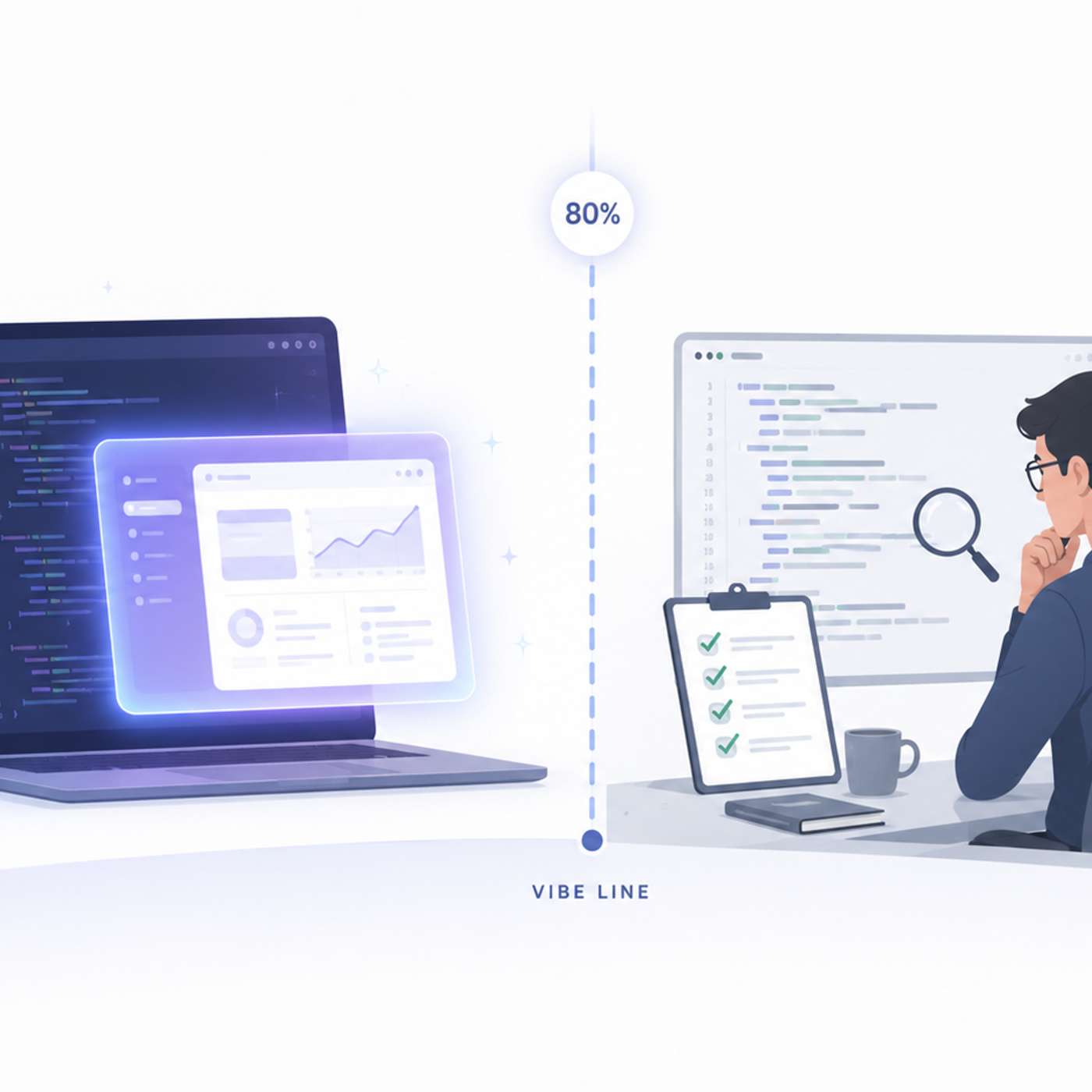
A simple four-question framework determines when AI-generated code requires rigorous engineering review. If code touches customer data, money, security, or is hard to undo, you must shift from 'vibe coding' to formal engineering practices and thorough testing.
Related Insights
In large enterprises with legacy systems, AI-generated "vibe code" is not ready for direct production deployment. Treat it as a "first draft" for exploration and testing. A successful transition to production requires implementing stage gates and checks and balances, rather than a direct, one-step process from the AI tool.

The trend of 'vibe coding'—casually using prompts to generate code without rigor—is creating low-quality, unmaintainable software. The AI engineering community has reached its limit with this approach and is actively searching for a new development paradigm that marries AI's speed with traditional engineering's craft and reliability.
![⚡ [AIE CODE Preview] Inside Google Labs: Building The Gemini Coding Agent — Jed Borovik, Jules thumbnail](https://assets.flightcast.com/V2Uploads/nvaja2542wefzb8rjg5f519m/01K4D8FB4MNA071BM5ZDSMH34N/square.jpg)
Exploratory AI coding, or 'vibe coding,' proved catastrophic for production environments. The most effective developers adapted by treating AI like a junior engineer, providing lightweight specifications, tests, and guardrails to ensure the output was viable and reliable.

TinySeed identifies "vibe-coding"—using AI to write code without expert engineering oversight—as a major investment risk. This approach leads to unmaintainable code, causing feature velocity to collapse and catastrophic regression bugs within 6-18 months, effectively creating a technical time bomb they are unwilling to fund.

The "vibe coding" trend, where non-technical staff use AI to rapidly build prototypes, is a legitimate accelerator for innovation. However, it's not yet a substitute for professional engineers when building scalable, mission-critical systems that are ready for deployment.
To avoid shipping "slop" from AI coding assistants, the solution is building robust infrastructure. Automated checks and security guardrails prevent bad code from reaching production, acting as a programmatic senior engineer for the non-technical builder.

'Vibe coding' describes using AI to generate code for tasks outside one's expertise. While it accelerates development and enables non-specialists, it relies on a 'vibe' that the code is correct, potentially introducing subtle bugs or bad practices that an expert would spot.

With AI generating code, a developer's value shifts from writing perfect syntax to validating that the system works as intended. Success is measured by outcomes—passing tests and meeting requirements—not by reading or understanding every line of the generated code.

Recent incidents of AI agents causing catastrophic production failures are ending the hype around "vibe coding." The industry consensus is shifting: AI is a powerful productivity multiplier for skilled developers but is not yet capable of managing the complexity, maintenance, and risk of professional software engineering on its own.

'Vibe coding' is hands-off prototyping where you don't review the code. 'Agentic engineering' is a deep discipline where professionals use coding agents to build production-ready software. This requires significant expertise to guide the agents and ensure quality, a crucial distinction for serious development.