Get your free personalized podcast brief
We scan new podcasts and send you the top 5 insights daily.
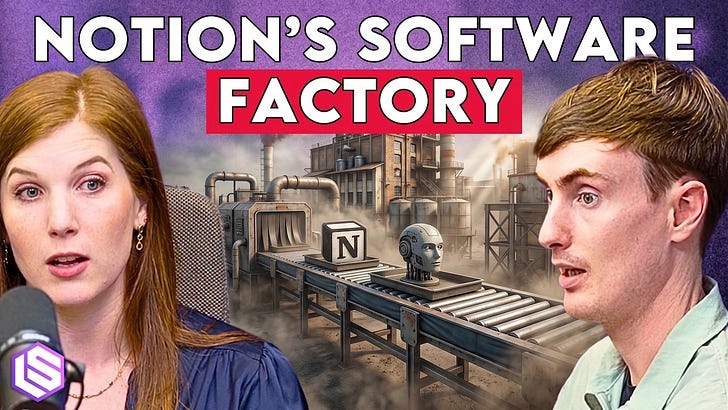
In the rapidly evolving AI space, rebuilding systems is common. Notion actively fosters a culture where engineers are driven by company goals, not attached to their past work. This prevents friction and allows the team to swarm problems and pivot quickly as capabilities change.
Related Insights
To maintain agility in the fast-paced AI landscape, Arvind Jain actively encourages his R&D team to throw out old code. He believes rewarding code deletion at the same level as building new features is essential to prevent the company from slowly becoming a legacy software stack.
In the AI era, foundation models can render complex, custom-built features obsolete overnight. This requires a culture where teams willingly discard their own hard-built IP without ego, accepting their work has a short shelf life.

The engineering role is shifting from direct coding to 'agent management.' Notion's co-founder Simon Last no longer types code; instead, he designs end-to-end tasks, assigns them to AI agents, and verifies the final output. This represents a fundamental change in the software development workflow.

When building core AI technology, prioritize hiring 'AI-native' recent graduates over seasoned veterans. These individuals often possess a fearless execution mindset and a foundational understanding of new paradigms that is critical for building from the ground up, countering the traditional wisdom of hiring for experience.

Lovable prioritizes hiring individuals with extreme passion, high agency, and autonomy—people for whom the work is a core part of their identity. This focus on intrinsic motivation, verified through paid work trials, allows them to build a team that can thrive in chaos and drive initiatives from start to finish without supervision.

Non-technical founders using AI tools must unlearn traditional project planning. The key is rapid iteration: building a first version you know you will discard. This mindset leverages the AI's speed, making it emotionally easier to pivot and refine ideas without the sunk cost fallacy of wasting developer time.

Contrary to the belief that AI architecture is only for senior staff, Atlassian finds that "AI native" junior employees are often more effective. They are unburdened by old workflows and naturally think in terms of AI-powered systems. Senior staff can struggle with the required behavioral change, making junior hires a key vector for innovation.

The underlying infrastructure for AI agents ('harnesses') becomes obsolete roughly every six months due to rapid advances in AI models. At Notion, this means completely rewriting the harness multiple times a year, demanding a culture comfortable with constantly rebuilding core systems and discarding previous assumptions.
To fully leverage rapidly improving AI models, companies cannot just plug in new APIs. Notion's co-founder reveals they completely rebuild their AI system architecture every six months, designing it around the specific capabilities of the latest models to avoid being stuck with suboptimal implementations.
In a paradigm shift like AI, an experienced hire's knowledge can become obsolete. It's often better to hire a hungry junior employee. Their lack of preconceived notions, combined with a high learning velocity powered by AI tools, allows them to surpass seasoned professionals who must unlearn outdated workflows.
