Get your free personalized podcast brief
We scan new podcasts and send you the top 5 insights daily.
Despite models demonstrating PhD-level capabilities, most people only use them for basic tasks. The biggest hurdle for AI companies is not making models smarter, but bridging this usability gap by making advanced power easily accessible to the average person, likely through better interfaces and agents.

Related Insights
Long-term success in the AI race will be determined by superior user experience (UX) and seamless integration into daily workflows, not just raw model performance on technical benchmarks. The most valuable AI will be the one people use every day, making UX the key competitive differentiator.

As models become more powerful, the primary challenge shifts from improving capabilities to creating better ways for humans to specify what they want. Natural language is too ambiguous and code too rigid, creating a need for a new abstraction layer for intent.
Despite access to state-of-the-art models, most ChatGPT users defaulted to older versions. The cognitive load of using a "model picker" and uncertainty about speed/quality trade-offs were bigger barriers than price. Automating this choice is key to driving mass adoption of advanced AI reasoning.

Anthropic's Cowork isn't a technological leap over Claude Code; it's a UI and marketing shift. This demonstrates that the primary barrier to mass AI adoption isn't model power, but productization. An intuitive UI is critical to unlock powerful tools for the 99% of users who won't use a command line.

A major focus for OpenAI's design team is the growing gap between what their models are capable of and what users actually know they can do. The design team's job is to create interfaces and tools that expose the model's full potential to the user.
Sam Altman argues there is a massive "capability overhang" where models are far more powerful than current tools allow users to leverage. He believes the biggest gains will come from improving user interfaces and workflows, not just from increasing raw AI intelligence.
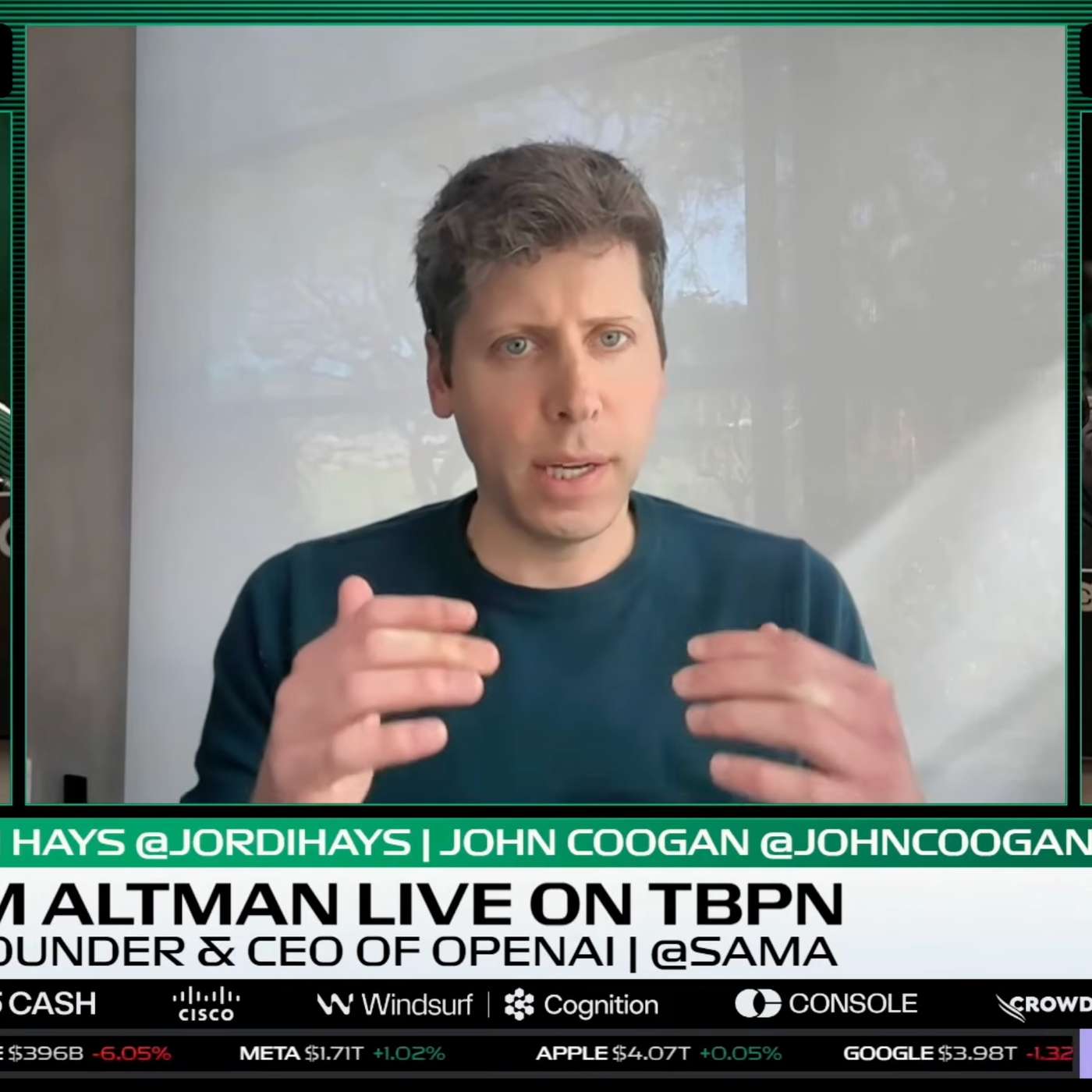
The primary barrier to widespread AI adoption is not the power of the models, but the difficulty of embedding them into users' existing habits. Meeting users where they already are—like their email inbox—is more effective than forcing them to adopt new applications or behaviors.
The perceived limits of today's AI are not inherent to the models themselves but to our failure to build the right "agentic scaffold" around them. There's a "model capability overhang" where much more potential can be unlocked with better prompting, context engineering, and tool integrations.

Most people use AI for trivial requests like recipes, while advanced tools for synthesis, learning, and research (e.g., NotebookLM) remain unknown to them. This highlights a massive education gap preventing widespread productivity gains from the technology's true potential.

A major drag on AI's impact is the "capability gap"—the chasm between what AI can do and what people know it can do. AI companies are now shifting from simply improving models to actively educating the market by releasing tool suites that demonstrate specific, practical applications to accelerate adoption by closing this awareness gap.
